
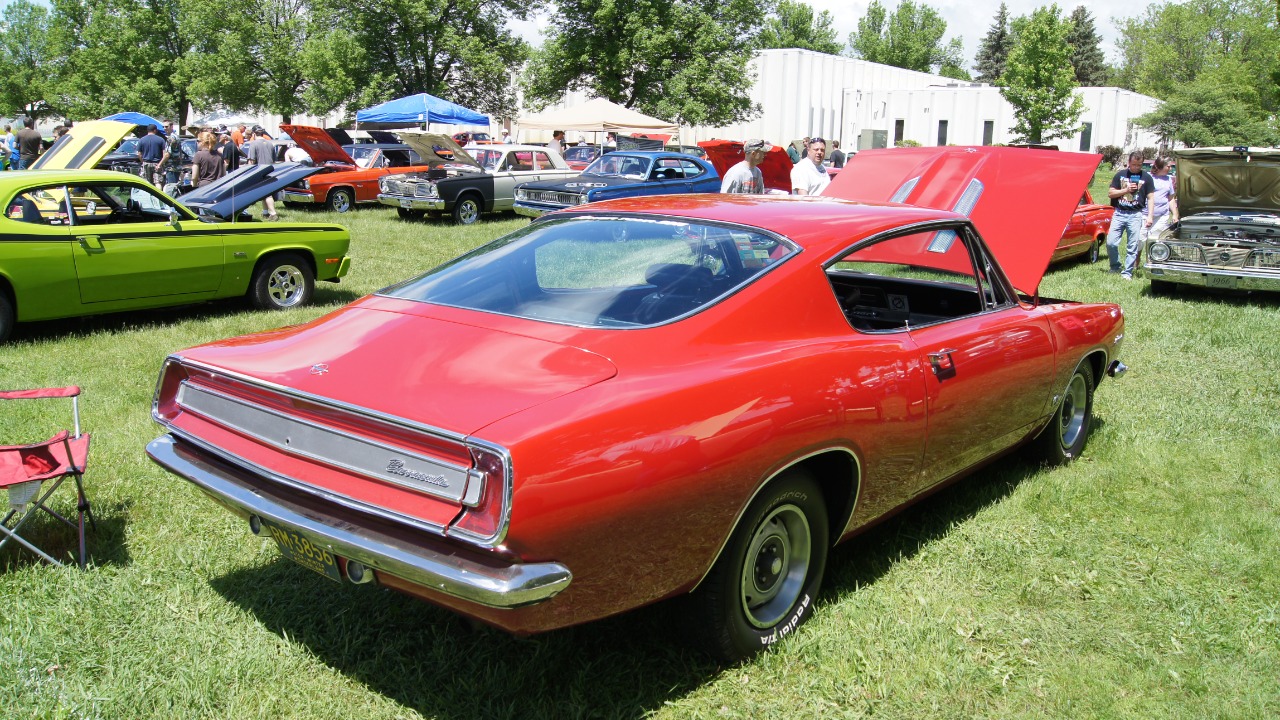
The 1967 Plymouth Barracuda Formula S did more than add power badges to an already sharp fastback. It quietly rewrote how a compact American performance car could turn, stop, and communicate with its driver, long before “handling package” became a marketing cliché. I want to unpack how that specific Formula S setup transformed the Barracuda from a straight-line contender into a genuinely balanced machine, and why those chassis tweaks still matter to enthusiasts today.
Rather than treating the Formula S as a mere trim level, Plymouth used it as a rolling test bed for suspension, tire, and brake upgrades that made the car feel lighter on its feet than its spec sheet suggested. Those changes, documented in period descriptions and later fact sheets, show how carefully chosen springs, shocks, and hardware could turn a stylish fastback into a surprisingly sophisticated driver’s car for its era.
The Formula S concept: performance and handling as a package
The key to understanding the 1967 Plymouth Barracuda Formula S is that it was engineered as a complete system, not just a bigger-engine option. Plymouth positioned the Formula S as the “performance and handling” version of the Barracuda, which meant the package bundled chassis tuning, wheel and tire upgrades, and braking improvements around the available V‑8 engines rather than treating those elements as afterthoughts. A detailed fact sheet notes that the Formula S was not a separate body style, but it was explicitly described as the model focused on performance and handling, which framed every other decision that went into the car’s setup.
That philosophy built on work Plymouth had already started earlier in the Barracuda’s life. Reporting on the car’s evolution points out that in 1965, the Barracuda’s first full year of production, Plymouth had already developed the Formula S high‑performance package to sharpen the car’s responses and give it more credibility among enthusiasts. By 1967, that concept had matured into a more cohesive offering, with the Formula S name signaling a specific blend of power and control rather than just cosmetic flair. The continuity from the early “Formula” idea in 1965 to the later 1967 Plymouth Barracuda Formula S shows that Plymouth treated handling as a core identity for this variant, not a short‑lived option.
Suspension tuning: making a compact fastback feel planted
When I look at what separated the Formula S from a standard Barracuda in 1967, the suspension tuning stands out as the foundation of its handling gains. The Cuda Formula S was upgraded in‑house by Plymouth with suspension changes that went beyond simple shock swaps, reflecting a deliberate attempt to give the car more composure in corners and at speed. Contemporary reviews and later retrospectives describe how the Formula S package tightened body control and reduced the float that could plague softer A‑body setups, which in practice meant the car tracked more confidently through sweepers and felt less nervous over mid‑corner bumps.
Those improvements mattered because the Barracuda’s long, low profile could have easily turned it into a pure straight‑line machine. Instead, the Formula S tuning helped the car feel lithe rather than lumbering. One later feature on a 1967 Plymouth Barracuda Formula S notes that, even in a “big‑block world,” the long, low and lithe Barracuda was competitive, a description that only makes sense if the suspension allowed the car to change direction with some grace. By pairing the compact A‑body footprint with firmer, better‑matched springs and shocks, Plymouth created a car that felt more European in its responses than its muscle‑car image might suggest, especially when compared with softer, non‑Formula versions.
Brakes, wheels, and tires: turning grip into confidence
Suspension tuning alone cannot deliver real‑world handling gains without matching brakes and tires, and that is where the Formula S package quietly did some of its most important work. Period coverage of the 1967 Barracuda’s performance options highlights that Plymouth did not ignore stopping power, describing how the high‑performance package combined upgraded front hardware with substantial 10‑inch drums in the rear. For a compact car of the era, that rear brake specification was significant, and it helped the Formula S resist fade better than lesser trims when driven hard on back roads or during repeated highway stops.
Wheel and tire choices also played a central role in how the Formula S felt from behind the wheel. The Cuda Formula S upgrades included wider, more performance‑oriented rubber than the base Barracuda, which allowed the suspension changes to translate into real cornering grip rather than just a firmer ride. Later enthusiast write‑ups of the 1967 Plymouth Barracuda Formula S emphasize how the car’s upgraded rolling stock worked with the chassis tuning to give the driver more confidence when turning in aggressively or transitioning from braking to cornering. In practical terms, that meant the car could carry more speed through a bend without feeling vague or overmatched, a key part of why the Formula S reputation has endured.
Engine choices and balance: power that the chassis could use
Handling is as much about balance as it is about raw grip, and the 1967 Plymouth Barracuda Formula S illustrates that point through its engine options. The Formula S package was closely associated with V‑8 power, and coverage of the 1967 Plymouth Barracuda Fact Sheet makes clear that the Formula S sat at the performance end of the Barracuda range, pairing its handling focus with stronger engines. At the same time, the way Plymouth integrated those engines into the chassis shows a clear effort to keep the car’s weight distribution and steering feel within a usable window, rather than simply dropping in the heaviest possible powerplant.
Later commentary on specific cars underscores how that balance played out on the road. One enthusiast account describes how a driver’s perception of the Barracuda changed after experiencing a 1967 Plymouth Barracuda Formula S, noting that the Cuda Formula S upgrades made the car feel more composed and controllable even as power increased. Another retrospective on a 1967 Plymouth Barracuda Formula S points out that, despite the era’s fixation on ever larger engines, the long, low and lithe Barracuda remained competitive because its chassis could actually deploy the available power without degenerating into wheelspin and understeer at every corner. In that sense, the Formula S handling improvements were not just about cornering for its own sake, but about making the car’s performance envelope broader and more approachable.
Legacy and why the 1967 Formula S still feels modern
Looking back from today, what strikes me about the 1967 Plymouth Barracuda Formula S is how modern its priorities feel. The idea of a “performance and handling” model that combines engine upgrades with carefully tuned suspension, stronger brakes, and better tires is now standard practice, but the Formula S was already following that template in the late 1960s. A detailed fact sheet published on Aug 6, 2024, explicitly describes the Formula S as the performance and handling model and notes that, While not a separate body, the Formula S designation signaled a distinct driving character. That language could easily apply to contemporary sport packages, which shows how far ahead of its time the basic concept was.
The car’s enduring appeal in enthusiast circles reinforces that point. A feature from Jul 29, 2022, on a 1967 Plymouth Barracuda Formula S highlights how collectors still seek out these cars not only for their styling and V‑8 power, but for the way the Formula S chassis feels on the road. Earlier historical coverage from Jan 23, 2009, traces that appeal back to the Barracuda’s early years, noting that Plymouth introduced the Formula high‑performance package In 1965 to give the Barracuda a more serious dynamic edge. Taken together, those reports show a clear throughline: from In 1965 to Aug 6, 2024, the Formula S name has been shorthand for a Barracuda that can corner and stop as convincingly as it accelerates, and the 1967 version remains the clearest expression of that idea.
More from Fast Lane Only

Leave a Reply