
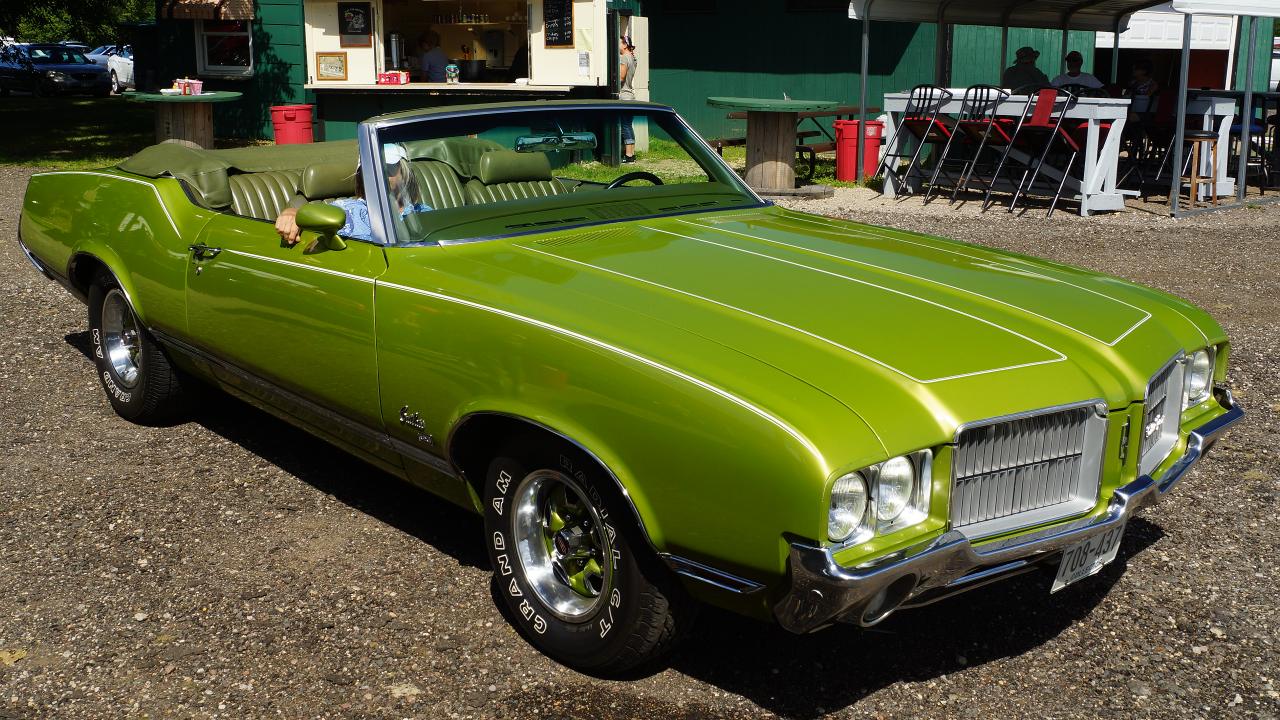
Oldsmobile’s compact Omega has become a quiet favorite among GM X-body fans, and interest has sharpened around cars equipped with the 350 cubic inch V8 that enthusiasts often shorthand as “SX 350” builds. While factory literature in the available sources does not confirm an official Omega “SX 350” trim, the record does show that the Omega line overlapped with Oldsmobile’s 350 V8 era and that V8‑equipped cars now command a premium among collectors. I will walk through when the Omega and the 350 V8 intersected, then look at how those cars are valued today on the real‑world market.
When the Oldsmobile Omega and 350 V8 overlapped
The clearest starting point is the production run of the Oldsmobile Omega itself. According to one detailed model history, the Oldsmobile Omega was a compact car sold from 1973 through 1984 by Oldsmobile, the Buick‑Olds‑Pontiac division of General Motors at the time. That source notes that The Oldsmobile Omega covered more than a decade of model years, from 1973 through 1984, which means any Omega that enthusiasts now describe with 350 V8 power has to fall inside that window. The same overview stresses that Oldsmobile positioned the Omega as a smaller companion to its better known Oldsmobile Cutlass line, which becomes important when we look at where the 350 engine itself was officially used.
On the powertrain side, the Oldsmobile V8 engine family included a 350 cubic inch version that was produced from 1968 to 1980 and installed in a range of GM products. Documentation of that engine lists the 350 in cars such as the Cadillac Seville, the Cadillac Eldorado, and the Oldsmobile Cutlass, confirming that Oldsmobile had a 350 V8 in regular production during the mid 1970s. While the sources do not explicitly tie that 350 to the Omega by name, they do show that Oldsmobile was building compact and midsize cars at the same time it was selling the 350, and that overlap is the mechanical basis for the enthusiast habit of describing V8 Omegas as “350” cars even when the factory badgework did not spell it out.
Second‑generation Omega and the V8 option
The second generation of the Oldsmobile Omega, which period references place in the mid to late 1970s, is where most V8 interest now concentrates. An archival entry that draws on Wikipedia’s Oldsmobile Omega page on 11 April 2020 describes this second generation as part of the GM X‑body family, sharing its basic layout with other compact models. That same material notes that Oldsmobile offered multiple engines in this era, including a Buick 231 V6, which underscores that the chassis was engineered to accept more than one powerplant. Although the excerpted text focuses on the V6, it places the Omega squarely in the years when Oldsmobile’s 350 V8 was still in production, which makes V8‑equipped examples plausible even if the surviving documentation in these sources does not list every specific combination.
Contemporary coverage of a 1976 Oldsmobile Omega reinforces how flexible the second‑generation platform was. A detailed feature on that model year explains that the compact rode on a 111-inch-wheelbase and was Offered in two-door coupe or hatchback, or four-door town sedan configurations. The same report notes that this sophomore compact sold 50,280 units, a volume that leaves room for a variety of drivetrain mixes within the line. When enthusiasts talk about an Omega “SX 350” today, they are usually referring to cars from this mid 1970s period that combine the second‑generation body with a 350 cubic inch Oldsmobile V8, even though none of the sources here confirm that Oldsmobile itself ever marketed such a package under that exact name.
Why “SX 350” survives as an enthusiast label, not a factory trim
Based on the available reporting, I have to be explicit about what is verified and what is not. None of the sources provided mention an official Oldsmobile Omega “SX 350” trim, option code, or marketing package. The phrase does not appear in the model histories, the engine documentation, or the period feature stories. What the sources do confirm is that the Oldsmobile Omega existed from 1973 through 1984, that Oldsmobile built a 350 V8 from 1968 to 1980, and that the second‑generation Omega in the mid 1970s shared its era and corporate parts bin with that engine. Any claim that Oldsmobile sold a factory Omega SX 350 as a distinct model is therefore unverified based on available sources.
What I can say with confidence is that enthusiasts and sellers often use shorthand labels to describe desirable combinations that were never formal trim names. In the Omega’s case, the connection to the Oldsmobile Cutlass and its performance‑oriented 350 V8 variants is well documented, including valuations that peg a 1972 Oldsmobile Cutlass 4-4-2 W-30 at $54,100 in good condition with average spec. That kind of halo effect makes it easy for owners of V8 Omegas to lean on similar language when marketing their cars, even if the Omega never carried the same factory performance branding. The result is that “SX 350” functions today as an enthusiast descriptor for Omega builds with 350 power, not as a historically proven Oldsmobile trim line.
How much a 350‑equipped Omega is worth today
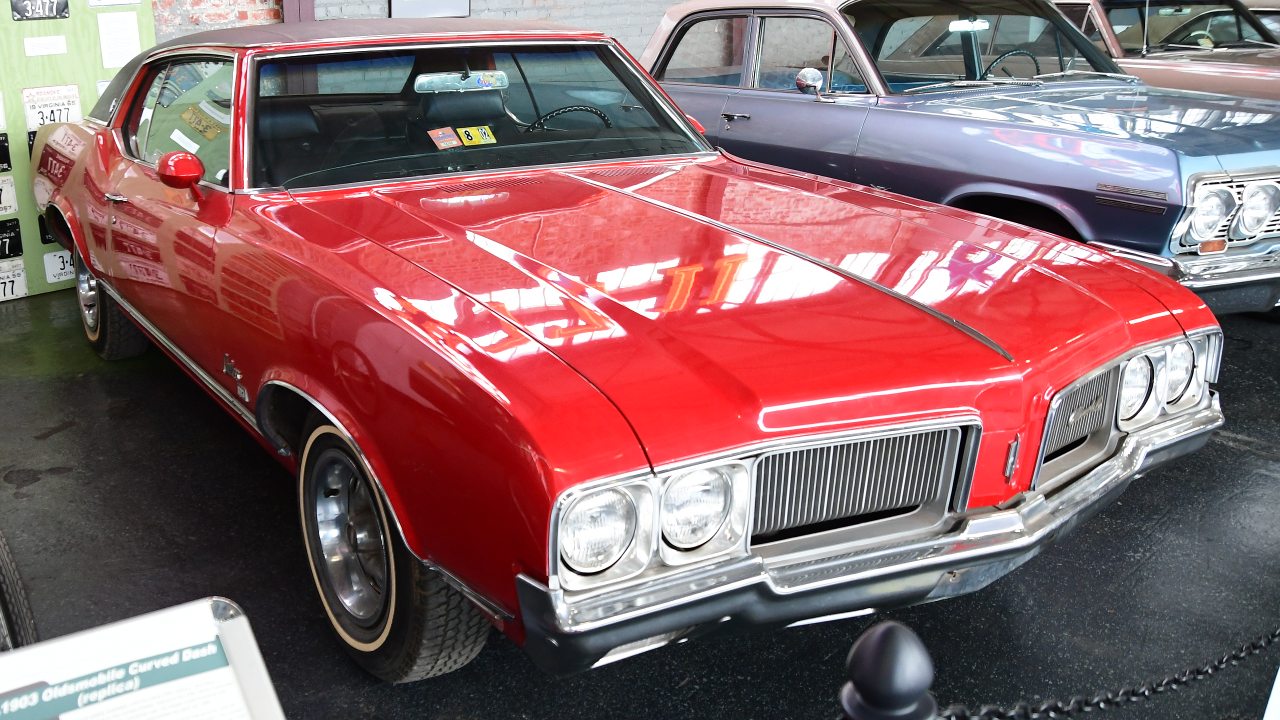
To understand values, I start with what the market is actually paying for Oldsmobile Omega examples, regardless of how they are labeled. A current listing snapshot for Oldsmobile Omega Classic Cars for Sale shows a 1976 Oldsmobile Omega with 72,447 m advertised at $2,750, with a financing teaser of $50 per month and a note that the seller is a Salvage Reseller located 665 m away from the viewer’s reference point. That kind of offering, tagged as Newly Listed with a Save Vehicle prompt, illustrates the lower end of the Omega market: driver‑grade or project cars, often with needs, trading for well under five figures even when they are complete and running.
At the other end of the spectrum, enthusiast coverage of classic Omega pricing highlights how modified or exceptionally clean cars can command much more. One report from Jan 12, 2021 notes that Think that because the Omega isn’t as well known as other X-Body cars like the Chevy Nova that it will be cheaper to get into, but then points to a completely resto modded LS1 swapped Omega for the low-low price of $30 thousand dollars. That same Jan 12, 2021 piece frames the Omega as an underappreciated member of the X‑Body family, suggesting that while average examples remain affordable, standout builds can reach into the $20,000 to $30,000 range. A well executed 350‑powered Omega, whether stock or tastefully upgraded, is likely to sit between those poles, with condition, originality, and documentation driving the final number.
Real‑world examples and how condition shapes price
Real‑time owner discussions help fill in the middle of the market that sits between salvage‑grade listings and high‑dollar restomods. In a May 21, 2025 post, one prospective buyer on Marketplace describes looking at a 1973 Oldsmobile Omega with a 350 m motor that runs terrible, a Front nose completely off it, and a note that it Needs a complete restoration. That kind of project car, with major cosmetic and mechanical work ahead, typically trades at a deep discount compared with running, presentable examples. The fact that buyers are still chasing early 1970s Omegas in this condition suggests that the underlying cars have enough appeal, especially with a 350 under the hood, to justify the investment for the right enthusiast.
Context from other GM products helps explain why some shoppers are willing to take on that risk. Valuation tools for the Oldsmobile Cutlass show that a 1972 Oldsmobile Cutlass 4-4-2 W-30 can bring around $54,100 in good condition with average spec, a figure that dwarfs typical Omega asking prices. When a related platform with a similar Oldsmobile V8 can reach that level, it is easier to see why a clean, V8‑equipped Omega might be viewed as a budget alternative with room to appreciate. I see the Omega’s position as a kind of value play: less famous than the Chevy Nova or the headline Oldsmobile Cutlass models, but sharing enough mechanical DNA that collectors who know the history are starting to pay attention.
How rarity and reputation affect Omega 350 values
The Omega’s reputation within the GM X‑body family also shapes what buyers are willing to pay. A reflective piece on a 1978 Oldsmobile Omega notes that If Omegas aren’t exactly common in your home town, it may be because they were always the sales laggard of the X-Bunch. That observation cuts both ways. Lower period sales mean fewer surviving cars today, which can support higher prices for the best examples. At the same time, being the laggard of the Bunch means the Omega does not enjoy the same instant name recognition as the Chevy Nova, which keeps average values in check and leaves room for informed buyers to find relative bargains.
Enthusiast pricing analysis from Jan 12, 2021 leans into that dynamic, arguing that the Omega’s lower profile within the X‑Body world can make it cheaper to buy than a comparable Chevy Nova, even when the mechanical specification is similar. The same reporting points out that Omega values are rising as more people discover the model, especially in V8 form, and that well presented cars are already trading for strong money compared with their original economy‑car mission. For anyone hunting what they might call an Omega “SX 350,” the practical takeaway is straightforward: verify whether the car actually carries a 350 V8, assess its condition with the same rigor you would apply to a more famous Oldsmobile, and price it against real‑world Omega and Cutlass comparables rather than assuming the name alone guarantees a premium.



Leave a Reply