

The BMW M2 CS has quietly become the car that enthusiasts describe in terms usually reserved for trouble: compact enough to thread through city streets, powerful enough to light up a back road, and just unruly enough to feel like it slipped through the cracks of modern caution. It is not simply a faster M2, it is a deliberate attempt to bottle the mischief that made older performance coupes so addictive, while still living inside today’s constraints on size, safety, and tech.
To understand how it landed in that sweet spot, I look at three things: the way BMW shrank the car’s footprint without neutering its power, the chassis tuning that lets the driver dance on the edge of grip, and the culture that has already grown around it among reviewers and owners. Put together, those elements explain why this small coupe feels like the last word in compact chaos rather than just another spec-sheet special.
The compact footprint that invites bad behavior
The starting point for the M2 CS’s character is its size. In an era when performance cars keep swelling, the smallest BMW coupe still occupies a footprint that feels almost old-school, short enough to place precisely on a narrow lane yet wide enough to look planted. BMW leaned into that by giving the car a focused, two-door body and then stripping mass wherever possible, using what the company describes as Noticeable weight reduction through intelligent lightweight design to sharpen its responses.
That relatively small shell is then stuffed with serious power, which is where the mischief really begins. The latest M2 CS is rated at 523-hp, a figure that would have sounded outrageous in a mid-size sedan not long ago, let alone in a compact coupe. The result is a car that feels over-engined in the best possible way, with straight-line shove that encourages short, sharp bursts of acceleration between corners and gaps in traffic, rather than long, sustained high-speed runs that belong on a track.
Steering, stance, and the art of quick direction changes
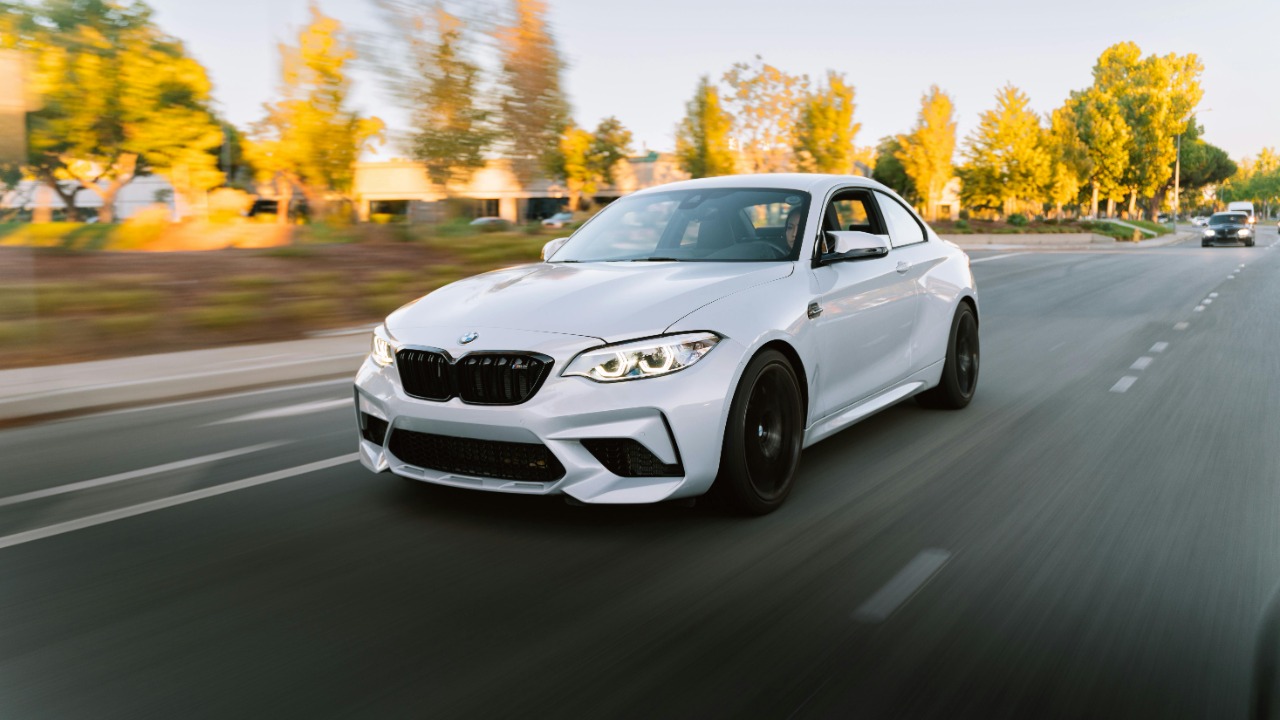
Power alone does not make a car playful; the way it changes direction does. The M2 CS has been tuned so that its steering, while not overflowing with old-school feedback, is described as razor sharp, translating small inputs into very quick changes of heading. That immediacy is what lets the car dart into gaps, clip late apexes on tight bends, and generally feel like it is always half a step ahead of the driver’s hands, urging them to turn in a little later and a little harder.
Underneath, the chassis is set up to rotate rather than simply cling, which is crucial to its mischievous personality. On a soaked circuit, the car has been praised for finding grip and grace, with the rear axle following the throttle with just the right amount of slip so that it rotated more eagerly through tighter complexes instead of simply pushing wide. That balance between traction and willingness to step out is what lets a skilled driver play with the car’s attitude mid-corner, using small lifts or throttle squeezes to adjust the line rather than relying solely on the steering wheel.
Power delivery that feels slightly unhinged
What makes the M2 CS feel like trouble waiting to happen is not just the number on the dyno sheet, it is how that power arrives. Descriptions of the car’s acceleration liken it to unleashing a destructive force, with one review comparing its appetite for tarmac to Ever thought about unleashing a colony of termites on someone’s timber-framed house. That image captures how the torque seems to chew through the road surface, especially in lower gears where the car lunges forward with a kind of gleeful violence.
Yet the M2 CS is not a blunt instrument. The same reports that dwell on its ferocity also note that it can find grip and composure even in poor conditions, which is part of what makes it so tempting to drive quickly when common sense says to back off. On a wet track, the 523-hp output is described as manageable rather than terrifying, the electronics and chassis working together so the driver can lean on the car’s abilities without feeling like every corner is a coin toss. That blend of huge power and surprising approachability is exactly what encourages a driver to push a little harder than they planned.
Everyday usability that lowers your guard
The most dangerous performance cars are often the ones that feel friendly at low speeds, and the M2 CS fits that mold. Despite its track-focused hardware, it has been characterized as a small-footprint sports coupe that can still handle daily duties, with ride quality that stays within the bounds of comfort and rear seats that are totally tolerable for adults. That practicality makes it easy to justify using the car for commutes and errands, which in turn means more opportunities to exploit its performance in short bursts.
Because the cabin is livable and the controls are not punishing, the car invites casual use of its performance rather than demanding a special occasion. I find that combination particularly potent: a compact coupe that can slip into a tight parking space, ride acceptably over broken pavement, and still feel like it is one downshift away from misbehavior. The more normal it feels in everyday driving, the more its explosive side catches you off guard when you finally give it full throttle on a familiar stretch of road.
The enthusiast echo chamber that amplifies its legend
Part of what cements the M2 CS as the right size for mischief is the way influential drivers talk about it. When someone as respected as Chris Harris is quoted as preferring the M2 CS to other serious machinery, that endorsement carries weight among enthusiasts who value feel and balance over raw numbers. The praise focuses on how the car’s compact dimensions and huge rear tires work together, giving it a planted stance that still allows for playful oversteer when provoked.
Owners echo that sentiment in more informal corners of the internet. On dedicated forums, drivers dissect why the M2 platform feels so alive in the turns, with one thread starting from the observation that Everytime someone test drives a Porsche on the street it may not wow them, but on track the story changes, and then comparing that experience to how the M2 behaves through a corner. The consensus that emerges is that the BMW’s size and setup make it easier to explore its limits on real roads without needing racetrack speeds, which is exactly what many drivers want from a so-called “baby” M car.
Why this size still matters in a supersized era
In a market where performance cars keep growing, the M2 CS stands out because it resists that inflation while still delivering numbers that belong in a much larger machine. I see its compactness not as a nostalgic throwback but as a strategic choice: a way to keep the driver feeling in command of the car’s footprint even as the powertrain and electronics push the boundaries of what is possible. The combination of a relatively short wheelbase, wide track, and serious power means the car always feels like it has more to give than the road can reasonably handle, which is the essence of its mischievous charm.
That is why the M2 CS has become a touchstone in conversations about modern performance. It is not the most powerful BMW, nor the most luxurious, but it may be the one that best captures the feeling of having just enough car to get into trouble and just enough control to get back out again. In a world of ever-larger, ever-faster machines, this compact coupe proves that the perfect size for mischief is still the one that fits the road, the driver, and the occasional sideways glance from the stability control light.



Leave a Reply