
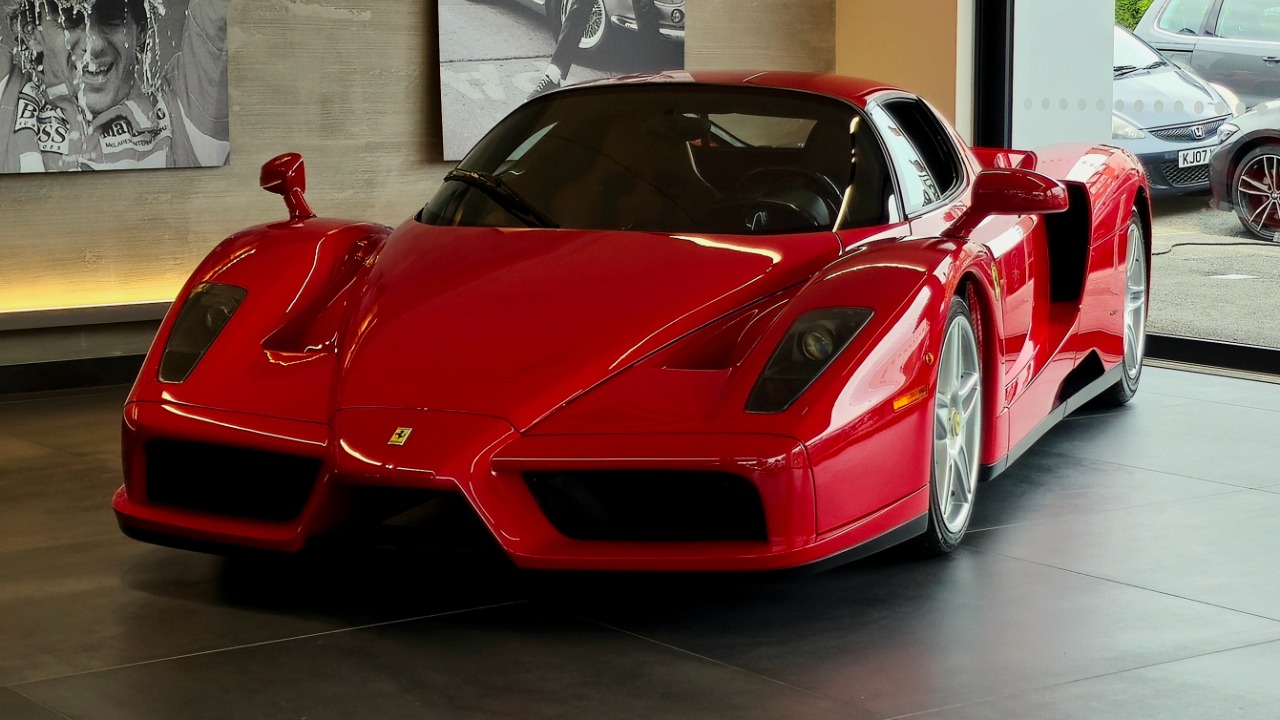
The Ferrari Enzo arrived as a road car that behaved like it had slipped out of the Formula One garage by mistake, a machine that translated paddles, carbon fiber and V12 fury into something barely domesticated. It did not just borrow race technology, it tried to make the driver feel like a grand prix star every time the ignition was turned. Two decades on, it still stands as the moment Ferrari let an F1 sensation escape the factory and onto public roads.
To understand why this matters, I look at how the Enzo fused competition hardware, aerodynamic thinking and a new generation of V12 engineering into a package that felt more like a prototype racer than a traditional supercar. The story is not nostalgia for a loud engine, it is about how a single model reset expectations of what a street‑legal Ferrari could be.
The F1 gearbox that changed how a Ferrari felt
What made the Enzo feel so alien at the time was not only its power, but the way it shifted gears. Instead of a traditional gated manual, The Enzo used an automated manual transmission that Ferrari itself called an F1 gearbox, with paddles behind the steering wheel commanding an automatically actuated clutch and gearset. That layout meant the driver’s hands never had to leave the wheel, a dynamic borrowed directly from contemporary single‑seaters and embedded in a road car for the first time at this level.
The system was brutally quick and, by some accounts, abrupt, but that harshness was part of the appeal for owners who wanted a car that felt more like a race machine than a grand tourer. The Enzo’s F1 gearbox, with its paddle‑shifters and rapid, sometimes jarring changes, made every upshift feel like a launch off the pit wall, a sensation that helped define the car’s reputation as a barely tamed track weapon on the street, as detailed in technical notes on The Enzo.
A new V12 that set the tone for Ferrari’s future
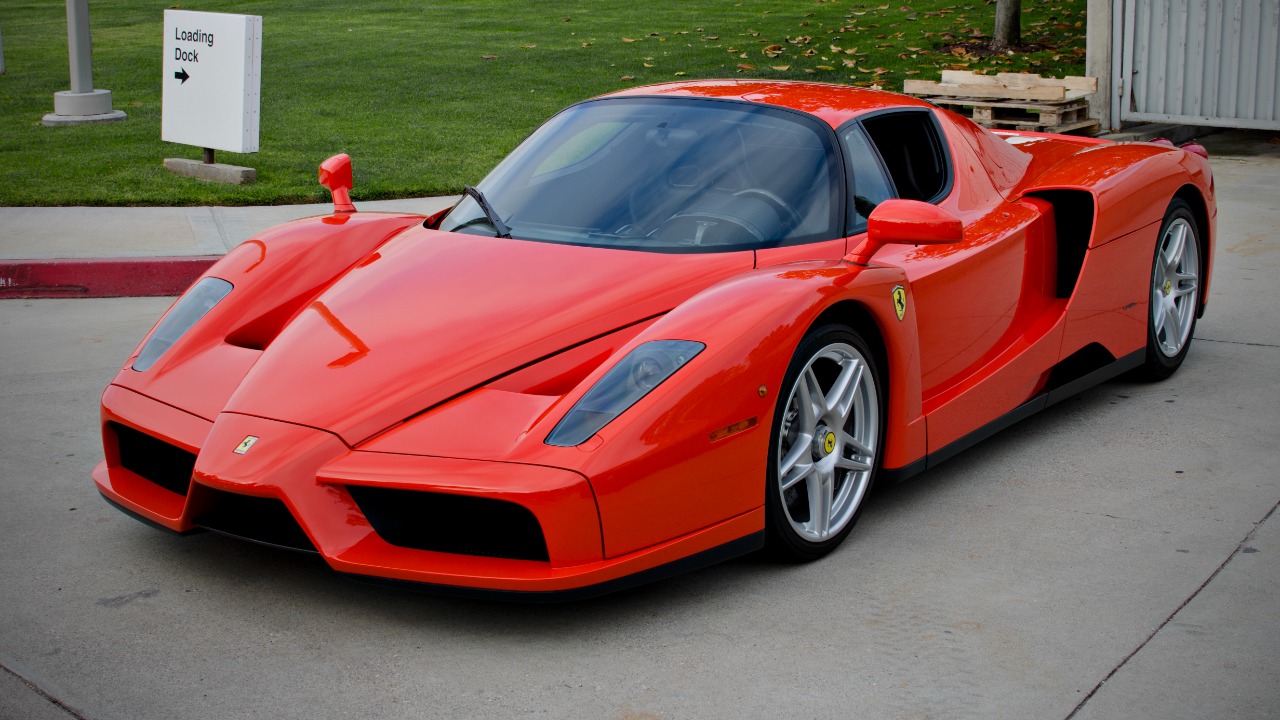
Under the rear bodywork, Ferrari used the Enzo to debut a fresh generation of twelve‑cylinder power. The Enzo was the first to receive the F140 V12, an engine that did not just serve this one halo model but formed the basis for all the Ferrari V12s that followed. That decision turned the car into a rolling test bed for the brand’s future, with its naturally aspirated soundtrack and high‑revving character later echoed in other flagship models.
By anchoring its next era of engines in this car, Ferrari signaled that the Enzo was more than a limited‑run showpiece. The F140 V12, introduced here at a time when it was among the most advanced units in the world, made the Enzo a bridge between the company’s racing heritage and its long‑term road‑car strategy, a link that is spelled out in factory reflections on how The Enzo was the first to carry this architecture.
From F40 to Enzo: evolving the race‑to‑road philosophy
The Enzo did not appear in a vacuum, it followed a lineage of extreme Ferraris that tried to bottle racing for the road. The #FerrariF40 was the last car Enzo Ferrari personally signed off on, a model named in honour of Ferrari’s forty years of brilliance that pushed the idea of taking a race track to the road. That car’s rawness, from its turbocharged power to its stripped‑back cabin, set expectations for what a flagship Ferrari should feel like in the hands of committed drivers.
By the time the Enzo arrived, the company had already learned how to translate that philosophy into something even more focused. Where the F40 was a brutal, analog statement, the Enzo layered in electronics, paddle shifting and advanced aerodynamics while still chasing the same goal of turning competition DNA into a street‑legal experience. The continuity between the F40 and the Enzo, and the way the former marked the final personal project of Enzo Ferrari himself, is captured in tributes that describe how The #FerrariF40 was the last car Enzo Ferrari personally signed off on and how it carried the race track to the road long before its successor refined the formula.
Aerodynamics and chassis: a Formula One mindset in carbon
Visually, the Enzo looked like a prototype racer that had been given just enough concession to pass road regulations, and that was not an accident. Pininfarina and Maranello engineers designed the Enzo to be aerodynamically stable without the pronounced wings like the ones seen on the F40 and the F50, relying instead on sculpted bodywork, underbody airflow and an integrated rear spoiler. That approach mirrored Formula One thinking, where managing air beneath and around the car can matter more than bolting on ever larger wings.
The result was a silhouette that felt more like a single‑seater wrapped in carbon fiber than a traditional coupe, with a long nose, tight cockpit and sharply cut tail that all served aerodynamic purpose. By keeping the body clean and letting the airflow do the work, the Enzo delivered high‑speed stability and downforce without the visual clutter of its predecessors, a philosophy that contemporary test drives highlighted when noting how Pininfarina and Maranello shaped the car to avoid the big wings seen on the F40 and the F50.
Bringing Formula One tech into everyday driving
Beyond its gearbox and aero, the Enzo was conceived as a showcase of how far Ferrari could push Formula One technology into a road‑legal package. While Ferrari had experimented in the past with bringing Formula One technology to the road, the Enzo was the first supercar of its kind from the company to integrate so many of those technologies into a livable, everyday driving experience. Carbon‑ceramic brakes, advanced traction systems and that F140 V12 all worked together to make the car feel like a race machine that could still be driven to dinner.
That balance between extremity and usability is what made the Enzo such a pivotal model. It was not a track‑only toy, yet it carried more direct F1 influence than anything Ferrari had sold to private customers before, turning each commute into something that felt like a formation lap. Auction notes underline this positioning, describing how While Ferrari had tried similar ideas earlier, the Enzo was the first to truly merge Formula One technologies into a livable, everyday driving experience.
Legacy, memory and the weight of the Enzo name
The car’s name carried its own pressure. Ferrari: Enzo Ferrari 🇮🇹 Meet the iconic Ferrari Enzo, a phrase that appears in modern tributes, captures how the model is framed as a masterpiece that embodies speed, innovation and a blend of advanced technology and racing heritage. Naming a flagship after the company’s founder was a statement that this car was meant to stand as a rolling summary of what the brand believed in at that moment.
That legacy is not only about performance figures, it is about the emotional connection between the company’s history and its most devoted followers. When enthusiasts say they Meet the Ferrari Enzo at events or museums, they are often responding to that mix of nostalgia for Enzo Ferrari himself and admiration for the engineering that bears his name, a relationship that is spelled out in commemorations that invite fans to Meet the Ferrari Enzo as a blend of advanced technology and racing heritage.
Shadows from racing history: the 156 and the cost of speed
To grasp why Ferrari treats its racing‑inspired road cars with such reverence, it helps to remember the darker chapters of its competition story. Tragically, the 156 was also involved in the worst accident in F1 history when Hill’s main rival for the title, his German teammate, was killed in a crash that scarred the sport. That episode showed how the pursuit of speed can carry devastating consequences, even for the most successful machines.
The aftermath of that crash led Ferrari to reconsider how it presented some of its most dominant race cars, with internal debates over whether to celebrate or quietly step back from a design that had delivered both glory and grief. Accounts of this period describe how Tragically, the 156 became a symbol of that tension, a reminder that the same engineering brilliance that inspires road cars like the Enzo can also sit at the center of motorsport’s hardest moments.
Wind‑tunnel sculpture and the feel of a race car on the road
One of the most striking aspects of the Enzo is how its body looks like it was carved by air rather than by a stylist’s pen. Exhibitions describe how the Ferrari Enzo Your browser can’t play this video. Created the body in a wind tunnel to mimic a formula one car, a process that prioritized airflow management over traditional beauty. That method explains the car’s sharp nose, deep side intakes and high‑mounted tail, all of which serve aerodynamic goals first and aesthetics second.
Seen in person, the Enzo’s proportions make sense only when you imagine it at speed, with air rushing over and under its surfaces. The wind‑tunnel development that Created the body to mimic a Formula One car is a key reason the Enzo feels so composed at high velocity, a point underscored by museum displays that highlight how engineers Ferrari Enzo Your body in a wind tunnel to achieve that race‑car‑like stability.
Driving impression: a race car on the open road
On the move, the Enzo delivers on the promise of its design brief. Following on from the F50 the Enzo raised the bar for what a supercar should be like, using technology from its Ferrari Enzo F1‑inspired systems to make the driver feel as if they were piloting a race car on the open road. The combination of its F140 V12, carbon chassis and paddle‑shift gearbox created an intensity that few rivals could match at the time.
That sensation is not just about outright speed, it is about the immediacy of every input and the way the car communicates grip, braking and direction changes. Owners and specialists often describe the Enzo as a machine that demands respect but rewards commitment, a view echoed in profiles that note how Following the F50, the Enzo made it feel like driving a race car on the open road.
The engine that lives on beyond the car
Even removed from the chassis, the Enzo’s powertrain continues to fascinate collectors. Perhaps the most obvious would be to fit it ( the Enzo’s automated manual gearbox ) to a classic Ferrari, an idea floated when a new, unused Ferrari Enzo V12 crate engine surfaced for sale. The notion of dropping that F140 V12 and its associated hardware into an older model speaks to how desirable the Enzo’s mechanical heart has become in its own right.
That crate engine, complete with the Enzo’s automated manual gearbox, represents a kind of modular slice of Ferrari history, a component that could transform any compatible chassis into something closer to the brand’s early‑2000s flagship. Coverage of the sale framed it as an opportunity to unleash a peal of straight‑piped V12 thunder in an unexpected setting, with commentators noting that Perhaps the most obvious use would be to pair it with a classic Ferrari and let that soundtrack loose.

Leave a Reply