
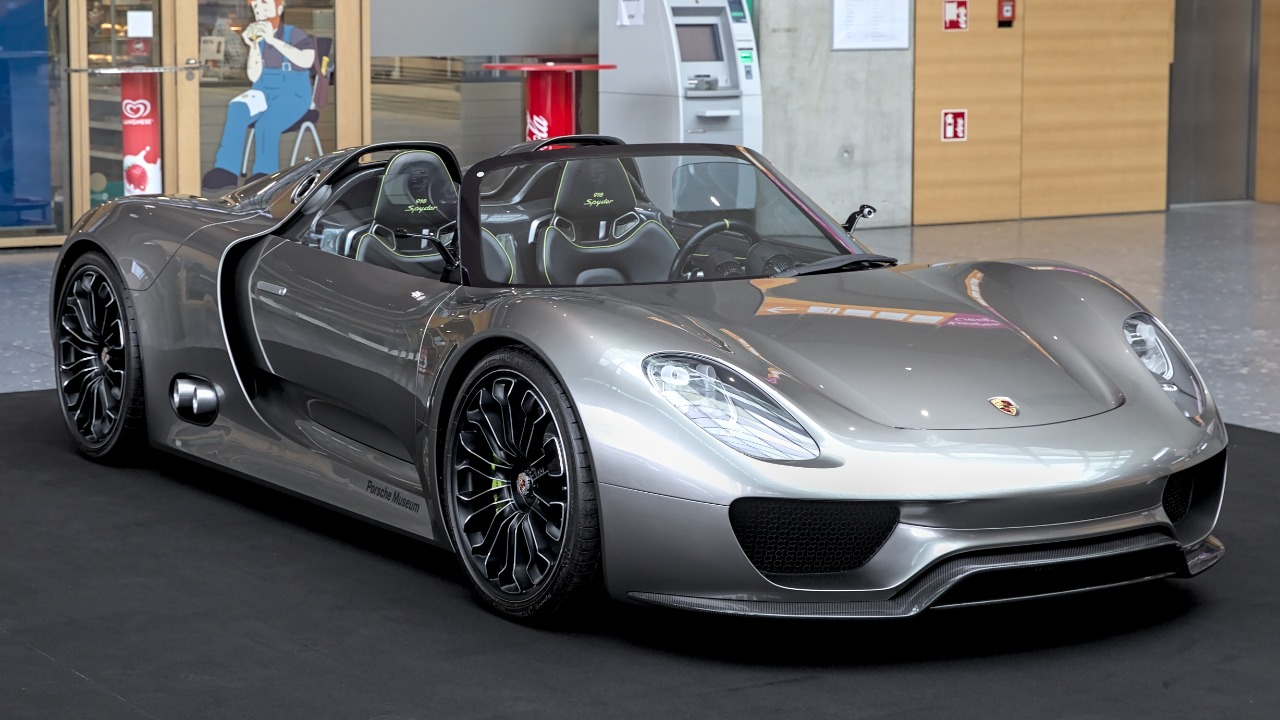
The Porsche 918 Spyder arrived at a moment when “hybrid” still sounded like a compromise, not a challenge to the world’s quickest cars. By pairing serious electric hardware with a race-bred V8, it did more than chase lap times, it reset what enthusiasts and engineers expected a battery-assisted supercar to feel like. I see its legacy today every time a new flagship model leans on electrons not as a crutch, but as a weapon.
To understand how the 918 Spyder rewrote the rulebook, you have to look past the headline numbers and into the philosophy behind them. This was not a greenwashing exercise bolted onto an existing platform, it was a clean-sheet attempt to prove that a hybrid could be both brutally fast and genuinely efficient, without dulling the sensations that make a hypercar special.
The moment hybrids stopped apologizing
Before the 918 Spyder, hybrids were largely framed as sensible choices, the cars you bought to save fuel rather than to set lap records. The 918 flipped that narrative by arriving as a purpose-built halo machine, a car whose entire identity was wrapped around the idea that electric assistance could amplify performance instead of muting it. In that context, the simple badge “918” became shorthand for a new kind of supercar, one that treated batteries and motors as core components of speed rather than add-ons for conscience.
That shift in attitude is why enthusiasts still talk about the car in almost mythic terms. Contemporary coverage described The Porsche 918 Spyder as a “Hypercar That Redefined Performance,” and that was not empty praise. Its ability to break the seven minute barrier at the Nürburgring put it in rare company, and it did so while carrying the extra mass and complexity of a hybrid system. Some cars make history, and this one did it by proving that a plug and a charging cable could coexist with the kind of lap time that once belonged only to stripped-out track specials.
Engineering a new kind of powertrain
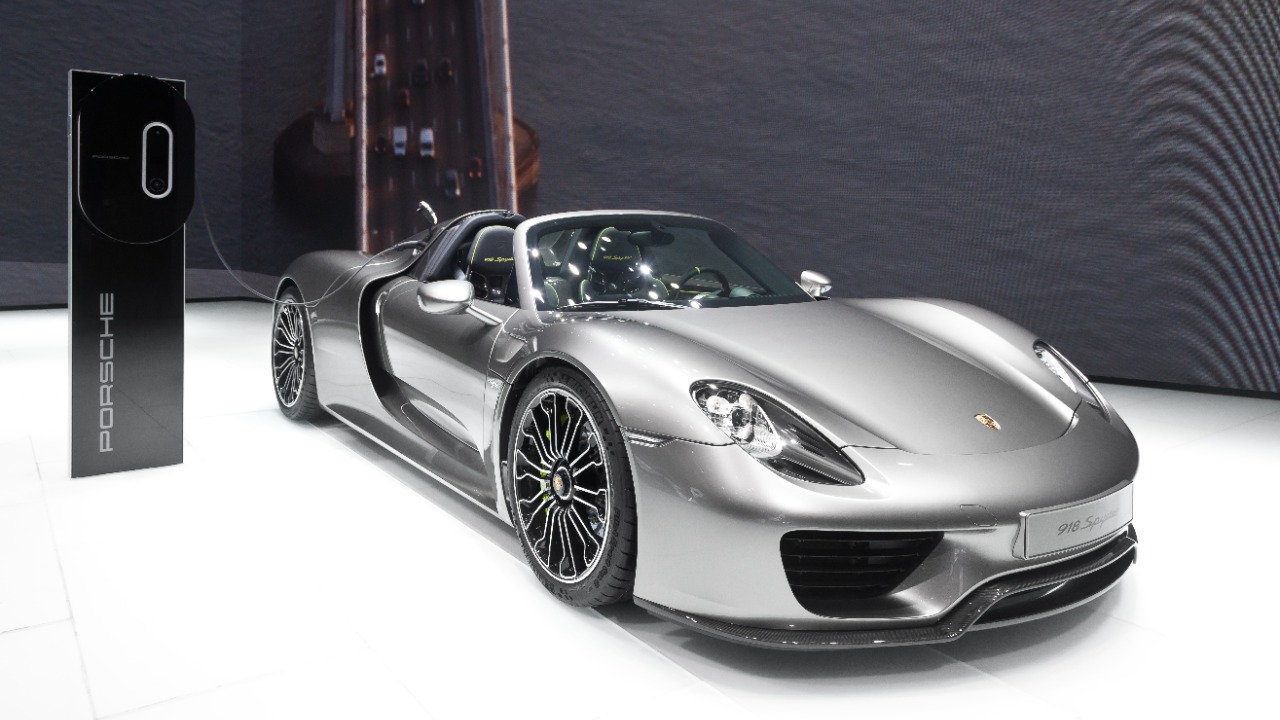
What made the 918 so convincing was not just that it was quick, but how it generated that speed. At its heart sat a 4.6L naturally aspirated V8, an engine that owed more to motorsport than to commuter duty. Instead of treating the electric side as an afterthought, engineers paired that combustion core with Electric Motors at both axles, using Two units to create precise AWD control that could shuffle torque instantly. The result was a car that felt alert and alive in ways a traditional all-wheel-drive system could not match, because the front axle could be driven purely by electrons while the rear V8 howled behind you.
From my perspective, that layout is where the 918 truly stepped away from the pack. It did not simply bolt a motor to the transmission; it used the hybrid system to reshape how the car put power to the ground. Reports on the French-language side of the project highlighted the same fundamentals, noting the central role of the 4.6L V8 Engine and the way the Electric Motors and AWD layout worked together to deliver both traction and efficiency. By integrating the hardware so deeply, the car made its complex powertrain feel seamless from behind the wheel, which is exactly what a skeptical audience needed to experience.
Numbers that backed up the promise
Of course, philosophy only gets a hypercar so far; the stopwatch has the final word. Early on, even as a prototype, The Spyder signaled that it was not interested in half measures. Coverage of the development car made it clear that Porche was serious about the “high-performance” part of “high-performance hybrid,” with projections that the car would top 200 mph and still manage up to 94 mph when powered solely by the electric motors. Those figures mattered because they showed that the EV side was not just for creeping through city centers, it was capable of real pace on its own.
When independent testing arrived, the numbers were even more startling. With the Weissach package fitted, the car was recorded sprinting from 0 to 62 m in just 2.6 seconds, beating its own targets by 0.2 and putting it squarely in the conversation with the quickest machines of its era. That kind of launch performance, verified on a Weissach equipped car, undercut the old assumption that batteries and control electronics would blunt the edge of a serious driver’s car. Instead, the hybrid system became the reason it could launch so violently, filling in torque where a conventional powertrain would still be gathering itself.
Chassis, handling, and the art of hiding mass
One of the biggest engineering challenges with any hybrid is weight, and the 918 had to carry a sizable battery pack along with its motors and V8. Rather than pretending that mass did not exist, the team attacked it with clever packaging and chassis tuning. The GT in Porsche’s lineup had long been known as a rear-wheel-drive purist’s machine, but the 918 made motion-use of all four corners, using the front electric motor to pull the car into a turn while the rear axle pushed it out. That approach helped the car defy its own weight, turning what could have been a liability into a dynamic advantage.
I find that detail especially telling because it shows how deeply the hybrid concept was baked into the car’s dynamics. Reports on the project noted that this layout would influence all Porsche sportscars to come, framing the 918 m development as a kind of rolling laboratory. By using the hybrid hardware to sharpen turn-in and traction rather than simply to chase efficiency, the engineers created a template that other performance brands would soon follow. The way The GT comparison was drawn at the time underlined just how radical it was to see a four-wheel-driven hybrid feel so agile.
Craftsmanship and the human factor
For all its digital sophistication, the 918 was not a cold piece of technology. It was built by people, and that human element is part of why it still feels special. Porsche said that 100 skilled employees from 14 different countries were selected from the 911 production line to assemble the car, each one trained to work with carbon fiber tubs, high-voltage systems, and intricate suspension components. That level of hand assembly, carried out in a dedicated space, gave the car a sense of craftsmanship that matched its price and performance.
When I look at that figure, I see more than a production statistic. Those 100 specialists were effectively ambassadors for a new era inside the company, bringing lessons from the 918 back to the broader range. The fact that they were drawn from the 911 line also matters, because it tied the experimental hypercar directly to Porsche’s core sports car. Coverage of the build process made it clear that Porsche wanted the 918’s exacting standards, and its alignment with the design specs, to ripple outward, influencing how future models were engineered and assembled.
A catalyst for a new hypercar arms race
The 918 did not exist in a vacuum. It arrived as part of a trio of hybrid flagships that included Ferrari’s LaFerrari and McLaren’s P1, with Jaguar’s stillborn C-X75 hovering at the edges of the conversation. What set the Porsche apart, in my view, was how unapologetically it leaned into the hybrid identity. Where some rivals treated the electric side as a way to fill gaps in the power curve, the 918 embraced the melding of electrons and hydrocarbons as its defining trait. That stance helped push the entire supercar world to take electrification seriously as a performance tool rather than a regulatory obligation.
Looking back, it is striking how quickly the rest of the industry followed. Once a car like the 918 had shown that a plug-in hypercar could lap the Nürburgring in under seven minutes while still offering meaningful electric-only capability, it became difficult for any brand to launch a flagship without some form of electrification. Analysis of the era pointed out that companies like Ferrari and Jaguar were forced to reckon with what this melding could do, and that pressure helped accelerate the broader shift toward hybrid and electric performance models.
How it feels from behind the wheel
For all the talk of lap times and kilowatts, the 918’s real achievement lies in how it behaves on the road. Owners and testers consistently describe a car that can glide through town in near silence, then transform into a ferocious track weapon with a twist of a dial. They noted Its ability to transition between electric cruising and explosive hybrid thrust without ever feeling disjointed, a trait that made the car surprisingly approachable despite its complexity. That duality is what convinced many skeptics that a hybrid could be both a daily companion and a weekend missile.
From my own perspective, that smooth shape-shifting is the clearest sign that the 918’s concept worked. It did not ask drivers to choose between conscience and excitement; it offered both in the same package. Enthusiast commentary captured that balance by highlighting how They felt the hybrid systems enhance rather than compromise a supercar’s capabilities, especially in the 918 Weissach specification. When I read those accounts, I see a car that did more than hit its engineering targets; it changed how drivers thought a hybrid could make them feel.
A legacy that still shapes the future
More than a decade after its debut, the 918’s influence is visible across the performance landscape. Its combination of a high-revving V8 and powerful electric motors showed that a hybrid could deliver both character and crushing speed, inspiring a wave of plug-in supercars and hypercars that followed. The car’s Nürburgring time, its intricate AWD system, and its meticulous construction all fed into a narrative that hybrids were no longer the sensible option in the corner of the showroom, they were the cutting edge.
That legacy is captured neatly in the way enthusiasts still talk about Its impact. Commentators point out that the Porsche 918 helped pave the way for future advancements in automotive technology, not just within its own brand but across the industry. When I look at the latest generation of electrified flagships, I see echoes of the 918’s philosophy everywhere, from torque-vectoring front axles to battery packs tuned as much for power delivery as for range. The car’s lasting contribution is that it made this direction feel inevitable. By proving that a hybrid could sit at the very top of the performance pyramid, the Porsche 918 turned electrification from a compromise into an aspiration, and the supercar world has been chasing that standard ever since.

Leave a Reply