
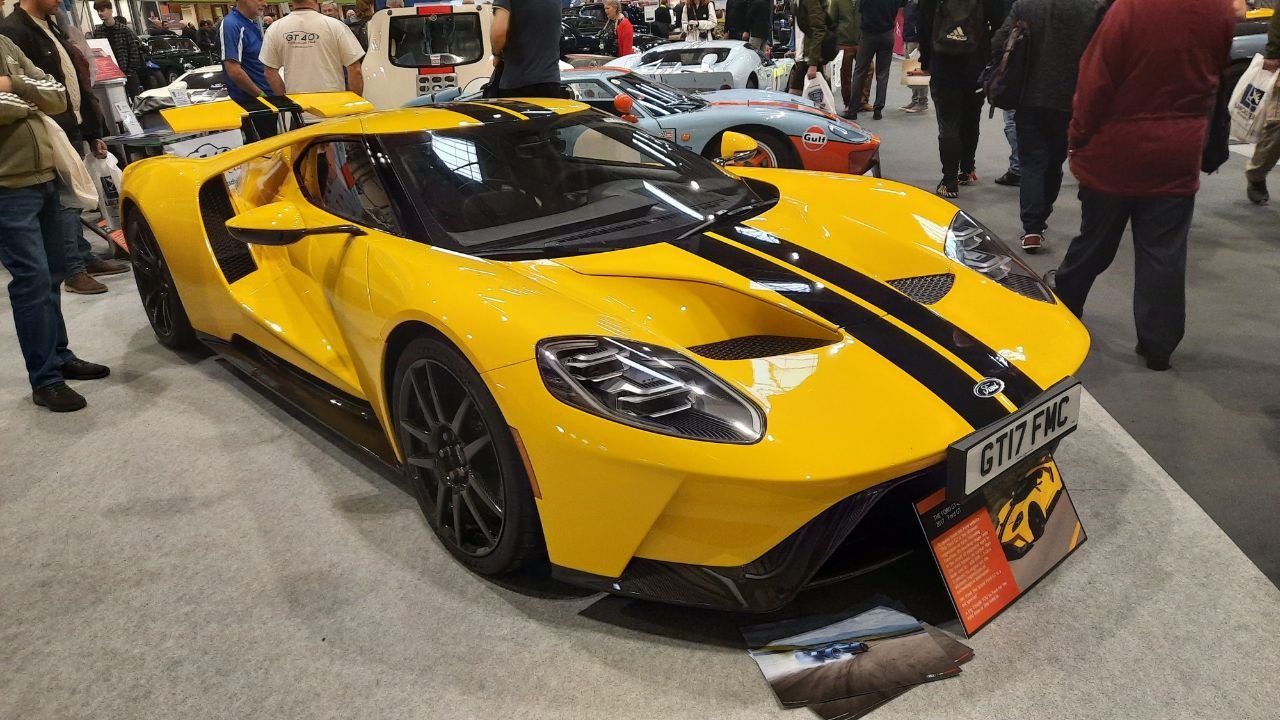
The 2017 Ford GT looks like it escaped from a wind tunnel, took a wrong turn at Le Mans, and accidentally ended up with license plates. Everything about it, from the way you climb past the carbon-fiber sill to the way the suspension crouches on command, feels closer to a development mule than a comfy grand tourer. A decade on, it still behaves like a rolling experiment that someone in the lab forgot to say no to.
I have driven plenty of fast cars that pretend to be race machines, but the GT flips that script, behaving like a race car that reluctantly tolerates public roads. The result is a street-legal science project that never quite relaxes, and that is exactly why it still feels like a prototype that somehow cleared emissions testing.
Race car first, road car reluctantly
The starting point is intent, and the Ford GT was conceived first and foremost to go endurance racing, not to valet-park outside a steakhouse. The car was built to compete at Le Mans in the GTE category, which meant the road car existed largely to satisfy the rulebook rather than your chiropractor. That is why the cabin feels shrink-wrapped around the cage and why the whole car gives off the vibe of a homologation special that escaped from the paddock. When reviewers described it as “a race car that has become a road car,” they were not being poetic, they were simply reading the spec sheet out loud, and even Car leaned into that line.
That racing-first mindset explains why the GT will never feel like the familiar toys of the supercar establishment. It will not coddle drivers used to Porsches and Ferraris and Lamborghinis, because the whole point was to build something that behaved like a competition car with just enough civility to pass an inspection. From the fixed driver’s seat to the way the bodywork looks shrink-wrapped over the mechanicals, it feels like the engineers finished the race version and then grudgingly added turn signals. I find that honesty refreshing, in the same way a track-only special is refreshing when it suddenly sprouts a license plate bracket.
Aero tricks that belong in a wind tunnel
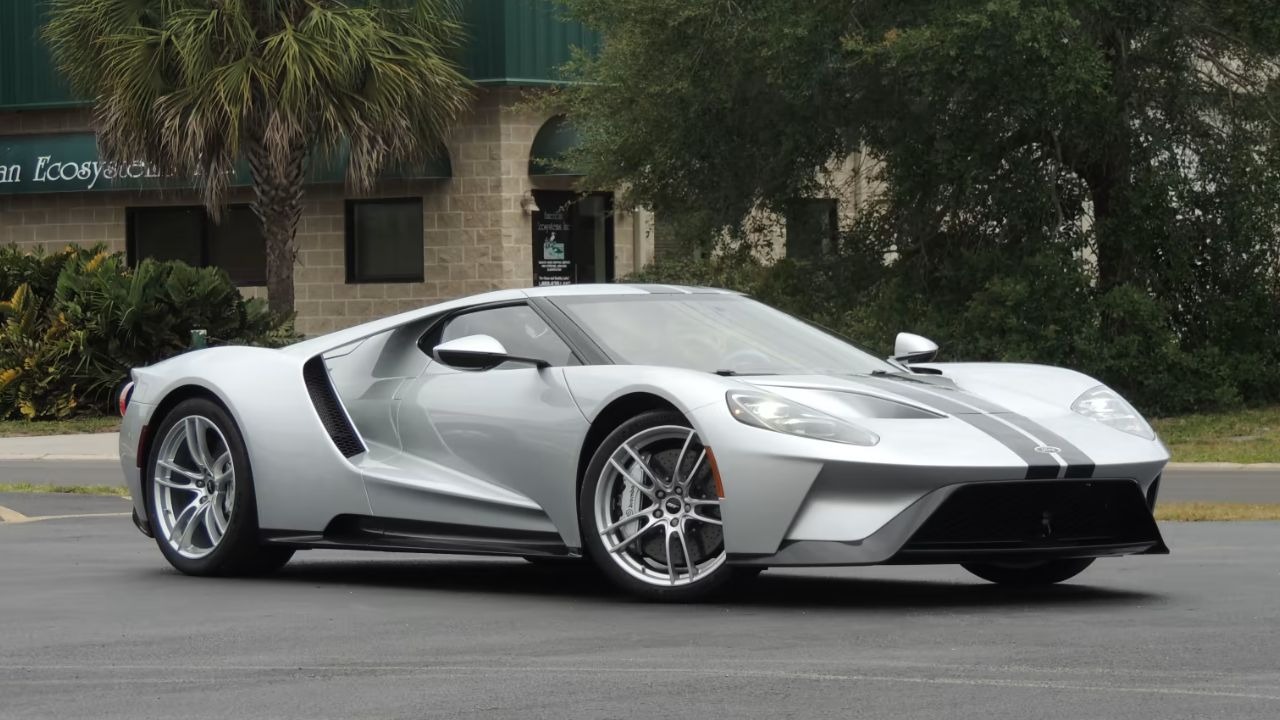
Nothing screams “prototype” like bodywork that seems to move more than the driver, and the GT’s active aerodynamics are the star of that show. The car constantly reshapes itself, with a rear wing and underbody elements that adjust to deliver superb stability and active aerodynamics that feel like they were borrowed from a prototype class. The body was obsessively sculpted so that every surface does a job, and the result is a car that looks fast standing still because the air has already signed a non-disclosure agreement. Ford’s own engineers talk about GT’s aerodynamics changing on demand to maintain positive downforce in all conditions, which is the sort of sentence you usually hear in a race trailer, not a dealership.
Even the basic shape feels like it was drawn by a computational fluid dynamics program that briefly achieved sentience. The minimalist carbon body is tightly wrapped over the mechanicals, with flying buttresses and long tunnels that exist to smooth the airflow and cool the engine rather than to win Instagram. Reviewers noted that, apart from the undersized cylinder count, the Ford GT packs in oversized engineering, right down to the way the bodywork is carved to smooth its aerodynamic profile. From behind the wheel, I feel less like I am driving a car and more like I am riding inside a moving experiment in airflow management that happens to have a horn.
A V6 that behaves like a lab project
Then there is the engine, which might be the most controversial part of the whole experiment. Instead of a big, theatrical V8, the GT uses a twin-turbocharged EcoBoost V6 that produces a prodigious amount of power from a relatively small displacement, landing just behind a 660-horsepower Ferrari 588 G GTB and a 666 horsepower rival. On paper, it looks like a science fair project that accidentally wandered into a dyno room, and behind the wheel it feels like Ford’s engineers cranked up every powertrain nerve ending. Reports describe how Ford sharpened the throttle so the take-up feels direct and intuitive, which is exactly how it comes across when you breathe on the pedal and the horizon suddenly accelerates toward you.
From the driver’s seat, the engine feels less like a traditional supercar powerplant and more like a calibrated instrument. Reviewers urged drivers to forget the cylinder count and focus on the fact that this is the most powerful EcoBoost engine yet, paired with drive modes labeled Normal, Sport, and Track that feel like software presets on a prototype test rig. The V6 sound, which a Pro Racer described as addictive, reinforces the impression that you are driving a development engine that somehow escaped the dyno cell. I find myself treating the throttle like a lab instrument, not a pedal, which is exactly how a street-legal prototype should feel.
Controls that feel like a test rig
Slip into the cockpit and the prototype vibe only intensifies. The steering wheel is a dense cluster of functions, with Controls placed exactly where your fingers expect them, as if the layout had been iterated through countless simulator sessions. My left thumb spins a black plastic dial on the wheel to switch from Engine idling in Normal to more aggressive settings, and the whole process feels more like arming systems in a pit lane than choosing a comfort mode in a road car. When my fingertips snick the right-hand paddle, that delicate, precise motion barely interrupts the surge of acceleration, reinforcing the sense that the paddles were designed for lap time first and daily drivability a distant second.
The rest of the cabin continues the theme of functional minimalism. The fixed driver’s seat, the narrow footwell, and the way the dash wraps around you all feel like they were designed to keep the driver locked in place on a 2.2-mile circuit rather than to impress a date. Even the door operation, which a Pro Racer praised in a driver’s Perspective by noting how Opening and closing the GT doors is a breeze, feels like a race engineer’s idea of convenience. They swing up and out of the way just enough to let you drop into the seat without dislocating anything important, but there is no mistaking the sense that you are climbing into a machine built for lap times, not latte runs.
On the road, it never stops feeling like a development car
Out in the real world, the GT behaves like a prototype that has been given a hall pass to mingle with traffic. The suspension can drop into a low, aggressive stance that makes speed bumps look like personal insults, yet in its more relaxed setting it damps bumpy roads surprisingly well, a duality that reflects how Though the car is track-focused, it still has to survive the school run. Like most supercars, the GT’s limits are so high that only severely poor driving can unsettle it on the street, and it stays composed and aloof until you really start to push, at which point it begins to reveal its true character as a barely domesticated race machine. Reviewers noted that, Like most of its peers, it needs serious commitment before it shows you the sharp edges.
Even when you are not at ten-tenths, the GT constantly reminds you that it was tuned on circuits, not cul-de-sacs. Lapping the Lapping the circuit, reviewers found a responsive but decidedly old school handling dynamic, with clear feedback and a sense that the car expects you to do some of the work. Even on the corners they missed, drivers reported that the GT made them feel like they were channeling Even the spirit of Dan Gurney or A. J. Foyt, which is exactly the sort of delusion a good prototype should inspire.
Looks and drama straight from the design studio
Visually, the GT still has the presence of a concept car that somehow slipped past the security guards at an auto show. The proportions are extreme, with a teardrop cabin, long rear deck, and those dramatic flying buttresses that make it look like a Le Mans prototype in disguise. Reviewers have joked that it is a Le Mans prototype hiding in plain sight, and I am inclined to agree every time I see one trying to blend into a parking lot full of crossovers. It is the rare modern supercar that still stops people mid-sentence, partly because it looks like it should be surrounded by engineers with laptops instead of shopping carts.
Even dealers leaned into that futuristic aura, pitching it as a car that was ahead of its time, with Cool Features of the design that were unapologetically focused on reaching very high speeds. The Ford GT wears its aero obsession on its sleeve, and that makes it feel less like a finished product and more like a rolling demonstration of what happens when you let the wind tunnel team run the styling department. I still catch myself staring at the voids in the rear bodywork and thinking they look like unfinished CAD surfaces, which is exactly the kind of nerdy thrill a street-legal prototype should deliver.
Why it still feels like a prototype today
What keeps the 2017 GT feeling experimental, even years later, is how unapologetically focused it remains on its original mission. It will not feel familiar to drivers of Ford GT rivals, and that is by design, because Ford Performance intended from the outset to build something that prioritized lap times and aero data over creature comforts. Even today, when I watch one being hustled around a circuit, it looks like a development car that accidentally got painted and polished before anyone remembered to hide it. The way it squats under power, the way the wing snaps to attention, the way the V6 howls, all of it feels like a test session that never ended.
On the right road, that focus turns into something addictive. Jun might be a fine month to cruise, but However the real fun starts once you get to the track or at least some sparsely populated winding roads, where, As Motor Tr noted, you can finally test out some top speeds. At that point the GT stops pretending to be a road car at all and simply becomes what it always wanted to be, a race-bred prototype that just happens to be wearing plates. I would not have it any other way.

Leave a Reply