
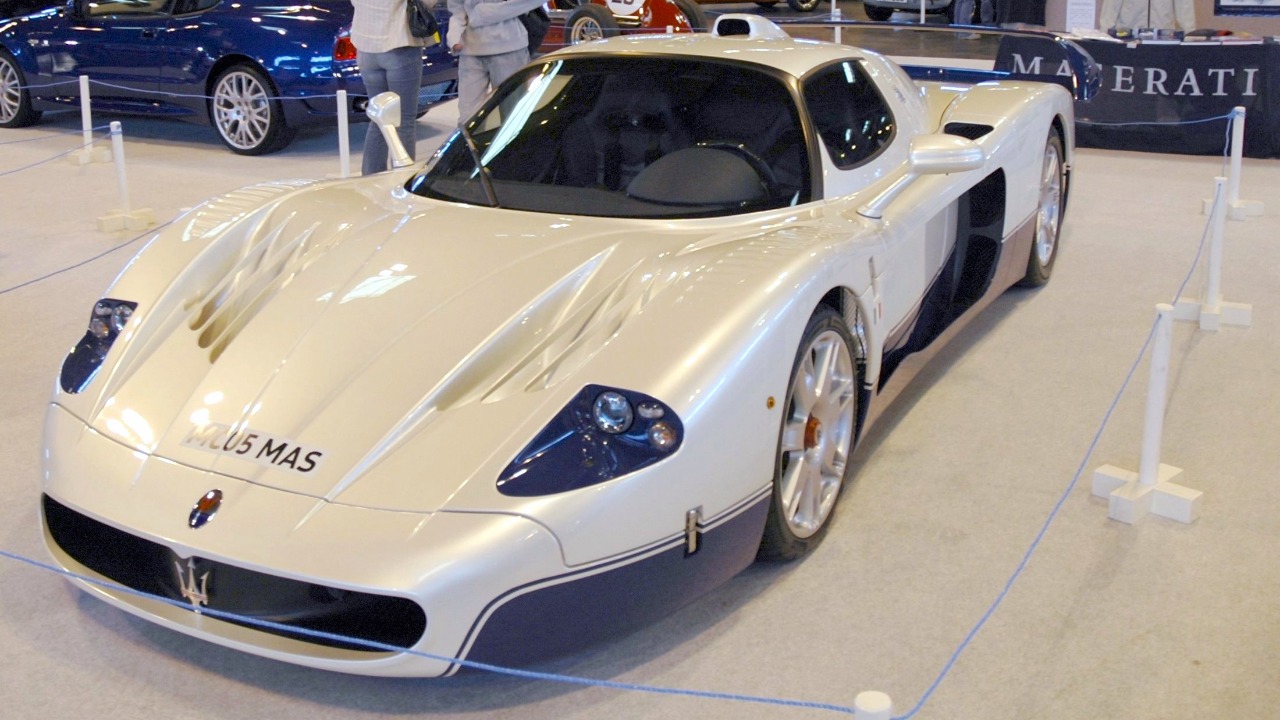
The Maserati MC12 arrived in the mid‑2000s as a homologation special with a single ruthless purpose: to drag Maserati back to the front of international sports car racing. In an era crowded with poster cars and headline horsepower, it quietly built a record and a mystique that still make its contemporaries feel like supporting acts. Today, when I look at the MC12 against its peers, it is the combination of racing dominance, rarity, and unapologetically focused design that keeps it shining brighter than the rest.
Plenty of supercars from that period were faster on paper or more usable on the road, but very few were engineered so nakedly around winning. The MC12’s story is not just about a wild V12 or a dramatic silhouette, it is about how a small run of competition‑bred machines rewrote expectations for what a modern Italian halo car could be, then left the stage before anyone could catch up.
Built to win first, impress later
What sets the MC12 apart for me starts with intent. Maserati did not sketch a road car and then see if it could be adapted for racing; it built a race car and grudgingly made it legal for the street. The GT1 program delivered a staggering record of 40 wins from 94 races, a strike rate that would make most factory efforts jealous and that underlines how thoroughly the car was engineered around competition success rather than boulevard posing, as period coverage of those 40 from 94 makes clear.
That focus shows up in the way the MC12 behaved on track. On the race track, the MC12 proved to be truly dominant in its day, with a chassis and aero package that leaned heavily on the kind of high‑downforce thinking and carbon construction more often associated with top‑tier single‑seaters, right down to the use of all sorts of Formula 1 tech in the suspension and braking systems that made it devastatingly effective in long‑distance events, as detailed in contemporary On the track analysis.
The “Enzo twin” that refused to be a clone
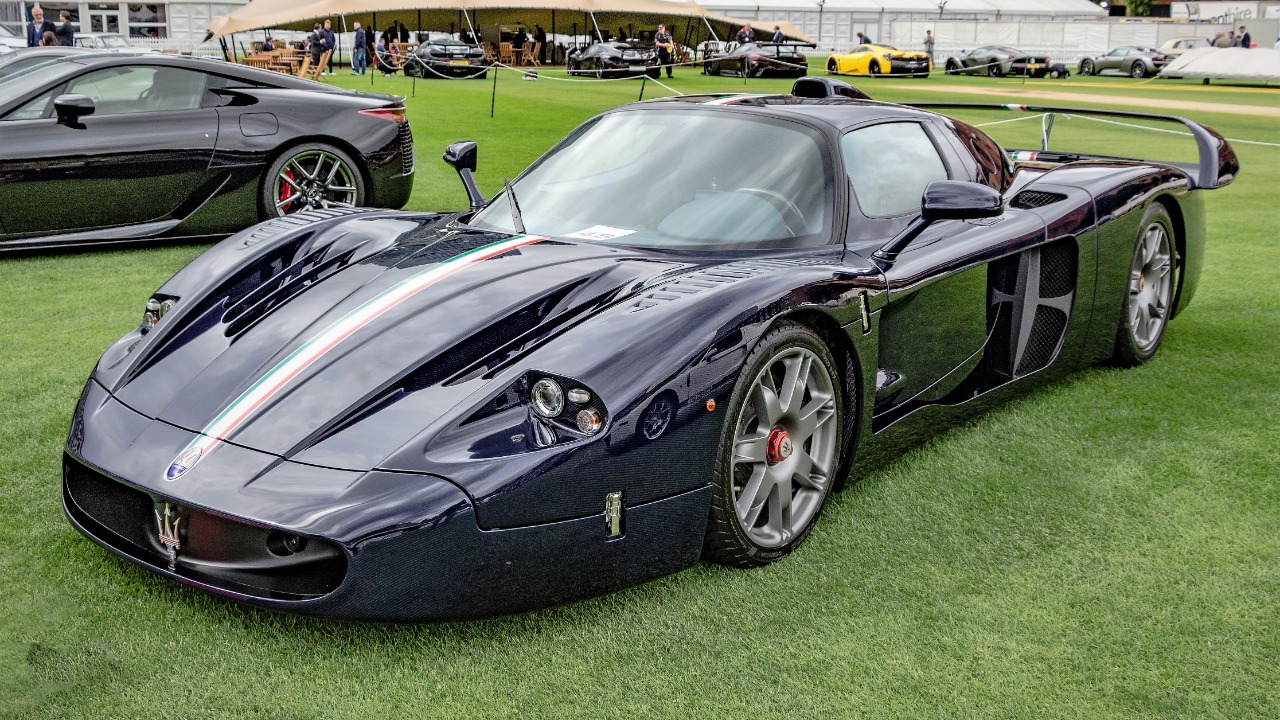
Of course, the MC12’s origin story is inseparable from the Ferrari Enzo. Under the skin, the Maserati borrowed the Enzo’s carbon tub and V12 architecture, and that shared DNA is why so many enthusiasts still talk about Enzo Ferrari Similarities when they compare the two. Both cars share the same basic layout and a close relative of the Enzo Ferrari engine, yet the MC12 was stretched, widened, and reshaped into something more extreme, with a longer tail and a towering rear wing that made no attempt to hide its racing brief.
That shared foundation led some to dismiss the Maserati as an Enzo in different clothes, but the details tell a different story. Not‑so‑apparently, Ferrari must always have better figures when it comes to forging Italian supercars born for the super‑rich, which is why the Enzo chased headline numbers while the MC12 accepted a lower power rating in exchange for stability, aero efficiency, and the packaging compromises of a removable roof panel and a stripped‑back cabin with no spare tire and no radio, a contrast that enthusiasts still debate in Not so apparently Ferrari commentary.
Design that favors downforce over drama
When I stand next to an MC12, what strikes me is how unapologetically functional it looks compared with its era’s more sculpted exotics. The side view is dominated by that vast rear deck and integrated wing, the nose is long and low, and the cabin seems almost shrunken in the middle, a shape dictated by airflow rather than fashion. Even casual observers have noticed that it was purpose built as a race car, which is why it has the more utilitarian styling that some say makes it better as a poster car than a piece of driveway jewelry, a sentiment that crops up in fan discussions of how the side view prioritizes function.
That design language was not an accident. Engineers leaned into a full‑width rear wing and a longtail profile that generated enormous stability at speed, a philosophy that set the MC12 apart from one‑off design exercises like the work James Glickenhaus commissioned from Pininfarina, and that made the Maserati a benchmark for how to turn a shared chassis into a dominating GT1 weapon, as detailed in technical breakdowns of how James Glickenhaus and Pininfarina approached their own projects compared with Maserati.
Rarity, values, and the collector halo
Rarity is another reason the MC12 still looms so large. Maserati built a total of 50 road‑going cars for customers, split across two batches, a tiny production run that instantly made each chassis a blue‑chip collectible and that still defines how the market views the model, as production figures for those 50 customer cars confirm. That scarcity is amplified by the even more limited MC12 Corse track specials, which were never homologated for the road and exist in a different, even more rarefied space.
The auction world has responded accordingly. The highest‑selling car at a recent sale was a 2005 Maserati MC12 that sold for a record‑setting $5,202,500, a figure that underlines how collectors now treat the model as a peer to the most coveted modern Ferraris and Porsches rather than a quirky offshoot, as the hammer price for that Maserati sale makes clear. Moreover, the MC12 Versione Corse benefits from a race‑winning pedigree and added rarity, with only 12 examples plus one prototype produced compared to 29 FXXs, a contrast that shows how the Maserati sits in an even smaller circle than Ferrari’s own track‑only flagship, as highlighted in auction notes that begin with the word Moreover.
From GT1 legend to internet folk hero
Time has only burnished the MC12’s reputation among fans who watched it race. In sports car circles, people still talk about how its pseudo‑factory team arrived and immediately started dictating the pace, with early seasons of GT1 competition remembered as a kind of rolling coronation for the blue‑and‑white coupes, a mood that comes through in long‑running threads where fans ask who remembers those days when the car’s initial dominance reshaped the grid. That kind of nostalgia is not just about lap times, it is about the feeling that a sleeping brand had suddenly woken up and decided to win everything in sight.
That reverence extends to the road cars, which have become minor celebrities every time one appears in public. Enthusiasts pore over photos of a 2005 Maserati MC12 in Fuji White with only 285 km on the clock, calling it One of 50 and treating it like a visiting race car rather than a mere supercar, a reaction that shows how the internet era has turned each sighting into an event, as seen in the Comments Section around that particular car. Even people who will never see one in person have absorbed the idea that this is not just another V12 exotic but a rolling piece of motorsport history.
Too extreme for the road, just right for legend
Part of the MC12’s aura comes from how uncompromising it feels as a road car. The Maserati MC12 based on the Ferrari Enzo was bigger, wider and even more difficult to handle than its already intimidating sibling, with a screaming V12 and a footprint that made it feel almost too extreme for most roads, a reputation that has been reinforced in clips that describe how The Maserati could turn from docile to monstrous in an instant. In contrast to the race version of the MC12, of which street‑legal versions were produced for homologation purposes, the MC12 Corses were never certified for public roads at all, a decision that underlines how far Maserati was willing to go in pursuit of lap time, as the description of the Cors models makes clear.
Even the more civilized Stradale versions leaned into that extremity. While it is based around the Ferrari Enzo, the MC12 wears a competition‑purpose body, offers a removable roof panel, and delivers a driving experience that feels closer to a GT1 car with plates than a grand tourer, a character that helps explain why collectors still chase While Enzo‑based examples so aggressively. You will remember that the MC12 was essentially an Enzo in drag, built for homologation purposes so the race cars could exist, and those MC12 racers were fast enough that the road cars inherited an aura of barely contained violence, a point often made in features that remind readers that You could buy a £2m ultra‑rare Maserati and still feel like you were driving a detuned race car.
A different kind of Italian icon
Stack the MC12 against its era’s icons and its appeal becomes clearer. The Ferrari Enzo in F140B configuration produced 651 horsepower at 7,800 rpm, figures that made it the most powerful naturally aspirated Ferrari road car of its time and that still impress on paper, as technical retrospectives on how In the Enzo era defined new‑age V12s make clear. Yet the Enzo’s legend is built as much on its numbers and its role in Ferrari’s lineage as on its competition record, while the MC12 flipped that balance, prioritizing trophies and lap charts over spec sheet bragging rights.
In that sense, the MC12 feels closer in spirit to older racing icons like the Ferrari 250 GTO, which is celebrated not only for its racing capabilities but also for its design, combining elegance with aerodynamic efficiency and a legendary V12 soundtrack that has turned it into one of the most valuable cars in the world, as owners still say when they describe how It is celebrated for rarity, beauty, and racing pedigree. The MC12 may not match that level of universal recognition, but by anchoring its identity in real competition success, extreme design, and tightly limited numbers, it has carved out a similarly pure niche, one where the usual supercar one‑upmanship fades and what remains is a car that still feels like it is playing a different game from its contemporaries.

Leave a Reply