

The AMC Rebel Machine arrived at the height of the muscle car wars with the power, attitude, and engineering to run with Detroit’s best, yet it never earned the same lasting status as rivals from Dodge, Ford, or Chevy. It was quick, visually unforgettable, and technically sophisticated for its time, but history largely filed it under “curiosity” instead of “icon.” I want to unpack why this one-year wonder deserved a far better legacy than the market and mainstream memory gave it.
A serious muscle car hiding behind a small badge
The core reason the Rebel Machine merited more respect is simple: it was a genuinely serious muscle car, not a marketing exercise. Underneath the Machine’s hood scoop lived the most powerful V8 AMC ever fitted to a production car, a 390 cubic inch engine tuned specifically for this package. Contemporary reporting notes that this setup delivered a power-to-weight ratio of about 10.7 pounds per horsepower, a figure that put the Rebel Machine squarely in the same performance conversation as the era’s better known street bruisers from Detroit. The car was not just quick in a straight line, it was engineered to stand up to the “muscle car bullies” that dominated the period, with gearing, suspension, and braking chosen to make full use of that output.
That level of performance came from a company that was already fighting uphill. AMC did not have the deep pockets or vast engineering departments of its Big Three rivals, yet it still produced a Rebel model that enthusiasts and analysts now single out as one of the most capable cars the brand ever built. Later assessments of AMC’s lineup describe the Rebel Machine as the standout version of the Rebel family, a configuration that helped define the company’s reputation for building surprisingly tough and reliable hardware even as its business struggles mounted. In other words, the Machine was not a fluke, it was the distilled version of what AMC could do when it focused its limited resources on a single, high-impact statement car.
Overshadowed by Dodge, Ford, and Chevy
If the Rebel Machine was so capable, its muted legacy has more to do with context than with the car itself. At the turn of the 1970s, the muscle car market was dominated by Dodge, Ford, and Chevy, brands that poured money into advertising, racing programs, and dealer networks that kept their cars in front of buyers. Reporting on overlooked classics points out that AMC as a company was overshadowed by these giants, and the Rebel Machine was no exception. It entered a crowded field where names like Charger, Mustang, and Chevelle already soaked up attention, leaving little room in the public imagination for a newcomer from a smaller manufacturer.
That imbalance in visibility meant the Rebel Machine never enjoyed the same halo effect as its rivals, even though it could run with them on the street. The car’s one-year production run only amplified that problem, because it did not have time to build a multi-year narrative in showrooms or on drag strips. Later retrospectives that group the Rebel Machine among “overlooked” American performance cars underline how thoroughly it was pushed to the margins by the marketing muscle of Dodge, Ford, and Chevy. The car’s relative obscurity today says more about that competitive landscape than about any shortcoming in the Machine’s design or capability.
Patriotic styling that masked real engineering
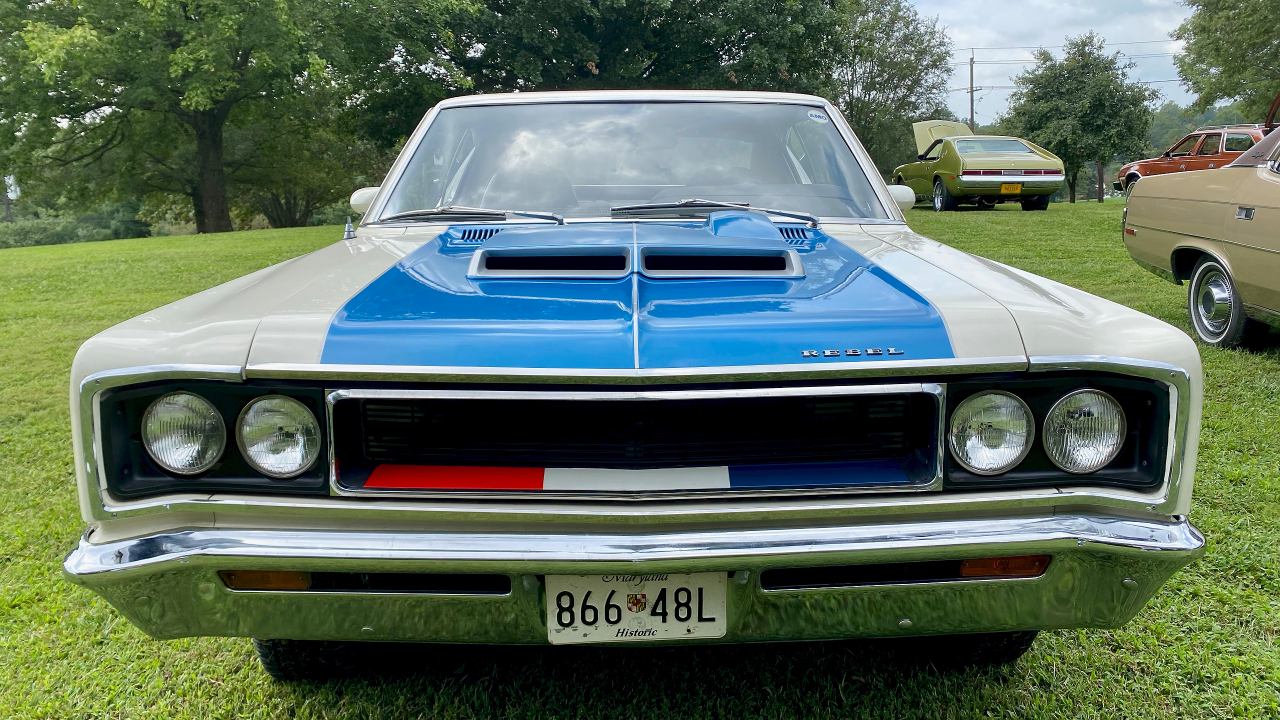
Visually, the Rebel Machine was impossible to ignore, and that was both its strength and its curse. The car’s most famous configuration wore a bold red, white, and blue color scheme that wrapped the body, hood scoop, and graphics in unapologetic Americana. Contemporary descriptions emphasize how patriotic the Machine looked, a rolling billboard for late‑1960s bravado that made subtle rivals seem almost timid. That visual drama helped the car stand out on the street and in period advertising, but it also encouraged some observers to dismiss it as a gimmick, a paint-and-decals special rather than a serious performance package.
Underneath that loud exterior, however, the Rebel Machine was carefully thought out. The functional hood scoop fed the high output 390 V8, and the car’s weight-to-power ratio of 10.7 pounds per horsepower was not an accident, it was the result of deliberate tuning and component choices. Later analysis of the Machine’s history stresses that this was the most powerful production V8 AMC ever installed, and that the rest of the car was built to handle it. The disconnect between the flamboyant styling and the disciplined engineering underneath is part of why I see the Machine as underappreciated: its looks were so loud that they distracted from the very real hardware that made it competitive.
A one-year experiment that proved AMC could punch up
The Rebel Machine’s brief life is central to understanding its reputation. It was effectively a one-year muscle car from AMC, a focused experiment that arrived, made its point, and disappeared. Enthusiast accounts, including owners who still drive these cars, emphasize that the Machine was sold only for the 1970 model year, which instantly limited its production volume and long-term visibility. When a car is built for such a short window, it has fewer chances to appear in period racing results, magazine tests, and family driveways, all of which shape how later generations remember a model.
Yet that short run also highlights how ambitious the project was for a company of AMC’s size. Analysts looking back at the era describe moments when smaller American manufacturers tried to challenge the Big Three without the benefit of deep budgets or large engineering teams. The Rebel Machine fits squarely into that narrative. It showed that AMC could create a car that stood up to Detroit’s muscle car bullies, even if the company could not sustain the program financially. The fact that the Machine was killed off despite its capability underscores how business realities, not product weakness, often decide which cars become legends and which fade into footnotes.
Reliability, rarity, and the case for a higher place in history
Another reason the Rebel Machine deserves more respect is that it was not just fast, it was fundamentally solid. Later evaluations of AMC’s output identify certain models as the most reliable cars the company ever produced, and the Rebel line, including the Machine, is singled out as part of that conversation. Those assessments argue that AMC made good cars but struggled to run a profitable business, a distinction that matters when judging the brand’s legacy. The Machine’s robust drivetrain and straightforward mechanical layout have helped surviving examples stay on the road decades later, which is why owners still showcase them as usable classics rather than fragile museum pieces.
That combination of reliability and low production has turned the Rebel Machine into a rare sight today, and rarity often fuels respect in the collector world. Yet the Machine still lags behind more common rivals in both recognition and valuation, a gap that traces back to the same overshadowing by Dodge, Ford, and Chevy that defined its launch. When I weigh the facts, from the most powerful AMC production V8 under its hood to its 10.7 pounds per horsepower ratio and its reputation among enthusiasts as a tough, well built car, it is hard to escape the conclusion that the Rebel Machine earned a higher place in American muscle history than it currently occupies. Its story is a reminder that performance, engineering, and reliability do not always guarantee fame, especially when a small American company is trying to shout over the biggest names in Detroit.



Leave a Reply