
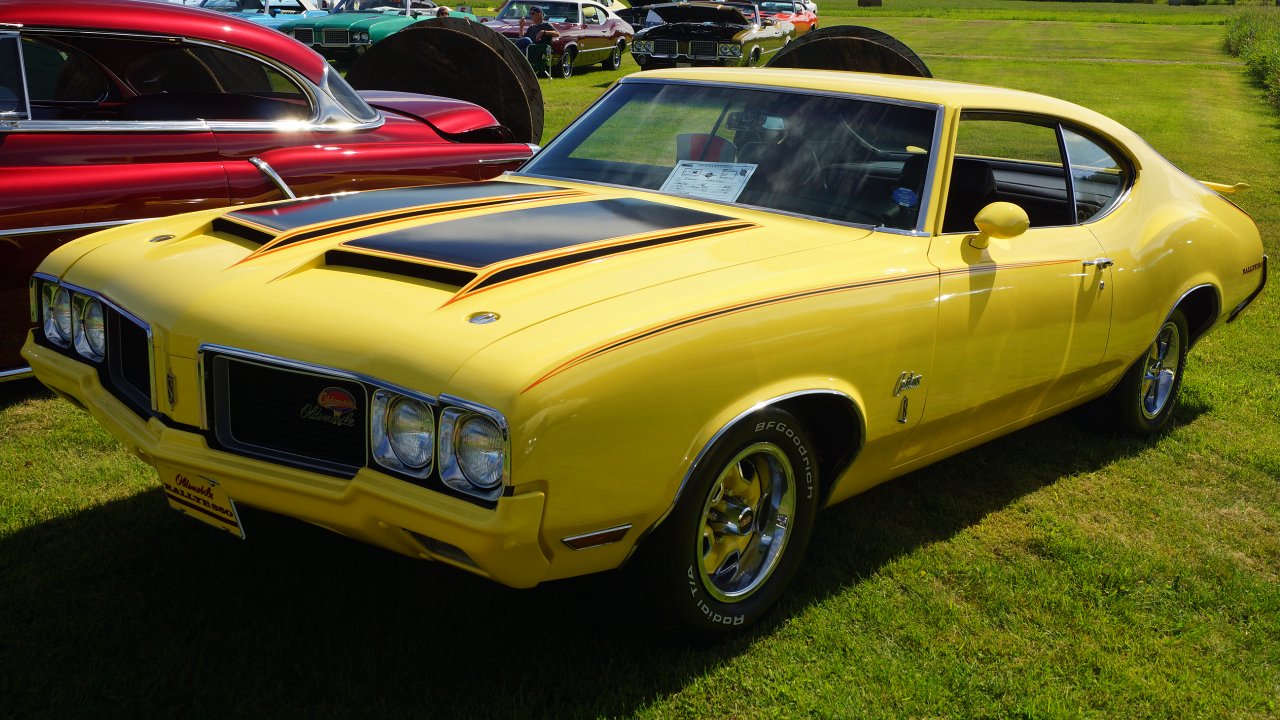
The 1970 Oldsmobile Rallye 350 arrived at the height of the muscle car wars with a message that cut against the chrome-heavy excess of its rivals. Instead of towering displacement and glittering brightwork, it leaned on a high-compression small block, a unified color package, and clever option bundling to prove that presence and performance did not require a big block or a mirror’s worth of shine. In doing so, it quietly challenged the idea that power had to be wrapped in chrome to be taken seriously on American streets.
Viewed today, the Rallye 350 looks less like an oddball and more like an early experiment in factory de‑chroming and branding, a car that used paint and engineering to make its point. I see it as a case study in how Oldsmobile tried to democratize muscle, using a Rocket 350 and a sea of Sebring Yellow to sell speed and style to buyers who could not stretch to a 442.
The small block that carried a big message
At the core of the Rallye 350 story is Oldsmobile’s decision to build its statement car around a 350 cubic inch small block instead of a larger, heavier big block. The company wanted to show that a muscle car did not need massive displacement to deliver satisfying performance, and that a carefully tuned small block could carry the same swagger without the weight penalty or insurance stigma. Reporting on the model notes that the main statement Oldsmobile was trying to make with the Rallye 350 was that a muscle car did not need a big block to be a muscle car, a point that framed the entire package around the 350 rather than the brand’s larger engines.
Under the hood, Olds started with the Rocket 350 block and gave it the provisions needed to feel like a serious performance engine rather than an entry-level compromise. Coverage of long‑term ownership of the car describes how Olds began with the Rocket foundation, then built out the powerplant so that the Rallye 350 felt like a complete performance package rather than a stripped version of a 442. That approach aligned with the broader claim that Olds Shows That No Big Block Is Needed, positioning the Rallye as proof that smart engineering and gearing could stand in for raw cubic inches while still delivering the kind of acceleration buyers expected from a bright yellow muscle car.
Sebring Yellow and the war on chrome
If the engine carried the message, the paint shouted it. The Rallye 350 Was Only Available In Sebring Yellow, a decision that turned the car into a rolling billboard for Oldsmobile’s experiment in color‑driven identity. Instead of relying on chrome to catch the eye, the company extended that Sebring Yellow across bumpers, wheels, and body accents, creating a monochrome look that was radical in an era when bright metal was still shorthand for prestige. The uniform color scheme made the car instantly recognizable and signaled that this was not just another Cutlass with a stripe kit.
Contemporary and retrospective coverage of the car’s styling often circles back to that paint decision, noting how the Rallye 350 package muted or replaced traditional brightwork with body‑color elements. Later commentary on specific examples, such as an Oldsmobile Rallye 350 F‑85 Club Coupe, highlights how deviations from the original formula, including chrome bumpers and trim rings, fundamentally change the car’s visual impact. Those details underscore how central the anti‑chrome stance was to the original design, and how the Sebring Yellow treatment functioned as both a styling statement and a rejection of the era’s chrome‑heavy norms.
Cutlass roots, Rallye identity
Beneath the paint and marketing, the Rallye 350 was still part of the Cutlass family, and that platform choice was deliberate. Oldsmobile’s decision to launch the Cutlass Rallye 350 at the height of the muscle car era was both a marketing gamble and a way to leverage a familiar, mid‑size chassis that buyers already trusted. By building the package on the Cutlass S and related F‑85 Club Coupe body styles, Oldsmobile could offer the look and feel of a specialty muscle car without the cost of developing a standalone model, while still giving the Rallye a distinct identity through its color, engine, and option mix.
Reporting on the car’s impact notes that Oldsmobile’s move turned the Cutlass Rallye into a kind of menace in the muscle market, not because it dominated drag strips, but because it blurred the line between everyday mid‑size and factory hot rod. The Rallye 350’s story is described as still being written in the classic muscle market, a reflection of how its Cutlass roots and unique package have aged differently from more conventional chrome‑laden models. That dual identity, part practical Cutlass and part extroverted Rallye, helps explain why the car remains both recognizable and slightly misunderstood decades later.
Living with a Rocket 350

The Rallye 350’s engineering choices were not just theoretical; they shaped how owners experienced the car over decades. Long‑term ownership accounts describe how, as enthusiasts know, it is the powerplant that puts the personality into a car, and how starting with the Rocket 350 block gave Olds a solid base for reliability and performance. Those stories emphasize that the Rallye 350 felt like a cohesive package from new, with the Rocket engine delivering the kind of torque and responsiveness that made the bright yellow paint feel earned rather than cosmetic.
One detailed profile of an owner who bought a new car the Rallye 350 as a teenager and kept it for 48 years illustrates how the small block concept held up in real life. The account notes that Olds started with the Rocket architecture and then tailored the setup so that the car covered most of your bases, from daily driving to occasional spirited runs. That lived experience reinforces Oldsmobile’s original thesis that a well‑built 350 could anchor a muscle car for the long haul, offering durability and character without the compromises that sometimes came with heavier big block options.
From showroom curiosity to collector talking point
In period, the Rallye 350’s combination of small block power and de‑chromed styling made it something of a curiosity, and Oldsmobile arguably missed cashing out fully on its potential. Analysis of the model’s market performance notes that something a muscle car needs to do to gain a following is to connect with buyers quickly, and the Rallye’s single‑color, small‑block formula may have been too far ahead of its time for shoppers who equated chrome and cubic inches with value. The fact that the car was only offered in Sebring Yellow further narrowed its appeal, even as that decision cemented its later recognition.
Decades later, the Rallye 350’s story is being reflected in collector values and renewed attention from enthusiasts who see it as a distinctive alternative to more conventional muscle cars. Coverage of specific survivors, including Oldsmobile Rallye 350 F‑85 Club Coupe examples that surface after long periods out of the spotlight, shows how the model has shifted from overlooked oddity to conversation piece at shows and auctions. Commentary on how the Rallye 350 turned Oldsmobile into a menace in the classic muscle market underscores that its impact is now measured less in production numbers and more in how its unusual blend of small block power and anti‑chrome styling stands out in a crowded field of restored 1970s performance cars.
How enthusiasts keep the Rallye 350’s legacy alive
The Rallye 350’s survival into the present owes as much to enthusiasts as it does to Oldsmobile’s original engineering. Video features that put viewers in the passenger seat of a 1970 Oldsmobile Olds Cutlass S W45 Rallye 350 capture how owners and hosts like Lou on My Car Story and guests such as Gary present the car today. In those segments, the focus often falls on how that Rallye 350 did pretty well on the road, with the Rocket 350 and chassis tuning still delivering a satisfying drive, and how the car’s Sebring Yellow presence continues to draw attention even among newer performance machinery.
These modern spotlights, combined with detailed written profiles and historical analyses, help frame the Rallye 350 as more than a footnote. They show how the car’s core ideas, from Olds Shows That No Big Block Is Needed to the decision to strip back chrome in favor of color, resonate with a generation of enthusiasts who value character and story as much as outright speed. By keeping examples on the road, sharing long‑term ownership tales, and revisiting the Cutlass Rallye’s place in the muscle hierarchy, owners and storytellers ensure that Oldsmobile’s experiment in small block power and painted bumpers continues to challenge assumptions about what a muscle car has to look like to be taken seriously.



Leave a Reply