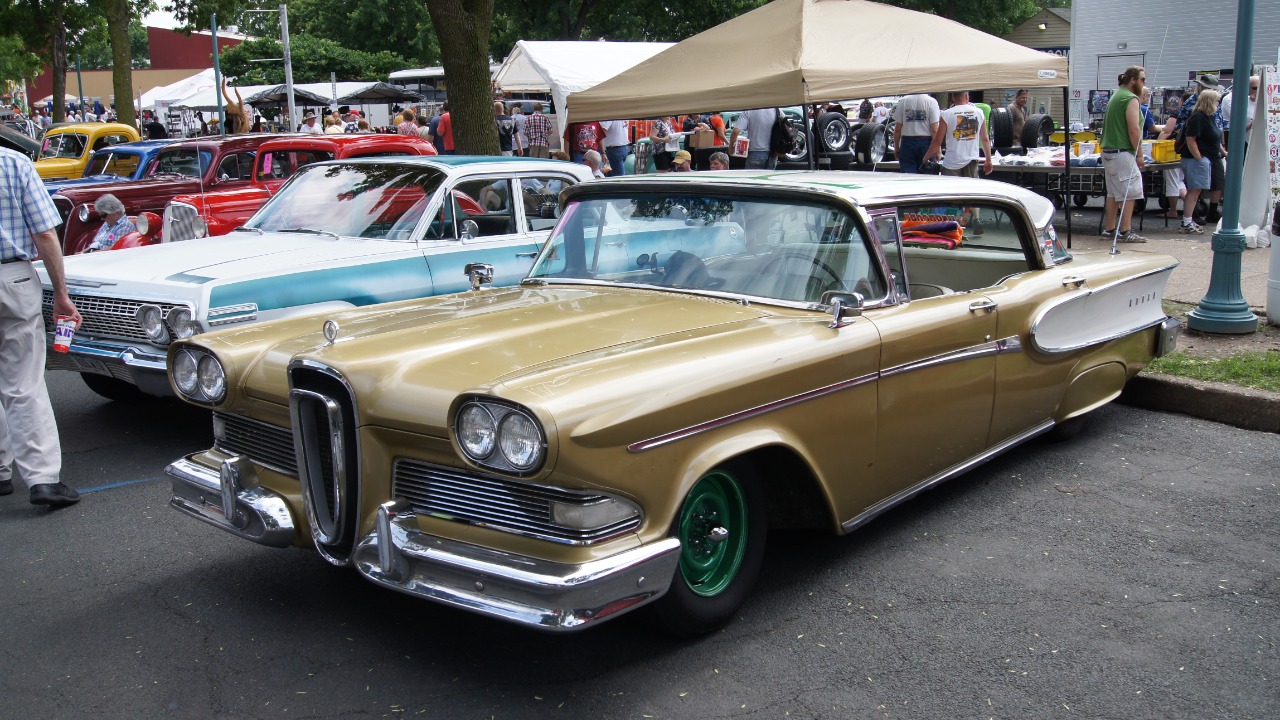
The 1958 Edsel Corsair arrived as a rolling promise that Detroit could invent an entirely new kind of American family car, with fresh styling, novel technology, and a brand built from scratch. Instead, it became shorthand for corporate overreach and misread ambition, a car that carried expectations it could never quite meet. Seen today, the Corsair tells a richer story: not just of failure, but of how big ideas collide with economic reality, marketing hype, and the limits of what buyers will accept.
Ford’s grand experiment in the medium-price market
The Ford Motor Company did not set out to build a punchline. The Ford Edsel was introduced by Ford Motor Company as a serious attempt to capture affluent, upwardly mobile buyers who were moving beyond basic transportation but did not yet want a full luxury badge. The Edsel division sat alongside Mercury and Lincoln, a separate brand with its own identity and showroom presence.
Corporate planners believed there was a wide gap between mass market Fords and higher priced cars, and they expected the Edsel line to fill that space with a mix of style and perceived prestige. Promotional films and period advertising, including an elaborate Ford Edsel launch travelogue, framed the car as the next big chapter in American motoring. The name itself honored Edsel Ford, the founder’s son, which added internal pressure for the project to succeed.
Where the Corsair fit in the Edsel family
Within that new brand, the Edsel Corsair occupied a mid upper tier position. The model line sat above more basic Edsels and just below the top Citation, giving buyers a sense of upgrade without reaching the absolute peak of the range. Period literature and enthusiast discussions identify the Edsel Corsair as part of Ford’s ambitious, short lived Edsel line, with the 1958 Edsel Corsair 4 Door Hardtop described as a memorable piece of American chrome history and Positioned as a mid upper level offering.
The Corsair shared its overall structure with the larger Citation. Sources on the Edsel Corsair note that, like the Citation, the Corsair used substantial underpinnings and a long wheelbase that placed it firmly in the big car category. Technical sheets for GENERAL SPECIFICATIONS list the MODEL wheelbase as 101 for one configuration and 124.05 for another, with Wheelbase and Additional Information laid out in formal charts that underscore how carefully Ford engineered the package in the run up to launch. Those figures, 101 and 124.05, capture the physical scale of a car that was meant to look and feel more substantial than a standard Ford sedan.
Styling that demanded attention
Designers gave the Corsair a look that could not be mistaken for anything else on the road. The front carried the infamous vertical grille opening, framed by quad headlights and heavy chrome, a face that enthusiasts either celebrate or criticize to this day. A 1958 Edsel Corsair Convertible is described as a distinctive American classic produced by Ford’s Edsel division, with a prominent grille, quad headlights, and dramatic side sculpting that help explain why the car still stands out in photographs and American car shows.
Body styles for the upmarket Edsels reflected that focus on presence. The Citation was offered in two door and four door hardtop and two door convertible versions, while the Corsair was available in two door and four door hardtop forms, a lineup that mirrored successful mid priced competitors but wrapped them in far more adventurous sheet metal. Enthusiast commentary often singles out the Corsair hardtop roofline and side sculpting as some of the most interesting work to come out of Detroit in that period.
Under the skin, big power and new ideas
The 1958 Edsel Corsair was not just about styling. Under the hood it carried a large displacement V8 and automatic transmission aimed at buyers who wanted effortless highway speed. Reference data on the 1958 Edsel Corsair notes that the car used a powerful engine with strong torque, and that this big block approach put it in direct competition with other medium price offerings of the era. One detailed specification sheet for the Edsel Corsair lists engine output in both horsepower and torque, and records the torque as 65.7 kgm at 2900 rpm, a figure that translates to brisk performance for a family sedan.
Beyond raw power, the car introduced features that Ford hoped would signal innovation. The Edsel line offered a push button transmission selector in the steering wheel hub, a Rolling Dome speedometer, and extensive use of power accessories. Contemporary retrospectives on the top 5 reasons why the Edsel failed acknowledge that Edsels were equipped with powerful engines, an advanced braking system and the Rolling Dome speedometer, and that these features were meant to justify the car’s place as an aspirational step up for buyers who already owned a Ford or Mercury.
The marketing build up and the weight of expectation
Ford did not quietly slip the Edsel into showrooms. The company poured money into promotion, building anticipation for a mysterious new car that promised to reshape the American driving experience. One period film about the launch shows Detroit in full promotional mode, with narration that describes how in 1958 Detroit exploded with ambition to reshape the history of the American automobile and how Ford proudly introduced a brand new division, language that captures the optimism around the Aug Detroit American project.
That build up created expectations that any production car would struggle to meet. Buyers who arrived at dealerships after months of teasing found a car that was different, but not necessarily better than alternatives. The Edsel name itself was unfamiliar, and despite the association with Edsel Ford, the badge had no track record. The company positioned the car as a premium step up, yet its mechanical parts and assembly practices were closely tied to existing Ford and Mercury lines, a reality that would soon undercut the marketing message.
Why the Edsel program floundered so quickly
Analysts have spent decades dissecting why the Edsel brand, and by extension the Corsair, failed so fast. A widely cited list of reasons points first to bad timing. Economic recession gripped the United States just as the car arrived, which meant potential buyers were less willing to experiment with an unproven nameplate. That same analysis notes that Edsels were built in existing Ford and Mercury plants, which led to mixed production and parts that did not always fit correctly, a quality problem that clashed with the promise of a premium experience and contributed to what many now describe as Bad Economic misfortune.
Other retrospectives focus on how the company misread the market. A detailed breakdown of the program’s collapse describes a section titled The Vision Behind the Edsel, followed by Market Misreading, The Design Dilemma, Pricing Problems, Poor Timing, and Quality concerns, which together paint a picture of a car launched without a clear audience. The same resource explains that the Edsel arrived without a well defined niche, that pricing overlapped existing Ford and Mercury products, and that the styling and name confused shoppers who might otherwise have considered a new brand.
The Corsair as a case study in misjudged innovation
The Corsair sits at the heart of that story. Positioned as a mid upper tier car, it embodied the Edsel approach to styling, pricing, and technology. Commentators who ask Why Edsel failed often point out that, despite the hype, the car’s design and features were not as revolutionary as promised. One enthusiast discussion framed the issue bluntly by asking Why did the Edsel fail, then answering that Automotive writers and academics have long pointed to unremarkable design and features, despite the polarizing grille, and to a marketing campaign that made the car a cautionary tale in automotive history.
The brand’s identity was also muddled. A short video summary of Edsel history explains that the Edsel division of Ford was created in 1956 as a division like Mercury and Lincoln, not a mere model line. That same clip notes that the Edsel was intended to slot between Ford and Mercury, but that the overlap in price and equipment made the distinction hard to grasp, a problem that undercut the Corsair’s appeal as a clear step up from a standard Ford sedan. The video’s reference to Feb, Edsel, Mercury, and Lincoln highlights how tightly the project was woven into Ford’s broader corporate structure.
Driving impressions and ownership reality
On paper, the Corsair delivered what buyers in the medium price segment expected: a large, comfortable cabin, strong acceleration, and generous chrome. Period specification sheets for the 1958 Edsel Corsair show a car with a substantial curb weight and a V8 that provided relaxed cruising at highway speeds. A separate data source on the Edsel Corsair notes that this car had a 4 barrel carburetor and torque of 65.7 kgm at 2900 rpm, figures that align with contemporary expectations for a big American family car.
In practice, however, owners encountered problems that chipped away at satisfaction. Analyses of why the Ford Edsel failed describe quality issues such as misaligned body panels, inconsistent trim fit, and early mechanical glitches in features like the push button transmission control. One breakdown of the failure lists Quality as a separate section, explaining how rushed development and the use of mixed production lines led to defects that gave the car an undeserved reputation for unreliability. These issues hit models like the Corsair particularly hard because they were marketed as a step above basic transportation.
Public reaction and the birth of an industry legend
Public reaction to the Edsel program shifted quickly from curiosity to skepticism. A social media post about the top 5 reasons why the Edsel failed describes the brand’s collapse as one of the most infamous failures in industry history, and notes that the reasons went far beyond its polarizing appearance. That same summary highlights Bad Timing The economic downturn, pricing that overlapped other Ford products, and confusing styling and naming as key factors that turned The Edsel into a symbol of corporate miscalculation.
Another analysis characterizes the project as a perfect storm of mistakes and refers to the saga as Fatal Mistakes That Turned Edsel Into Ford’s Worst Bet. That piece points to confusing styling and naming, along with the decision to build Edsels in existing plants, as choices that turned what was meant to be a bold new brand into Detroit’s most expensive flop. The Corsair, as one of the line’s more visible models, became a central part of that narrative.
How the Corsair is remembered today
Time has softened some of the harshest judgments. Enthusiasts now seek out surviving Corsairs, especially the 4 Door Hardtop and convertible variants, as rare artifacts of a bold experiment. A modern appreciation of the 1958 Edsel Corsair 4 Door Hardtop describes it as a short lived but memorable piece of American automotive history and notes that it was launched as part of Ford’s ambitious Edsel line. The same commentary emphasizes how the car’s styling, from its chrome to its roofline, captures the optimism of late 1950s design.
More from Fast Lane Only