By the mid 1960s, American performance cars were at a crossroads, pulled between raw power and the need for more sophisticated engineering. The 1965 Corvette arrived right at that tension point, combining big-block muscle, sharper handling and meaningful safety upgrades in a way that made it feel like a reset for the American sports car. Six decades later, a well kept 1965 Corvette still drives like the moment when Detroit stopped chasing Europe and started competing with it on its own terms.
The moment Corvette grew up
By 1965, Corvette had already spent years refining its design and performance, and the cumulative work showed. Contemporary descriptions of the 1965 Chevrolet Corvette Convertible describe it as a major turning point for Corvette after a long run of incremental improvements that began early in the second generation. The car that emerged was a cleaner, more mature expression of the American sports car idea, with a focus on stopping and cornering as much as straight line speed. That mix is a key reason the 1965 Chevrolet Corvette Convertible is still regarded as a classic in automotive history, a status reflected in how carefully institutions such as the National Corvette Museum present the model.
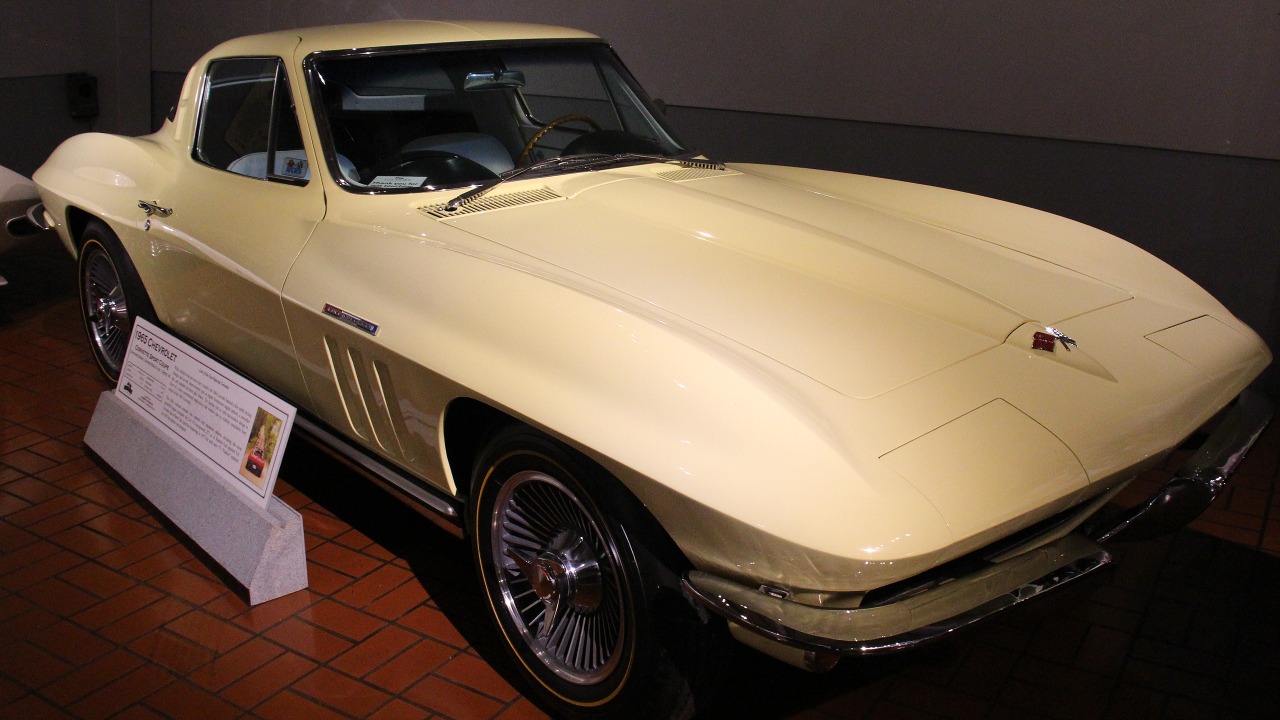
On the outside, the car looked familiar, but the details told a different story. The 1965 Sting Ray adopted a smooth hood without the earlier depressions and distractions, a subtle change that made the front end look more purposeful and better suited to the serious hardware underneath. The grille bars were finished in black, and the instrument faces inside were given a flat black treatment that reduced glare and made the cabin feel more like a focused cockpit than a chrome laden cruiser. These small decisions signaled that Corvette styling was now working in service of performance rather than simply ornamenting it.
Four wheel discs and an American first
The most important change arrived where most drivers never see it: behind the wheels. In 1965, Corvette became the first American production car to make four wheel disc brakes standard equipment. At a time when many domestic cars still relied on drum brakes that faded under repeated hard stops, fitting discs at all four corners moved Corvette into the same conversation as advanced European sports cars. Chevrolet’s decision to standardize this technology, rather than hide it on a short option list, showed a new confidence that buyers valued control and repeatable braking as much as horsepower.
That braking upgrade did more than shorten stopping distances. It changed how the car could be driven. With discs that resisted fade, a driver could carry more speed into a corner, rely on consistent pedal feel and recover quickly for the next bend. On a fast back road or a road course, the 1965 car simply felt more modern than its predecessors, and that sensation remains obvious to anyone who drives a well maintained example today. The move also nudged other American manufacturers toward similar upgrades, proving that there was a market for performance hardware that went beyond engine size.
Sting Ray style and the mid year identity
The 1965 Corvette Stingray, often referred to as the Corvette Sting Ray in period material, has since become an automotive icon for its mix of sleek design and performance. Enthusiasts highlight how the 1965 Corvette Sting Ray was a true American sports car, with a low, aerodynamic profile, hidden headlamps and sharply defined fenders that framed the car’s stance. That shape, especially in convertible form, captured a mid century optimism that still reads clearly in photographs and at car shows.
Fans of the so called MidYear Corvette era often point to 1965 as the sweet spot. The split window drama of 1963 had been resolved, the chassis was sorted, and the car carried the distinctive side vents and muscular haunches that defined the second generation. Period descriptions of the 1965 Corvette Stingray emphasize how its numerous features and qualities, from the fiberglass bodywork to the independent rear suspension, created a package that felt cohesive rather than experimental. The car was no longer trying to prove that an American company could build a sports car. It simply was one.
Inside the 1965 Corvette experience
Step into a 1965 Corvette and the sense of transition is just as strong. The flat black instrument faces place the large tachometer and speedometer directly in front of the driver, flanked by auxiliary gauges that communicate oil pressure, water temperature and fuel level with a clarity more often associated with European machinery of the time. The three spoke steering wheel, thin by modern standards, gives a direct sense of what the front tires are doing, aided by the car’s relatively compact dimensions.
Optional side mounted exhausts, available in 1965, added both drama and function. They freed space under the car, improved ground clearance and provided a soundtrack that matched the car’s performance intent. The fiberglass body, a Corvette hallmark since the beginning, kept weight in check and allowed Chevrolet to sculpt aggressive fender lines without the stamping limitations that constrained many steel bodied rivals. A closer look at period specification sheets shows how purposeful these changes were, right down to details such as the black grille bars and revised interior finishes that made the car feel more serious behind the wheel.
Big block power and American excess
If the chassis and brakes signaled maturity, the engine options reminded everyone that this was still a product of American car culture. For the first time, Chevrolet offered a big block V8 in Corvette: the 396 cubic inch engine rated at 425 horsepower. Cars fitted with the 396/425 combination quickly became legends in their own right, and scarcity only amplified the effect. Out of 15,226 1965 Corvettes that were convertibles, only 1,409 left the factory with the 396/425 configuration, a figure that collectors still cite when explaining the appeal of these cars.
The presence of that big block did more than add straight line speed. It tested the rest of the package. The new four wheel disc brakes, the independent suspension and the revised steering all had to cope with a surge of torque that earlier small block cars did not deliver. That the 1965 chassis handled the challenge is part of why many enthusiasts describe this model year as the point where Corvette engineering caught up to its ambition. The car could finally put its power to the ground with control, rather than simply lighting the rear tires and hoping the brakes would hold at the next intersection.
Why 1965 still feels modern on the road
Driving a sorted 1965 Corvette today, the age shows in the best possible ways. The steering is heavier at parking speeds than that of a modern sports car, yet it lightens predictably once under way and communicates surface changes through the wheel. The independent rear suspension, paired with those four wheel discs, gives the car a planted feel that surprises drivers who expect 1960s American cars to wallow. Contemporary commentary on the 1965 Chevrolet Corvette StingRay highlights that its handling was excellent for its era, and that judgment still holds on present day roads.
Compared with later generations that grew larger and more insulated, the 1965 car feels intimate. The cowl is low, the view over the hood is clear, and the fender peaks help place the car in a lane. There is wind noise in the convertible at highway speeds, and the ride can be busy on broken pavement, yet those traits contribute to the sense of connection. The car asks the driver to participate, to manage weight transfer with the throttle and to time braking inputs with some care. That involvement is part of why many drivers say a mid 1960s Corvette feels more alive than some faster, more refined modern machines.
The 1965 Corvette in American culture
Beyond the mechanical details, the 1965 Corvette carries symbolic weight. Enthusiast writers often describe The Corvette as being as American as apple pie, and the 1965 Chevy Corvette in particular is singled out as an iconic example of what American Cars could be in the muscle era. Offered through venues such as Vicari auctions, well preserved cars from this model year still attract attention not only for their condition but for what they represent: a blend of style, speed and national identity that resonated with buyers in the 1960s and continues to resonate with collectors and casual fans.
That cultural role is reinforced by how often the 1965 car appears in media, from classic television reruns to contemporary social feeds that celebrate vintage performance. The combination of a fiberglass body, a rumbling V8 and a recognizable silhouette has made the car a shorthand for American freedom and mechanical excess. Yet the 1965 model tempers that excess with engineering choices that align more closely with international sports car norms, which makes it easier for modern drivers to appreciate on more than nostalgic grounds.
How institutions curate the 1965 story
Institutions dedicated to preserving Corvette history have leaned heavily on 1965 as a teaching tool. The National Corvette Museum, for instance, highlights how by 1965 Corvette had reached a major turning point after years of refining its design and performance, and how Chevrolet used four wheel disc brakes to give the car remarkable stopping power and control. Exhibits and sweepstakes centered on a 1965 Chevrolet Corvette Convertible tend to emphasize this balance of innovation and tradition, presenting the car as both a desirable object and a case study in American automotive progress.
Social media posts from the same circles often repeat key points: that by 1965, Corvette had matured into a serious sports car, that after a long development path Chevrolet finally aligned braking, handling and power, and that this combination helped the car stand out among American offerings. Visual material shared on platforms such as Instagram underlines the styling changes, while captions focus on the engineering firsts. Together, this curated narrative has shaped how new generations encounter the 1965 Corvette, even if they have never seen one in person.
Enthusiast communities and living history
Outside museums, enthusiast communities keep the 1965 story current. Groups that center on Chevrolet Corvette Stingray Styling and the broader Sting Ray era trade details about correct finishes, option codes and restoration techniques. They share period photos, discuss how the smooth hood and blacked out trim distinguish 1965 from earlier years, and debate the merits of small block versus big block cars on modern roads. These conversations, often hosted in online groups and club meets, function as a kind of distributed archive that preserves knowledge which might otherwise fade.
Specialist publications and clubs, including those that publish deep dives into Uncovering the Corvette History for specific years, compile factory specifications, production changes and anecdotal reports from original owners. Coverage of the 1965 Corvette in such venues often stresses how the grille bars turned black, how the instrument faces adopted a flat black finish and how optional side mounted exhausts changed both appearance and sound. By repeating these details, enthusiasts reinforce the idea that 1965 is not simply another model year but a benchmark that helps explain later developments.
More from Fast Lane Only