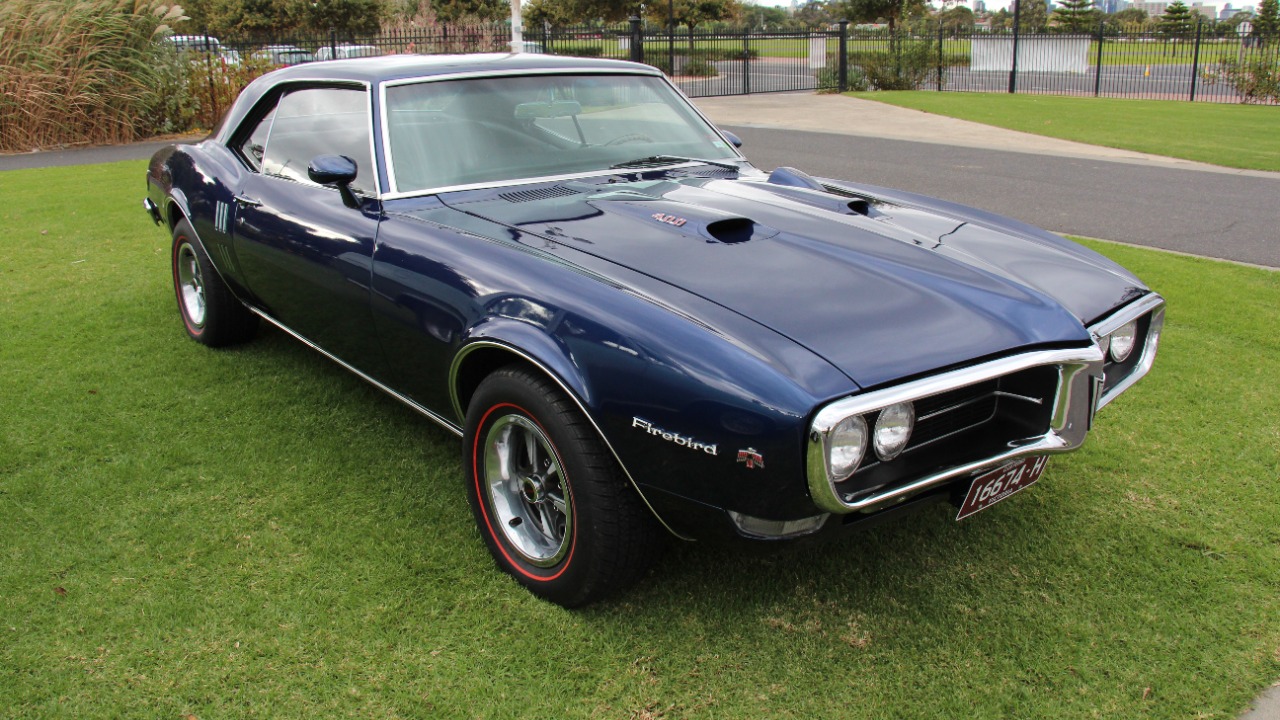
The 1968 Ram Air II Firebird arrived quietly in the middle of the model year, yet it pushed Pontiac performance well beyond what most buyers and even many engineers were prepared to expect. Built in tiny numbers and wrapped in relatively subtle styling, it turned the first-generation Firebird into a serious factory drag weapon that still surprises people who assume the big stories only start with Ram Air IV.
Today, the Ram Air II Firebird sits at the intersection of rarity, engineering ambition, and muscle car mythology, a car that took the already potent 400 platform and reworked it into something far more focused. To understand why it matters, it helps to see how it grew out of the broader 1968 Pontiac Firebird lineup, how its hardware differed, and why its legend keeps growing in the pits and at auction.
The 1968 Pontiac Firebird baseline
The standard 1968 Pontiac Firebird was already a strong entry in the pony car class. Fact sheets for the year highlight that the base V8 grew to 350 CID, with the two-barrel version rated at 265 horsepower. That move alone signaled Pontiac’s intent to keep the Firebird competitive from the bottom of the range upward.
Above the 350, Pontiac offered a series of 400 cubic inch engines that turned the car into a full-fledged muscle machine. Period coverage of the Pontiac Firebird Image notes a new 400 HO engine, and that option, with its more aggressive camshaft and freer flowing exhaust, was rated at 335 horsepower. Buyers could already step into serious performance without touching the later Ram Air packages.
Beyond engines, the Firebird’s chassis and equipment were evolving. The model year brought changes to ventilation that removed the old vent windows and added side marker lamps, while the F-body platform shared with Chevrolet’s Camaro gained detail improvements to ride and handling. Against that backdrop, the Ram Air II was not a simple option but a midyear escalation.
From Ram Air I to a quiet revolution
When enthusiasts talk about Pontiac performance, Ram Air IV tends to dominate the conversation. Multiple accounts of the period point out that Most people know about the famous Ram Air IV engines from 1969 and 1970. But Pontiac did not wait for 1969 to sharpen the Firebird.
Earlier in 1968, the company had already launched the first Ram Air package, essentially a hotter 400 with functional cold air induction. That engine was stout, but Pontiac engineers were still refining the formula for serious drag racing customers. In the middle of the year, they quietly released the Ram Air II, an engine that looked similar on paper but was far more specialized in its internals.
Social posts from Pontiac circles emphasize that this midyear move was not heavily promoted at the time. The option appeared on order sheets for buyers who knew to ask, especially those following Super Stock and Stock Automatic classes. That low-key rollout helps explain why the Ram Air II remained obscure compared with the later Ram Air IV despite its advanced hardware.
Inside the Ram Air II engine
At the heart of the package sat a 400 cubic inch V8 with a very different personality from the standard 400 HO. Technical breakdowns list the Ram Air II Engine as an OHV V-8 with cast iron block and heads, and they specify a Displacement of 400-cu in. Factory ratings pegged Horsepower at 340 at 5,300 rpm, figures that many Pontiac specialists now believe were conservative.
The key distinction lay in the cylinder heads. Ram Air II introduced round-port castings that would later become famous on Ram Air IV. These heads improved high-rpm breathing, especially when paired with the aggressive camshaft timing and high compression ratios that Pontiac selected for the package. Combined with a free-flowing exhaust and functional hood scoops, the engine was designed to thrive in the upper rev range where drag racers spent their time.
Contemporary comparisons to other muscle cars help frame the output. A 1968 Buick Skylark Grand Sport Tribute, for instance, featured a big V8 fed by a four-barrel carburetor rated at 340 horsepower and 400 lb/ft of torque. Pontiac’s Ram Air II shared that 340 rating on paper, but thanks to the round-port heads and more competition-focused internals, it often behaved like a much stronger engine at the track.
Chassis, suspension, and subtle upgrades
The 1968 Firebird did not rely solely on power. Chassis updates for the year gave the car a more controlled feel, and these improvements were especially important once the Ram Air II arrived. Coverage of the Firebird’s evolution notes that the 68 m models were updated with multi-leaf rear springs, replacing the 1967 mono-leaf design. That change reduced axle wrap and improved traction under hard acceleration.
Specialists in classic suspension catalog the Firebird’s springs and hardware in detail, with references to the way Pontiac tuned rates for different engine and option combinations. The move to multi-leaf rear springs aligned with Pontiac’s broader effort to make high-output cars more manageable on real roads and at the drag strip.
Ventilation and lighting changes also played a supporting role. The 1968 model gained a new ventilation system that did away with vent windows and added side marker lamps, subtle updates that modernized the car’s appearance and functionality. For Ram Air II buyers, these were quiet benefits wrapped around a very loud mechanical statement.
Built for the strip, disguised for the street
Although the Ram Air II was engineered as a competition piece, Pontiac did not shout about its intentions with wild graphics. Auction descriptions of surviving cars describe a relatively understated exterior with a scooped hood, small “400” engine callouts, and, optionally, a hood tachometer. One such listing notes that looking beyond the scooped hood and “400” callouts reveals a cloaked purpose-built for drag racing.
That dual identity was deliberate. Pontiac wanted a car that could run in Stock classes, which required factory appearance and equipment, while still allowing owners to drive to work or cruise on weekends. The company had already positioned the Firebird as a slightly more upscale alternative to some rivals, an approach that period commentary from enthusiasts and American OES brand watchers often highlight. The Ram Air II slotted into that strategy as a sleeper with serious intent.
Marketing material and later social media posts from Pontiac-focused groups add that the engine was developed to meet demand for maximum performance and to give Pontiac a competitive entry in drag racing competition, particularly in the Stock Automatic Class in 1968. That context explains the careful balance between subtle styling and aggressive mechanics.
How rare is rare?
Rarity is central to the Ram Air II story. A widely shared auction preview from Apr for a 1968 Pontiac Firebird Ram Air II notes that in total there were 110 examples produced, and that the car in question was a first of its kind. The post emphasizes how even these can command six-figure prices today, underscoring how limited production has fueled collector interest.
That figure of 110 cars, combined with the midyear timing and the focus on drag racing customers, means that many enthusiasts went years without seeing a Ram Air II Firebird in person. Some only learned of the option through race coverage or through Pontiac’s parts books when they hunted for specific round-port components.
Modern restoration shops and specialists now treat the Ram Air II hardware as blue-chip material. Cylinder heads, exhaust manifolds and unique internal parts are carefully documented, and cars with verified factory provenance attract intense scrutiny when they appear for sale. The low production run also explains why the option remains less famous in the wider car culture despite its significance among Pontiac fans.
Performance where it counts
The Ram Air II’s reputation ultimately rests on what it did at the strip. Enthusiast accounts describe period-correct cars running deep into the 12-second range in quarter-mile competition, with some modern recreations and well-tuned examples going quicker. One social post about a 1968 Firebird mentions the car running 9.99 seconds at 136.80 mph, although that example is clearly far from stock and reflects the platform’s potential when heavily modified.
More representative are Stock and Super Stock cars that stayed close to factory specifications. A widely shared story about a 1968 Pontiac Firebird 400 Ram Air II cites times of 12.87 seconds at 109.48 mph, numbers that align with the idea of an underrated 340-horsepower engine working through optimal gearing and traction. Those figures placed the Firebird squarely among the quickest showroom-based machines of its day.
Video comparisons from drag strips continue to showcase the car’s strength. A clip titled “1968 Firebird Ram Air II vs 1969 Dart GTS 340” captures a head-to-head run between the Pontiac and a small-block Mopar. With the New Year approaching, the narrator jokes about resolving not to get any more mega reactions from these cars, then proceeds to get exactly that as the pair streaks down the track. The footage reinforces how competitive the Ram Air II remained against well-regarded rivals.
Engineering intent and racing validation
The Ram Air II did not appear in a vacuum. Pontiac’s broader performance program in the late 1960s involved a coordinated push across engines, suspensions, and racing support. Commentators on American OES brands recall that Pontiac’s Firebird was intended to be a little bit more upscale to compete with other pony cars, yet the engineering team was equally focused on delivering results in sanctioned competition.
Social posts from Jun highlight that the Ram Air II Firebird was developed to meet the demand for maximum performance and to give Pontiac a competitive entry in drag racing competition. The same discussions reference its impact in the Stock Automatic Class in 1968, where factory-backed and independent racers used the package to chase class wins and records.
Those racing efforts validated the hardware. When cars with documented Ram Air II equipment consistently ran at the front of their classes, it confirmed that the round-port heads, camshaft profiles, and breathing improvements were more than marketing. That track record also laid the groundwork for the Ram Air IV program that followed, which borrowed heavily from the Ram Air II architecture while adding further refinements.
Color, trim, and the sleeper aesthetic
Part of the Ram Air II Firebird’s charm lies in how ordinary it could look. Paint code references tied to the Pontiac Firebird Fact Sheet from Over Drive Magazine list colors such as Starlight Black, Cameo Ivory, and Alpine Blue for 1968 Firebirds. Many Ram Air II cars were ordered in these standard hues with minimal striping, so only the hood scoops and small emblems hinted at what was lurking under the surface.
Interior choices followed the broader Firebird catalog, with bucket seats, console options, and available gauges. Some buyers opted for the hood-mounted tachometer that became a Pontiac signature, while others kept the dash layout clean. The result was a car that could pass for a well-appointed cruiser until it launched off the line.
More from Fast Lane Only