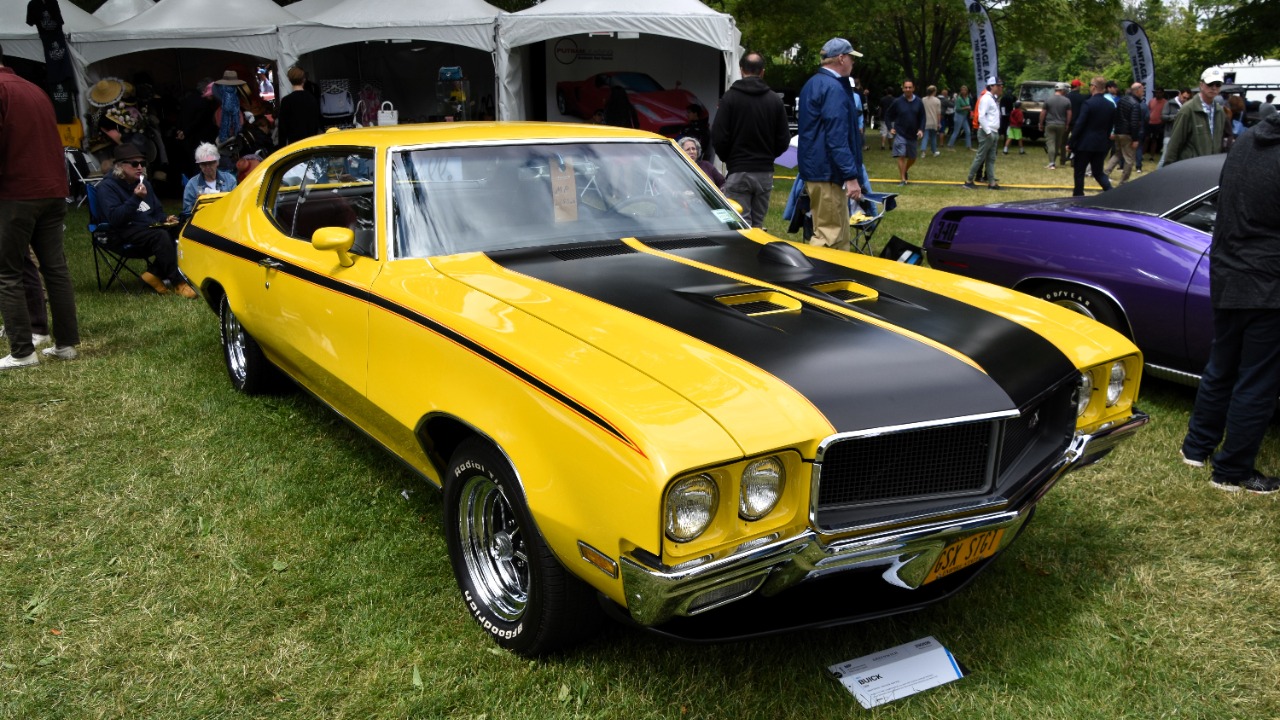
The 1970 Buick GSX Stage 1 never shouted about its strength, yet its torque figures stunned anyone who pushed the loud pedal. In an era obsessed with peak horsepower and wild graphics, Buick quietly built a luxury coupe that could twist the crank harder than almost anything on the road. The result was a so-called gentleman’s car that, once its 510 lb-ft rating surfaced, forced rivals and drivers alike to rethink what a muscle car could be.
The quiet arrival of a torque king
When Buick slid the GSX Stage 1 into showrooms at the start of the 1970 model year, the brand was not known for street brawlers. The company’s reputation leaned toward comfort, muted styling, and mature buyers. Under the surface of the new Gran Sport line, however, engineers had been preparing something very different. The GSX package sat on the Buick Skylark platform and was positioned as the top-performance variant, with the GSX name literally standing for Gran Sport eXperimental, a label that signaled a more aggressive direction for the Buick Skylark.
From the outset, the car’s mission was torque. Buick’s big-block program focused on huge displacement and a long stroke, not just headline horsepower. The Stage 1 version of the 455 cubic inch V8 was tuned for brutal low-end pull that arrived early in the rev range and held on through the midband. Period coverage and later analysis describe the GSX Stage 1 as a “torque bully” engineered to hit its massive twist figure sooner than most rivals and to maintain that shove where street drivers actually lived in the tach.
How Buick built 510 lb-ft without the fanfare
The core of the GSX legend is the Stage 1 455. Several sources point to a factory torque rating of 510 lb-ft, a number that placed the car in rare air among production machines of its time. One detailed technical account of the Buick GSX Stage highlights how engineers used high-flow cylinder heads, a specific cam profile, and careful carburetor calibration to unlock that figure while keeping drivability intact.
The Stage 1 package did more than bump compression and cam timing. Reports on the 1970 Buick GS 455 describe the Stage 1 V8 as rated at 360 HP, with the same displacement of 455 cubic inches, and stress that the official horsepower number was likely conservative. The phrase “Breaks Free From GM” appears in that context, suggesting that the division’s internal horsepower caps did not tell the whole story of what the engine could do. The same coverage lists the engine as a 455ci Stage 1 V-8 with 360 HP, a combination that, when paired with 510 lb-ft of torque, created a car that felt far more muscular than its brochure figures implied.
Buick’s strategy was deliberate. Corporate policy and insurance pressures pushed manufacturers to keep claimed horsepower in check. Torque figures drew less regulatory and underwriting attention, so Buick could quietly deliver a monster without provoking the same scrutiny that surrounded some rival big-blocks. Dyno sheets that circulated among enthusiasts later suggested that the GSX Stage 1’s output was higher than the official line, which only deepened the car’s mystique.
A sleeper in a gentleman’s suit
Styling played a key role in how the GSX Stage 1 slipped under the radar. One detailed retrospective describes the car as a “Sleeper in a Gentleman Suit,” a phrase that captures its strange dual identity. The GSX carried stripes, spoilers, and a hood tach, yet the underlying design still reflected Buick’s preference for smooth lines and upscale trim. The most shocking aspect, as that account of the Sleeper Gentleman Suit puts it, was its persona: a car that did not need to shout to prove its point.
Other design-focused descriptions of the GSX emphasize how the package balanced aggression with Buick refinement. Overviews of the car’s Design and Appearance note key visual features such as huge black side stripes, a bold front air dam, and a rear spoiler that made the GSX look ready for the track. Inside, the cabin leaned heavily into comfort, with plush seating and a level of quiet that contrasted sharply with bare-bones rivals. That mix of race-inspired exterior cues and near-luxury interiors reinforced the notion that this was a gentleman’s muscle car, not a stripped-out street racer.
Specifications that did not match the stereotype
On paper, the 1970 Buick GSX did not look like an obvious drag-strip terror. A detailed profile of the car lists its Specifications with a Weight of 4,000 lbs, a Number built of 687, and a Base price of $4,880. The same source identifies the Top Available Engine with a Displacement of 455 cubic inches, confirming that the biggest motor was central to the GSX identity. Those figures paint a picture of a relatively heavy, fairly expensive mid-size coupe that sat at the upper end of the muscle market.
Yet the numbers also hint at why the GSX Stage 1 felt so different. A 4,000-pound car with 510 lb-ft of torque behaves in a way that spec sheets alone cannot convey. Contemporary and modern accounts agree that the GSX could launch hard enough to embarrass lighter competitors, especially on the street, where traction and mid-range pull matter more than peak horsepower. The production total of 687 further explains why the car remained a rare sight, and why it slipped out of mainstream memory even as its technical achievements grew more appreciated among specialists.
Stage 1: the hidden upgrade that changed everything
Within the GSX lineup, the Stage 1 package is where the legend truly resides. Several enthusiast breakdowns of the 1970 Buick GSX 455 Stage 1 describe how the more powerful Stage 1 version produced the same torque rating as the standard 455, yet carried a higher advertised horsepower figure. One summary of a Stage 1 car notes that the upgrade added 10 more horsepower on paper in 1970, even though the real-world difference felt larger thanks to the tuning changes.
Technical write-ups on the GS 455 emphasize that the Stage 1 package included revised cylinder heads, a hotter camshaft, and specific carburetion that collectively sharpened throttle response and broadened the torque curve. References to the Stage 1 engine as a 455ci V-8 with 360 HP and abundant torque support the idea that Buick intentionally kept the official horsepower modest while letting the car’s performance speak for itself. The Stage 1 badge itself became shorthand for hidden strength, a quiet code among those who knew that this particular Buick could run with the fiercest big-blocks.
Drivetrain and the 455 that shocked rivals
Powertrain descriptions of the GSX highlight just how serious the hardware was. One enthusiast post on the Buick GSX calls out the 455 as the heart of the car and emphasizes that the engine delivered enough torque, quoted at 510 lb-ft, to stand its ground with any other muscle machine of the era. The same overview notes that buyers could pair the big-block with a manual gearbox or an optional 3-speed automatic, giving the GSX the flexibility to serve as either a drag-strip toy or a high-speed cruiser.
Other performance-focused accounts describe the GSX as a “torque king” and stress that the defining characteristic of the Stage 1 package was not its peak horsepower but its ability to deliver massive thrust early in the rev range. Analyses of the car’s quarter-mile capability suggest that this low-end strength allowed it to run with or beat more highly publicized rivals, including some Chevrolet and Pontiac flagships, especially in real-world conditions rather than perfect test-track scenarios.
Luxury, Spartan rivals, and the Buick identity
Part of what made the GSX Stage 1 so misunderstood was its position within Buick’s broader lineup. Video commentary on the 1970 Buick GSX 455 and 455 Stage 1 often contrasts the car with both luxurious and Spartan lower-end models from other brands. One such piece explicitly mentions how the channel had previously covered several luxurious cars as well as Spartan lower-end cars, then turns to the GSX as an example of a machine that tried to bridge those worlds. The GSX offered near-luxury comfort and finish, yet its performance numbers placed it firmly among the hardcore muscle cars.
That tension is also visible in descriptions of the Skylark GS line. A museum profile of the 1971 GSX Stage 1 coupe explains that the Skylark GS Line of mid-sized Buick coupes was upgraded with large displacement powerplants to create the GSX model cars, a move that effectively grafted drag-strip capability onto a platform originally designed for family duty. The result was a car that could be driven to work in quiet comfort, then taken to the strip on the weekend to surprise drivers of more overtly aggressive machines.
Rarity, reputation, and the GSX Historical Society
The combination of low production and understated marketing helped turn the GSX into a cult object. A social media post about a specific car notes that the 1970 Buick GSX is one of the most powerful and rarest muscle cars of the golden era, and mentions that the GSX Historical Society recognizes one example as number 2 in its registry. The same post emphasizes that the Buick GSX blended brute force with the brand’s signature refinement, a pairing that did not always resonate with buyers who equated muscle with stripped interiors and loud exhausts.
Another enthusiast reel frames the GSX in historical terms and states that it held the highest production car torque for 30 years with 510 lb-ft in 1970. That claim, attached to the 510 figure, underscores just how far ahead of its time the GSX Stage 1 was in terms of twist. For three decades, according to that account, no other regular-production car surpassed the Buick’s torque rating, which helps explain why modern collectors now view it as a benchmark despite its low profile when new.
From overlooked to a revered collector piece
Contemporary owners and historians often describe the GSX Stage 1 as a muscle car that received very little notice when it was new but has since become a prized piece of history. One enthusiast reflection on the 1970 Buick GS 455 calls the car an absolute beast and laments that it gets very little notice, even while acknowledging its status as an important piece of muscle car history. Another post about a 1970 Buick Skylark GSX Stage 1 notes that in the golden age of American muscle, the Buick Skylark GSX Stage 1 emerged as the ultimate expression of the brand’s performance ambitions and that collectors now revere it.
Those modern perspectives align with the market reality. With only 687 examples built in 1970, and an even smaller subset equipped with the full Stage 1 package, surviving cars command intense interest. The combination of rarity, documented torque figures, and the car’s dual character as both luxury coupe and drag-strip threat has turned the GSX Stage 1 into a blue-chip collectible. Owners often highlight specific features such as Saturn Yellow paint, hood-mounted tachometers, and distinctive striping, yet it is the unseen internal hardware that truly drives values.
More from Fast Lane Only