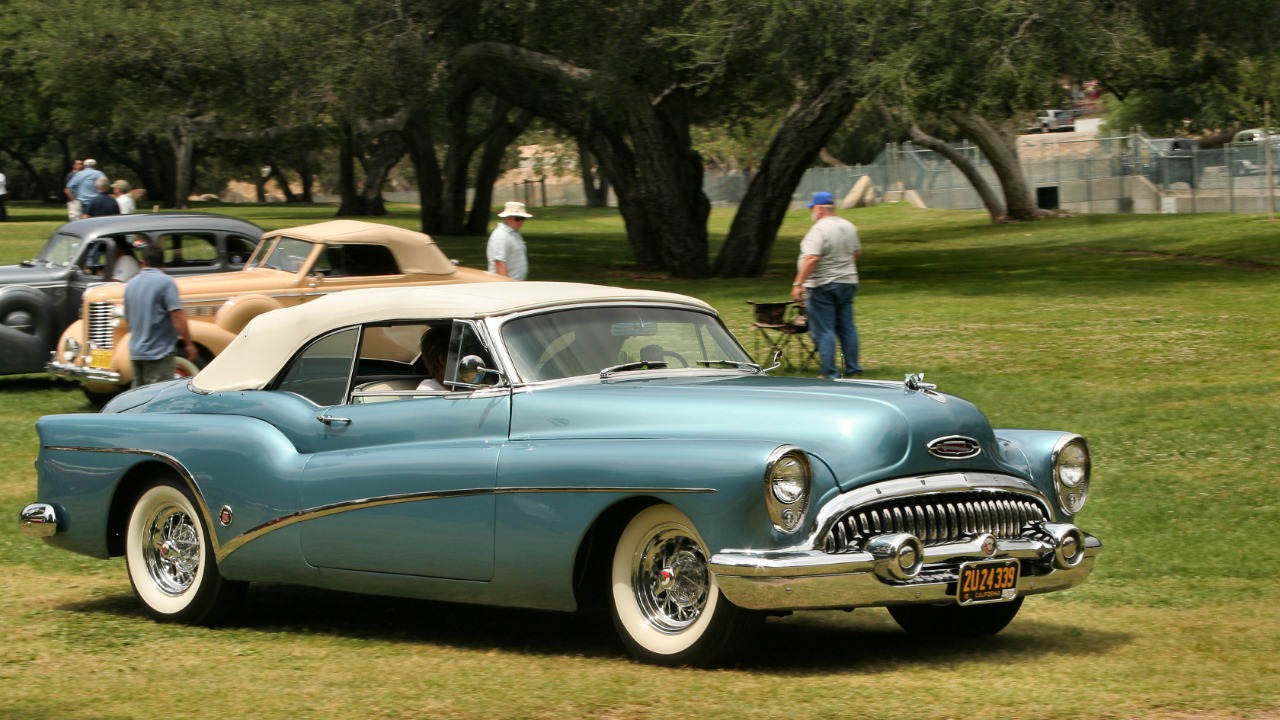
The 1953 Buick Skylark did not slip quietly into showrooms. It exploded onto American roads as a rolling anniversary party for Buick, a limited-production convertible that made subtlety feel like a lack of imagination. Seven decades later, it still looks less like a product plan and more like a champagne toast cast in steel and chrome.
Conceived as a celebration of Buick’s 50th year, the Skylark fused Motorama fantasy with showroom reality and treated every surface as an excuse for drama. From its cut-down doors to its lavish interior, it turned ordinary drives into a kind of parade, whether anyone was watching or not.
A golden anniversary on four wheels
Buick reached its 50th anniversary in the early 1950s and chose to mark the milestone with something far more theatrical than a badge package. The company used its premium Roadmaster chassis as the foundation for a special convertible that would showcase the brand’s most advanced styling and engineering. Contemporary documentation of the broader 1953 Buick line shows how the division was already leaning into flamboyant curves and heavy chrome, and the Skylark simply pushed those tendencies to their limit, turning the celebratory model into the most extroverted member of the family, as seen in period material on 1953 Buick.
The car was positioned as a limited-production flagship, not a mass-market convertible. Intended to be rare, expensive and intensely desirable, it served as a halo that would radiate glamour across Buick showrooms. The strategy followed General Motors’ broader practice of using dream cars to test public reaction, then bringing the most successful ideas to the street in small, image-building runs.
From Motorama fantasy to “Anniversary Conver” reality
General Motors had been using its traveling Motorama exhibitions to float futuristic concepts, and the Skylark drew heavily on that world of show cars. Enthusiast accounts describe it as a “production dream car” that allowed buyers to drive home something that looked as if it had just rolled off a Motorama stage, a characterization reinforced by coverage of the Buick Skylark as a limited-production fantasy made real.
Created specifically to commemorate Buick’s 50th anniversary, the model was marketed as an “Anniversary Conver,” a phrase that captured both its celebratory mission and its open-top form. One period description notes that it was introduced during Buick’s 50th anniversary and presented as a special convertible in New York, framing the car as a centerpiece of the brand’s golden-year festivities and echoing the language in a post on the Anniversary Conver.
Where earlier Motorama concepts were pure showpieces, the Skylark was very much a retail proposition. It carried a full suite of comfort and convenience features and was built to be driven, not just admired under spotlights. Yet the show-car lineage remained obvious every time its owner dropped the top and watched bystanders react.
Styling that borrowed from California customizers
The Skylark’s visual drama did not feel accidental. Contemporary observers have pointed out that its chopped windshield, cut-down doors and rear wheel openings resembled the work of California customizers, whose low, sleek cars were beginning to influence mainstream taste. One retrospective explicitly describes the 1953 Buick Skylark convertible as “California customizers inspired,” and credits that scene with shaping the car’s distinctive stance and silhouette, as reflected in the description of how custom shops influenced Skylark proportions.
The result was a factory car that looked like it had already spent time in a custom shop. Its doors were sectioned so deeply that the tops sat barely above the seats, exaggerating the length of the body and making the occupants appear to sit lower in the car. The rear quarters were sculpted to showcase the wheels, and the fenders flowed in uninterrupted sweeps that seemed closer to hand-formed metalwork than to standard production stampings.
Even small details carried the same sense of theatricality. The windshield was chopped compared with other Buicks, which reduced visual bulk and gave the profile a sportier rake. Chrome was used not just as decoration but as a way to underline and exaggerate the car’s curves, so that light played across the body in motion. The overall effect was closer to a custom showpiece than to a typical midcentury family convertible.
Luxury that bordered on decadent
The 1953 Buick Skylark was not only about exterior drama. Inside, it was designed as a sanctuary of comfort and style. One owner’s description from a modern enthusiast group captures the mood by stating that “Inside, the Skylark was a sanctuary of luxury,” with premium leather and carefully detailed trim, an impression that aligns with the way fans describe how “Inside, the Skylark” surrounded occupants with high-end materials, as in a post that highlights how Inside the car felt like a lounge.
Contemporary descriptions emphasize full power equipment, including power windows and power seats, paired with rich upholstery and extensive brightwork. The dashboard carried Buick’s signature instrument layout but was dressed to match the car’s special status, with color coordination and trim choices that set it apart from more modest models. Everything about the cabin signaled that this was the top of Buick’s range, a place where the brand could showcase what American luxury meant in the early 1950s.
Several enthusiast accounts today describe the 1953 Buick Skylark as one of the most luxurious and iconic convertibles of its decade, built to celebrate Buick’s 50th anniversary and to set benchmarks for American automotive opulence. One group post states that the 1953 Buick Skylark stands as one of the most luxurious and iconic convertibles of the 1950s and that it was built to celebrate Buick’s 50th anniversary, describing how it set “benchmarks for American automotive opulence,” a characterization echoed in a discussion of how the Buick Skylark defined midcentury glamour.
Engineering as spectacle
The Skylark’s engineering matched its styling ambition. The car was based on the Buick Roadmaster chassis, which provided a robust platform and allowed Buick to install its most advanced powertrain. One enthusiast overview notes that the 1953 Buick Skylark was produced to commemorate Buick’s 50th anniversary and that it was based on the Buick Roadmaster chassis, then goes on to describe the model as epitomizing 1950s automotive luxury and design, confirming that the Buick Roadmaster underpinnings were central to its character.
Under the hood sat Buick’s new V8, a key part of the brand’s move away from straight-eight engines. The Skylark used that engine not just for performance but as a statement that the company was embracing modern power. Enthusiasts often point to this combination of cutting-edge mechanicals and elaborate styling as a reason the car remains such a prized collector’s item.
Contemporary descriptions of the Skylark’s equipment list highlight features such as power steering and power brakes, along with a Selectronic radio, as standard or widely available on the model. One retrospective explicitly states that the 1953 Buick Skylark was created to commemorate Buick’s 50th anniversary and that it came with high-end features including power steering, power brakes and a Selectronic radio, describing how the Buick Skylark Created package represented the pinnacle of Buick’s engineering at the time.
Period footage and modern walkaround videos of surviving cars also stress details like backup lights, automatic transmission, turn signals, a glare proof mirror and a windshield washer, all of which reinforced the impression that the Skylark was loaded with technology. A video focused on the 1953 Buick Skylark lists those features in quick succession, underscoring how even seemingly small conveniences were folded into the car’s identity as a fully equipped luxury convertible, as seen in the clip titled “1953 Buick skylark, To commemorate 50 years of Buick” that showcases these backup lights and other items.
The centerpiece of the party
Within Buick’s own anniversary celebrations, the Skylark occupied center stage. One enthusiast description calls the 1953 Buick Skylark convertible “the centerpiece of Buick’s 50th Anniversary,” underscoring that it was not just another model but the focal point of the brand’s golden-year story. That same account notes that The Skylark came with standard equipment that was unusually generous for the time, reinforcing its status as the flagship of the line, a view reflected in a video caption that describes how the Buick Skylark served as the anniversary centerpiece and how The Skylark was specified.
In that context, the car’s price and limited production numbers made sense. Buick did not intend to flood the market with Skylarks; the model’s exclusivity was part of its appeal. Buyers were not just purchasing transportation; they were buying a visible role in Buick’s anniversary narrative, a way to participate in the celebration every time they drove.
The strategy worked in the sense that the Skylark quickly became a symbol of Buick’s ambition. It showed that the company was willing to invest in a car that prioritized image and innovation over strict cost efficiency, a move that helped position Buick as a serious player in the premium American market.
Instant icon, lasting legend
From its debut, the Skylark stood apart even within Buick’s own lineup. One retrospective notes that when the Buick Skylark first arrived in 1953 it was noteworthy and groundbreaking, conceived as part of Buick’s 50th Anniversary program and already collectible in its first year, a perspective captured in a feature that recalls how “When the Buick Skylark” appeared it immediately drew attention, as described in a look back at how When the Buick entered the market.
Modern enthusiasts often speak of the car in almost reverent terms. One group post states that the 1953 Buick Skylark is one of the most celebrated American cars of the early 1950s and reiterates that it stands as one of the most luxurious and iconic convertibles of the decade, again tying its status to the fact that it was built to celebrate Buick’s 50th anniversary, as described in a discussion of how the Buick Skylark became one of the most celebrated American cars of its era.
The car’s rarity and its combination of show-car styling and advanced features have turned it into a blue-chip collectible. Surviving examples attract intense interest at auctions and in private sales, often commanding prices that reflect both their historical significance and their enduring aesthetic appeal. Enthusiast communities regularly share images and videos of restored Skylarks, celebrating details such as the intricate wheel arches, the carefully stitched leather and the polished chrome that still gleams under modern lights.
The Skylark as design teacher
The 1953 Skylark also served as a design laboratory for Buick. Elements that appeared on the car, such as the lower, more swept-back windshield and the dramatic wheel openings, helped preview themes that would filter into later models. Its willingness to borrow from custom culture and to blur the line between factory and coachbuilt aesthetics hinted at a more adventurous approach to styling within General Motors.
Detailed walkarounds of surviving cars, such as one shared by a custom builder who focuses on the 1953 Buick Skylark convertible as a limited-production model marking Buick’s 50th anniversary, highlight how the bodywork and trim created a cohesive design statement. That description emphasizes the car’s top-of-the-line status and its historical significance in Buick’s legacy, framing the Buick Skylark as a touchstone for later custom and factory designs alike.
More from Fast Lane Only