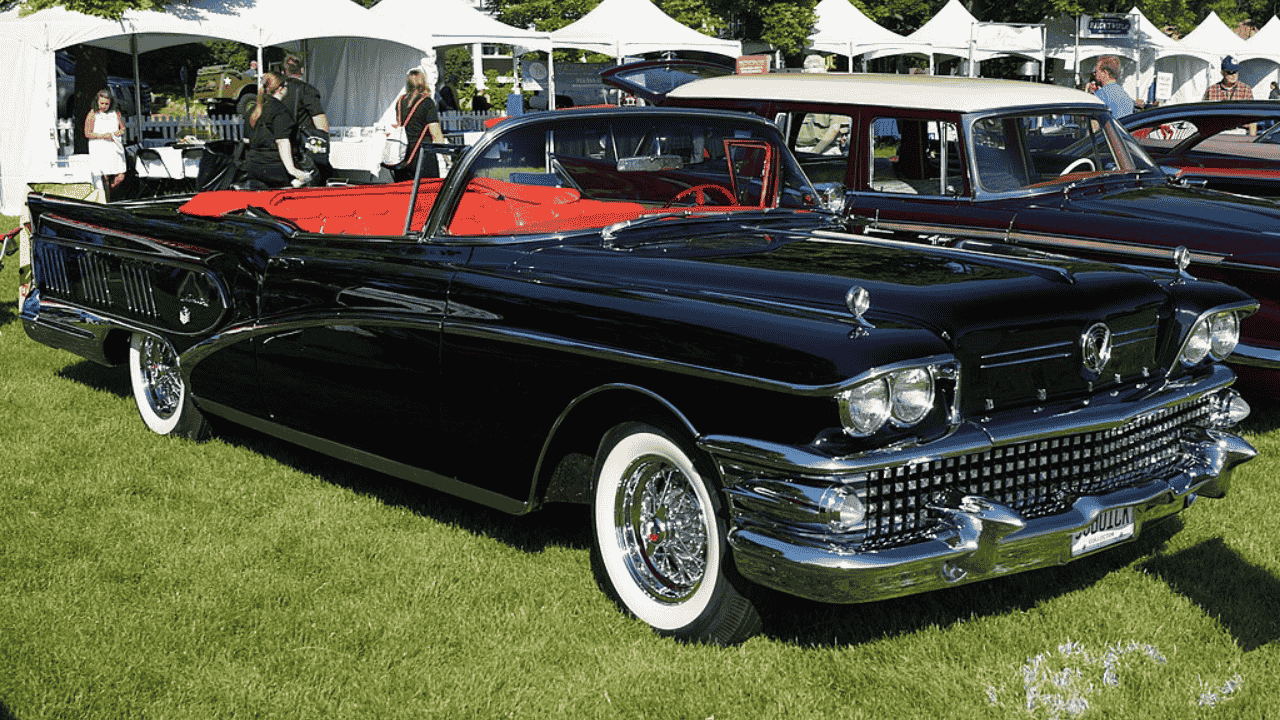
Buick did not whisper in 1958. It shouted. The Limited arrived as a shimmering, oversized rebuttal to subtlety, a car that wore its ambition in chrome and sheet metal and made no pretense of modesty. In a year when American styling reached for the extremes, Buick’s flagship went bigger, longer and flashier, even as the market around it was starting to pull back.
The 1958 Limited was more than a top trim level. It was Buick’s attempt to build a car so long, so wide and so lavish that it could brush against Cadillac territory on presence alone. That gamble produced one of the most extravagant American luxury cars of the decade, and also one of the most short‑lived.
The return of the Limited name
The Limited badge already carried weight in Buick history. The name had been used on premium models before the war, then disappeared as the company reorganized its lineup. When the division revived the series in the late 1950s, it did so with a clear aim: create an ultimate Buick for the model year and put it at the very top of the range.
That revival took the form of the Buick Series 700 Limited, sometimes simply labeled as Series 700 in factory material. On paper and in person, the Limited was engineered to sit above the Roadmaster. The car’s official specifications list the Series 700 Length at 227.5 in (5,778 mm), a figure that instantly separated it from the rest of the Buick showroom and made it one of the longest regular production cars in America. The same data shows the Series 700 weight in the 4,500 to 4,900 pound range, underlining just how much steel and trim the division was willing to commit to its flagship, and those details are preserved in the technical tables for the Limited Series 700.
In period advertising and dealer talk, the Limited was pitched to buyers who wanted something more exclusive than a Roadmaster but did not want to cross the showroom floor into a Cadillac store. It was a calculated stretch of the Buick brand, and the numbers show how far the company went to justify that stretch.
Longer than a Roadmaster, longer than almost anything
Size was the simplest way for Buick to signal that the Limited sat above the Roadmaster. Contemporary comparisons describe how the Limited was differentiated via its length, with the car spanning 227.5 inches from bumper to bumper. That figure meant the Limited literally overshadowed the top tier Roadmaster, already a large car by any standard, and gave Buick salespeople a measurable talking point when courting prestige‑minded buyers.
Other period descriptions emphasize that overall length as well. Enthusiasts who focus specifically on the 1958 Limited Convertible cite an overall length measured at 227.1 inches, or almost 19 feet, which placed the car among the largest production automobiles of its time. That measurement appears in discussions of the Overall length 227.1 inches and is usually paired with comments about how the car dominated traffic and parking spaces alike.
The Limited’s footprint was not just about bragging rights. The extended deck four door hardtop and the long coupe roofline were designed to broadcast luxury in the driveway and at the country club entrance. Owners did not buy a Limited to blend in. They bought it so that the car would be the first and last thing anyone saw.
Chrome at its peak
If the dimensions made the Limited impossible to ignore, the trim ensured that nobody would miss the point. Enthusiast accounts of the 1958 Buick Limited Convertible describe that year as the moment when chrome usage peaked for American automakers, with designers creating some of the most lavishly trimmed vehicles the industry had ever produced. The Limited Convertible is singled out as one of the most extravagant American cars of that chrome era, and collectors often describe it as a rolling monument to brightwork.
Photographic spreads of the 1958 Buick Limited Convertible Chrome show a body almost fully outlined in polished metal. The grille carried a dense pattern of small rectangles, the sides were broken up by deep sculpted sweeps filled with chrome, and the rear wore heavy bumpers and intricate tail lamp housings. One popular description of the car notes that only 839 examples of the Limited Convertible were built, a production total that is repeated in multiple references to the Buick Limited Convertible cars.
Fans of the period often refer to the 1958 Buicks as some of the most chromed‑up cars ever made, and the Limited sits at the center of that claim. In a lineup already known for heavy brightwork, the flagship took the concept as far as Buick could reasonably push it.
Inside the Series 700 Limited
The Limited did not rely on exterior flash alone. Buick equipped the Series 700 with a long list of standard features that were still optional on lesser models. Factory information shows that power brakes were standard on the Limited, along with power steering, which made the car’s considerable size more manageable in city driving and tight parking. The same material notes that interiors were trimmed in high grade cloth and leather in sedans and coupes, with full leather in convertibles, and those details are preserved in documentation about power brakes were on the Limited.
Descriptions of individual models, such as the Buick Roadmaster Limited Riviera Sedan identified as Model 750, confirm that all Limited models carried a similar level of equipment. References to the 1958 Buick Roadmaster Limited Riviera Sedan Model 750 list production at 5,571 cars and a curb weight of 4,710 pounds, figures that match the sense of a fully loaded luxury car and appear in factory‑style tables for Production 5,571 cars.
Even among these variants, the convertible stood apart. Collectors and historians describe the 1958 Buick Limited Convertible as one of the most extravagant American luxury convertibles of its time, with full leather upholstery, extensive power equipment and a level of trim that justified its position at the top of the Buick price sheet.
The power under all that metal
Under the hood, the Limited relied on Buick’s established V8 technology rather than a clean‑sheet engine. Technical writeups on the 1958 Buick Limited Classic Car explain that engine specifications remained largely unchanged for that year. In the broader Buick line, the Special model’s engine is described as having a 9.5:1 compression ratio and a two barrel carburetor, which allowed the Special to develop strong power for its class, and that specific ratio is recorded as Engine compression 9.5 to 1.
While the Limited used a higher tier version of Buick’s V8, the key point is that the division did not need an exotic powerplant to move the big car. The standard V8, paired with automatic transmission, delivered sufficient torque to pull the Series 700’s 4,500 to 4,900 pounds of mass with authority. Owners and testers of the period focused less on outright acceleration and more on the sense of effortlessness at highway speeds, which matched the car’s mission as a prestige cruiser.
A short, intense bid for Cadillac territory
Buick’s leadership saw the Limited as a way to move the brand closer to Cadillac in both price and image. Contemporary commentary notes that the Buick Limited series was revived in 1958 as the ultimate Buick for the model year, available only as a four door hardtop, a two door hardtop and a convertible. Some accounts add that pricing for the Limited could exceed that of certain Cadillac models, which underlines how aggressively Buick positioned its flagship in the market, and those comparisons appear in discussions of the Buick Limited was as a Cadillac rival.
The strategy was bold, but it arrived at an awkward moment. The late 1950s were a time of economic uncertainty and changing tastes. Buyers who had embraced flamboyant styling earlier in the decade were starting to look for cleaner lines and more restrained luxury. Against that backdrop, the Limited’s extreme length and heavy chrome could feel out of step even as the car reached showrooms.
Enthusiast groups sometimes describe Buick’s experiment with rivaling Cadillac as short‑lived, and the production numbers support that view. The Limited name would not continue as a separate series for long, which makes the 1958 cars a kind of one‑year statement about what Buick thought top tier American luxury could look like.
“Long, wide, drenched in chrome”
Modern video features on the 1958 Buick Limited tend to adopt a tone of fascinated disbelief. One widely shared clip describes how, in 1958, Buick unveiled a machine unlike anything it had built before, long, wide and drenched in chrome from front to rear. Commentators in that piece talk through the car’s dimensions, the elaborate trim and the interior appointments, painting a picture of a vehicle that pushed excess to its logical limit, and those remarks are captured in coverage of how Buick unveiled a that was long and wide and drenched in chrome.
Other enthusiasts refer to the Limited Riviera Coupe as “The Chrome King,” a nickname that fits the visual evidence. Walkaround videos linger on the stacked headlights, the deep side sweeps and the complex rear fascia. Even viewers who normally prefer subtle classics often admit a certain admiration for the sheer commitment on display.
Social media posts about the 1958 Buicks more broadly call them some of the most chromed‑up cars ever built, which is not hyperbole when one studies the Limited. From the grille to the tail lamps, almost every visual line is reinforced with brightwork. The result is a car that reflects its surroundings like a rolling mirror and turns any sunny day into a light show.
Rarity and collector appeal
The Limited’s short production run and high original price have combined to make surviving examples relatively rare. The convertible is the standout. Multiple sources repeat that only 839 Limited Convertibles were built, a figure that has turned the model into a coveted prize for collectors. That number appears in detailed discussions of the Discovered Buick Limited units.
Hardtop sedans and coupes are more common, but even those are hardly everyday finds. The Model 750 Riviera Sedan’s production figure of 5,571 cars, while larger than the convertible’s total, still places it well below mass‑market volumes for the period. That scarcity, combined with the car’s unmistakable styling, has given the Limited a strong following in classic car circles.
Owners often talk about the practical challenges that come with such a large and ornate vehicle. The car’s length can make modern parking spaces a tight fit, and the generous use of chrome means restoration work can be expensive. Yet those same traits are exactly what draw enthusiasts in. For many, the Limited represents a high‑water mark of American automotive extravagance that will never be repeated.
More from Fast Lane Only