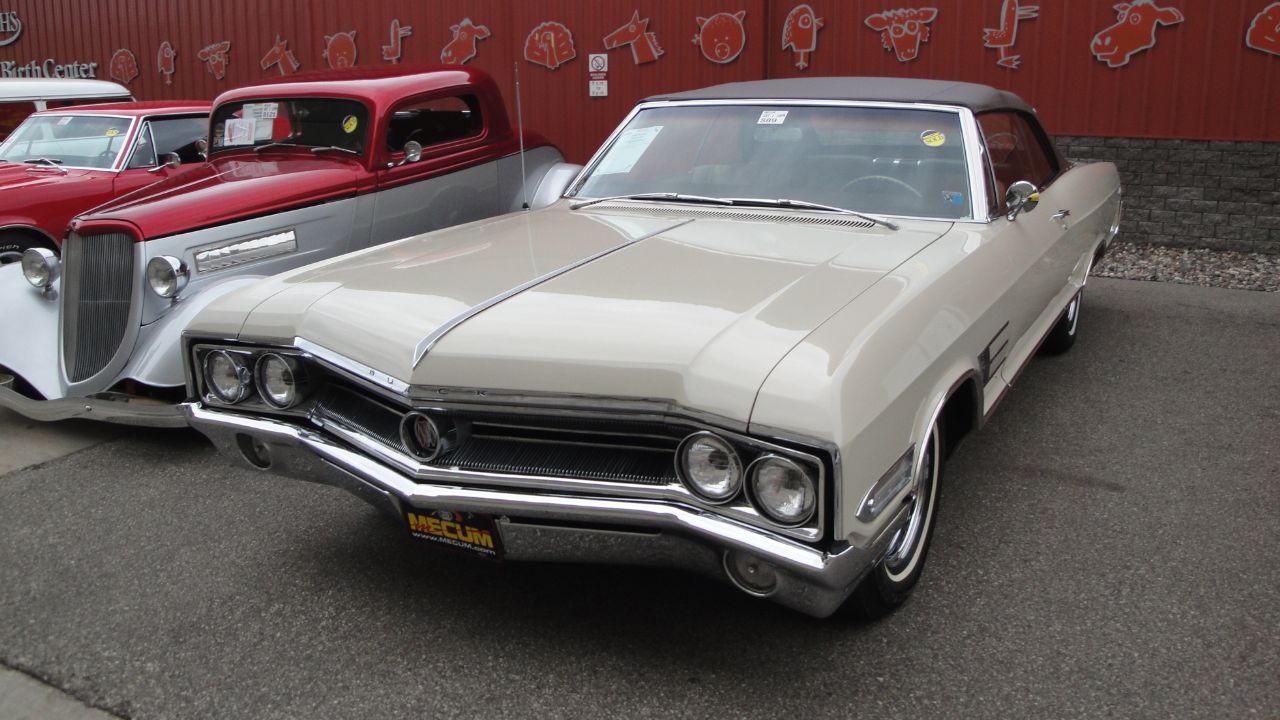
Buick’s 1965 Wildcat did not need stripes, spoilers or shouting graphics to make its point. It carried the quiet confidence of a full-size car that could run with muscle machines while still looking ready for a country club parking lot. That mix of restraint and authority is why the car still resonates with owners and onlookers decades later.
The year GM felt on top of the world
Within General Motors, 1965 was remembered as a strong year, and enthusiasts often single out the Buick Wildcat as proof. One admirer summed it up simply, saying that 1965 was a good year for GM and adding that they always liked the 1965 Buick Wildcat. The model sat in the sweet spot between the sensible LeSabre and the indulgent Electra, aimed at buyers who wanted something more assertive without crossing into brash territory.
Rather than chasing the youth-market flash that would define many later muscle cars, the Wildcat leaned on proportion and presence. Long, level body sides, a low roofline and a wide track made the car look planted even at rest. The stance was bold and muscular, yet the surfaces stayed clean and the trim restrained, which gave the big Buick an elegance that matched its price and its intended audience.
“Banker’s hot rod” with a businesslike mission
The Wildcat nameplate had already earned a reputation as a fast, well-appointed full-size car by the time the 1965 model arrived. Period coverage described the line as a kind of banker’s hot rod, and that image held until sales nosedived in and the Wildcat was dropped in favor of a new nameplate called Centurion. In 1965, though, the formula was still near its peak.
Under the hood, Buick installed serious power. The standard Wildcat V8 displaced 401 cubic inches and was rated at 325 horsepower, or 242 kW, according to period specifications that describe the 401 cubic-inch Wildcat engine as the base choice through 1966, with an optional 425 cubic-inch version above it. That combination of 325 horsepower and a 401 cubic-inch block gave the car effortless highway speed and strong passing power, while the larger 425 engine pushed the Wildcat deeper into performance territory without turning it into a stripped-down racer.
The car’s mission was clear: Buick wanted to combine full-size comfort with genuine performance appeal, and contemporary enthusiasts still describe the 1965 Buick Wildcat as reflecting that effort. One summary of the model notes that the Wildcat was equipped with strong V8 engines and that its muscular design marked a shift toward more assertive styling for the brand. The car was meant for drivers who valued a quick, confident surge onto the freeway as much as they valued a quiet ride and a well-finished interior.
Design: bold, but never loud
On the outside, the 1965 Wildcat walked a careful line. One description of the 1965 Buick Wildcat Coupe highlights its bold, muscular design and emphasizes how the car combined a long, sweeping profile with a clean, elegant finish and distinctive tail lights. That account of the Buick Wildcat Coupe captures the core of the styling philosophy.
The front end carried a wide grille and quad headlights, but the detailing stayed relatively understated compared with some of the era’s more flamboyant full-size offerings. Along the sides, crisp character lines and long front fenders visually stretched the car. Owners and historians point out that both the LeSabres and Wildcats utilized the General Motors B Body Shell, shared with big-name models such as the Chevrolet Impala and Pontiac Catalina, which gave the Wildcat its generous footprint and long wheelbase without requiring a bespoke platform.
At the rear, the Wildcat’s tail lamps and bumper treatment continued the theme of quiet strength. The lenses were integrated into a clean panel that avoided the heavy chrome flourishes that could date a car quickly. The result was a shape that looked contemporary in the mid 1960s yet still reads as tasteful today, which helps explain why enthusiasts still gravitate to the car at shows and in online communities.
Inside the Wildcat Coupe
Inside, the Wildcat Coupe offered a spacious and luxurious cabin that matched its exterior promise. A period description of the interior notes that the front seats were designed for comfort, with wide, supportive cushions that made long drives easy. The same account points out that the Wildcat Coupe combined this comfort with upscale trim and thoughtful details.
Instrumentation was straightforward and legible, reflecting Buick’s focus on mature buyers who valued clarity over novelty. Brightwork was used sparingly to highlight key elements rather than to overwhelm the dashboard. The overall effect was closer to a personal luxury car than to a bare-bones performance machine, which again fit the Wildcat’s role as an executive express rather than a street brawler.
Owners who grew up with these cars often recall the cabin as a place where families spent real time together. One enthusiast who encountered a low mileage original Wildcat decades later remarked how similar it felt to the car their parents had owned, noting that the interior is in remarkably preserved condition. That memory, shared in a discussion of a survivor car, shows how the 1965 Wildcat’s materials and layout left a lasting impression on people who rode in it when it was new.
Convertible confidence
The Wildcat was not limited to coupes and sedans. The Buick Wildcat Convertible gave the car an open-air personality without sacrificing its underlying composure. Enthusiasts still trade advice about maintaining these cars, including questions about where to find the fifth bow frame for a 1966 Buick Wildcat convertible top. Those conversations often sit alongside photos and comments about earlier models, such as a 1963 Buick Wildcat Convertible that appears in the same thread, where one caption even truncates the name as Buic.
A reference to a Buick Wildcat Convertible from 1965 reinforces how the open-top version carried the same long, low lines as the coupe. With the roof down, the car’s length and horizontal emphasis became even more apparent, yet the design still avoided the exaggerated fins and chrome spears that had dominated earlier in the decade. The convertible Wildcat projected a relaxed confidence, as if it expected to be noticed but did not need to shout to earn that attention.
Under the hood: Nailhead heritage
Powertrains were central to the Wildcat’s identity. A modern overview of a 1965 Buick Wildcat highlights a 401 CID Nailhead V8 as a defining feature, listing the 401 displacement explicitly in a summary of the car’s specifications. That engine, often simply called the Nail, delivered strong low-end torque that suited the Wildcat’s full-size weight and highway mission.
Factory literature and later technical summaries align in describing the standard Wildcat V8 as a 401 cubic-inch unit rated at 325 horsepower, or 242 kW, with an optional 425 cubic-inch version available from 1964 through 1966. Some configurations of the larger engine used dual four-barrel carburetors, sometimes referred to as dual quads, which pushed the car well into serious performance territory. Yet even with the hotter setups, Buick kept the car’s manners refined, with automatic transmissions and power accessories that made everyday driving easy.
That balance of power and civility is a key reason enthusiasts still see the Wildcat as more than a straight-line machine. Owners describe the car as equipped for both brisk acceleration and relaxed cruising, with the strong V8 engines working quietly at highway speeds. The drivetrain choices reinforced the message that performance could be part of a well-rounded package rather than an end in itself.
Big body, subtle moves
Chassis engineering on the 1965 Wildcat reflected its full-size roots. Both the LeSabres and Wildcats utilized the General Motors B Body Shell, which they shared with other large cars such as the Chevrolet Impala and Pontiac Bonneville. That common structure gave the Wildcat a long wheelbase and generous interior space, along with the ride quality buyers expected from a big Buick.
At the same time, the Wildcat’s suspension tuning and tire choices aimed to give the car more agility than its dimensions might suggest. Period and modern commentators alike observe that the early muscle era was filled with full-size cars, and a video walkaround of a Buick display at a muscle car event notes that the muscle cars at the beginning were really fulls size cars, with the presenter standing at the edge of the Buick section to make the point. In that context, the Wildcat’s relatively tidy bodywork and controlled stance read as purposeful rather than ostentatious.
The car’s steering and braking hardware were not sports car sharp by modern standards, yet they were more than adequate for the power on tap. Drivers who remember these cars often talk about the sense of stability at speed and the way the long hood pointed down the road, giving a feeling of calm authority rather than nervous excitement.
Living memory and family stories
For many people, the 1965 Wildcat is not just a specification sheet or a styling exercise. It is a family memory. In a collection of car recollections, one enthusiast describes a low mileage original Wildcat that was displayed at an event and notes how similar it was to the car their parents had owned. That account, shared in February and focused on the Wildcat, emphasizes how the interior is in such preserved condition that it instantly transported the observer back to childhood.
Another enthusiast-focused discussion calls 1965 a good year for the industry and singles out the Wildcat as a standout, reflecting how the car has become a shorthand for a certain era of American motoring. These personal stories are not just nostalgia. They show how the Wildcat’s mix of comfort, style and performance made it part of everyday life, from family road trips to special occasions, in a way that more extreme muscle cars sometimes did not manage.
From contemporary coupe to sought-after classic
Today, the 1965 Buick Wildcat Coupe remains a sought-after classic, appreciated for its combination of style, performance and luxury. One enthusiast summary explicitly states that today the 1965 Buick Wildcat Coupe is valued for that mix and notes that it still turns heads when it appears at shows or on the street. The same comment points out that the car’s appeal rests on both its exterior design and the power under the hood.
Collectors often highlight the way the Wildcat’s restrained styling has aged. While some contemporaries now look locked to a specific year or fad, the Buick’s clean lines and modest trim let it slip more easily into modern traffic without seeming like a caricature of the 1960s. That quality helps explain why restored and well-preserved examples command attention in auction listings and enthusiast circles.
Survivor cars, such as the low mileage Wildcat mentioned by an owner who compared it to their parents’ car, add another layer of appeal. They show how original materials and finishes from 1965 can still present well when cared for, reinforcing the idea that Buick built the Wildcat to a standard that matched its ambitious positioning in the market.
More from Fast Lane Only