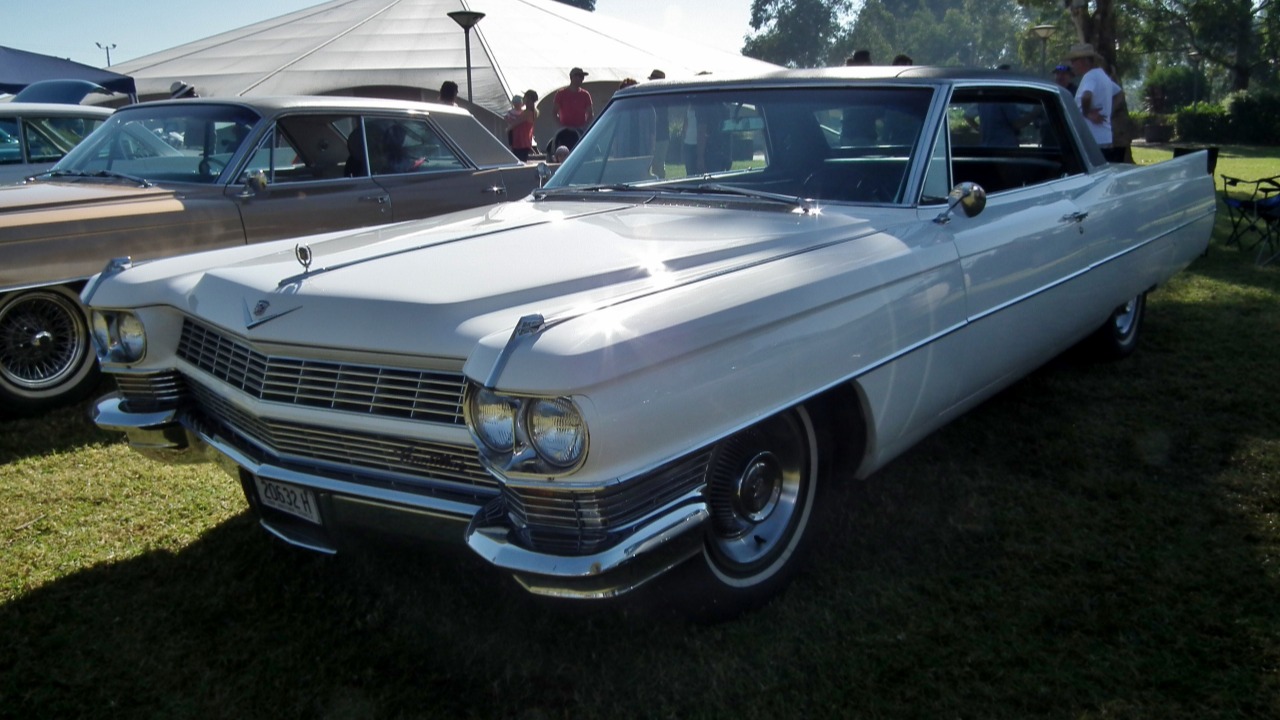
The 1964 Cadillac Coupe de Ville arrived at the end of Detroit’s fin era and did not apologize for what it represented. Long, low and lavish, it was a confident expression of American luxury that leaned into size, comfort and quiet power instead of sporty pretense. Six decades later, its appeal rests on how completely it embraced that identity.
Rather than chase European handling or minimalist restraint, Cadillac built a car that treated distance as a pleasure and excess as an art form. The Coupe de Ville’s final-year tailfins, vast cabin and effortless V8 powertrain turned every trip into a slow-motion display of status, and that clarity of purpose still shapes how collectors and drivers talk about it.
Last of the classic fins
By 1964, even Detroit knew the jet-age fin craze was nearly over. The 1964 Cadillac Coupe deVille was the last model year to wear the brand’s iconic tail fin, a detail that had defined Cadillac’s look since the 1940s. Contemporary descriptions of the car highlight the “distinguished classic simplicity” of its styling, especially in the way the rear quarters tapered into those final fins and vertical taillamps on the 1964 Cadillac Coupe.
Designers did not simply bolt flamboyant fins onto a slab-sided body. The Coupe de Ville for 1964 carried a cleaner, more formal roofline, a straighter body side and restrained chrome that framed, rather than overwhelmed, the sheet metal. Observers at the time and since have described the rear styling as “definitely definitive,” with the fins integrated into a broad decklid and wide bumper that gave the car a planted, almost architectural stance at the Cadillac Coupe.
At a moment when other brands were already trimming fins or abandoning them, Cadillac chose to refine rather than retreat. The 1964 car did not pretend to be something else. It closed the fin chapter with a design that looked expensive and assured, which is exactly how buyers wanted to feel.
Powertrain that matched the posture
A car that large needed an engine with equal presence. Earlier in the decade, Cadillac relied on the familiar 390 cubic inch V8, and for 1963 that engine, at 390 cu. in. or 6,384 cc, had already received a new, shorter block and other updates that carried into the Coupe de Ville. Period road tests noted the way this V8 delivered quiet, almost effortless thrust that suited the car’s mission better than any high-strung performance tune could have.
Other contemporary descriptions of the DeVille line emphasize how Cadillac kept escalating power. For 1964 the engine family grew to 429 cubic inches, with output quoted at 340 horsepower in coverage of the 429-cubic-inch 340 horsepower specification. The focus was not on racetrack numbers but on the sensation of endless torque through a smooth automatic transmission.
That combination meant the Coupe de Ville could cover highway miles with a light throttle and minimal fuss. The powertrain did not chase sports car reflexes. It reinforced the car’s character as a serene, high-speed lounge that happened to have a steering wheel.
A cabin built as a rolling living room
If the exterior projected wealth, the interior was where Cadillac delivered on it. Owners who have chronicled their experiences describe leather seats of “high quality” and remark that there is hardly “a spec of plastic in or on this car” apart from a few small pieces, with Everything else finished in metal, wood or substantial trim.
Equipment lists from the period read like a manifesto for comfort. Power windows, power seats, automatic climate control and an anti-glare inside rearview mirror were presented as standard or expected features on the 1964 Cadillac Deville. The goal was to insulate occupants from noise, vibration and effort, not to connect them to the road.
That philosophy extended to the driving position. Surviving examples of the 1964 Cadillac Coupe DeVille Hardtop Coupe are often praised for power steering that can be worked with a fingertip and for options like a tiltable steering column on the Car is a. The result feels closer to a mid-century lounge chair than a modern bucket seat.
Engineering for quiet confidence
Underneath the glamour, the 1964 DeVille range relied on serious hardware. All Cadillacs of that year rode on a 129 inch wheelbase, a dimension that gave the Coupe de Ville its stretched proportions and allowed engineers to tune the suspension for a long, gentle ride as described in coverage of All Cadillacs. The focus was on stability at speed and isolation from broken pavement.
Chassis inspections of surviving 1964 Cadillac Sedan DeVille models highlight the amount of rustproofing and the strength of the straight steel frame, with solid floor pans and only slight corrosion in non-structural areas noted when Perusing the undercarriage. That durability supports the idea that Cadillac engineered these cars to outlast fashion cycles.
Contemporary European testers who sampled the Coupe de Ville often commented on the isolation from mechanical noise and the lightness of controls. They sometimes compared the refinement of the 1964 Cadillacs to the earliest single-cylinder Cadillacs of 1905, noting how far the company had come in making starting and driving as simple as turning the ignition key, as reflected in period discussions of the Honorably, Cadillacs of comparison.
How it feels on the road today
Modern owners and sellers tend to describe the 1964 Coupe de Ville with a mix of amusement and affection. One listing framed the car as “long, low and wide,” emphasizing how it still dominates a parking lot, while also noting that the seller almost humorously called it a fun weekend cruiser in coverage of Long, Low and. The joke lands because the Coupe de Ville is the opposite of nimble, yet it remains deeply enjoyable at relaxed speeds.
Survivor cars that have avoided heavy modification show how well the original formula still works. Enthusiasts point to examples that remain largely untouched, from original paint to unmolested interiors, as proof that the materials and construction hold up when cared for, especially when They surface in the collector market.
On the road, drivers still talk about the way the car seems to float at highway speeds, with the big V8 barely turning over and the cabin hushed. The steering can feel vague by modern standards, and body roll is pronounced, yet those traits are part of the charm. The Coupe de Ville does not pretend to be agile. It invites a slower, more theatrical style of driving where every arrival feels like an entrance.
Why its unapologetic character matters now
In a modern market filled with crossovers that all chase similar blends of efficiency and performance, the 1964 Cadillac Coupe de Ville stands out for how single-minded it is. It was a luxury coupe that fully accepted its role as a status symbol, from the last flourish of its tailfins to the softness of its suspension and the weight of its doors.
The car’s enduring appeal among enthusiasts, from those who catalog its history on sites dedicated to the Discovered Cadillac Coupe to groups that share period road tests and photos of the Discovered Vintage Autocar, reflects a broader nostalgia for machines that knew exactly what they were for. The Coupe de Ville was built to carry four or five people in comfort and to signal that its owner had arrived, in every sense.
That clarity of purpose is why the 1964 model year, perched between the excess of the 1950s and the restraint of the later 1960s, feels so significant. The Coupe de Ville did not hedge its bets. It leaned fully into size, style and serenity, and in doing so created a kind of luxury that still resonates whenever one of these cars glides silently past.
More from Fast Lane Only