The Chrysler Turbine Car did not just sound like the future. For a brief moment in the early 1960s, it put jet technology in American driveways and made a radical alternative to pistons feel almost ordinary. Its haunting whoosh, coppery bodywork, and experimental powerplant suggested a different path for the automobile, one that nearly became mainstream before politics, cost, and timing shut the program down.
Six decades later, the Turbine Car survives as a handful of museum pieces and a legend that still feels strangely contemporary. Its blend of futuristic engineering and real-world usability raises a question that lingers over every surviving example: how close did America come to commuting in jet-powered family cars?
The jet-age dream in a family coupe
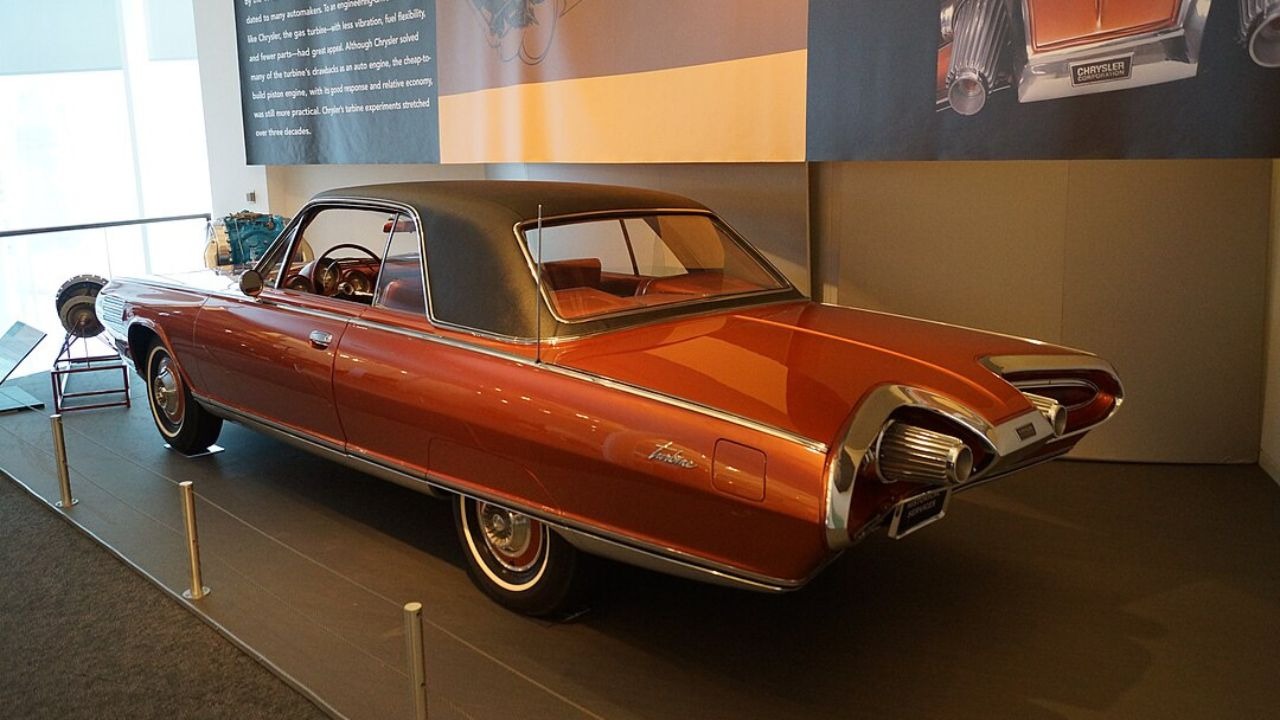
From the outside, the Turbine Car looked less like a spaceship and more like an upscale personal luxury coupe. Period observers noted that Chrysler’s Turbine Cars resembled contemporary Fords, especially the Thunderbird, rather than the finned extravagance that had defined the brand in the 1950s. The shape was low and long, with a formal roofline and restrained surfaces that hid the radical hardware underneath.
The drama concentrated at the ends. The front fascia framed a deep central opening that suggested a jet intake, while the taillights sat inside turbine-like cones that reinforced the theme. As one detailed feature on the car points out, the designers used a turbine motif throughout, from the wheel covers to the interior trim, in ways that set the car apart from the Thunderbird it otherwise echoed in profile. That same report highlights how the hand-built Ghia bodywork gave the car an expensive, coachbuilt presence that went far beyond a typical Detroit prototype.
Chrysler had turned to Italian coachbuilder Ghia for the Turbine Car’s body, and the result combined American scale with European crispness. The coppery finish, often referred to as Turbine Bronze, made the car look like a rolling piece of industrial sculpture. Inside, the cabin mixed conventional controls with aircraft cues. The dashboard wrapped around the driver, the gauges had a jet-age flair, and the center console carried controls for the experimental drivetrain without intimidating drivers used to regular automatics.
Under the skin, however, nothing was ordinary. The car rode on a conventional chassis with power steering and a TorqueFlite automatic, but the engine bay held a small gas turbine instead of a cast-iron V8. According to technical descriptions of the Chrysler Turbine Car, the A-831 powerplant sat compactly in the nose, feeding its power through a torque converter rather than a traditional clutch. The layout preserved familiar driving dynamics while completely rethinking how the power was produced.
A-831: the helicopter heart that ran on almost anything
The A-831 engine at the center of the program was the product of a long corporate fascination with turbines. Chrysler engineers had spent years developing small gas turbines for automotive use, chasing the promise of fewer moving parts, less maintenance, and exceptional durability. The A-831 unit in the Turbine Car delivered an advertised 130 horsepower and a remarkable 425 pound-feet of torque, figures preserved in technical notes on the car’s specification.
Unlike a piston engine that relies on repeated explosions in individual cylinders, the turbine spun a single shaft at very high speed. One video overview of the car’s powerplant notes that the engine revved to over 60,000 revolutions per minute, a figure that would be impossible in a conventional road-going V8. Another clip that introduces the car to a modern audience describes how the same basic turbine concept appears in many helicopters, which hints at the aerospace lineage behind Chrysler’s experiment.
That aerospace connection carried practical benefits. The A-831 could operate on a wide range of fuels, including gasoline, diesel, kerosene, and even more exotic liquids. One popular short video about the Turbine Car jokes that the engine would run on anything, including tequila and perfume, and while that claim sits at the playful end of the spectrum, it reflects real multi-fuel capability that Chrysler demonstrated with everything from regular pump gas to furnace oil. The combustion process was continuous and very clean in terms of unburned hydrocarbons, and the engine had far fewer wear-prone parts than a comparable piston unit.
Yet the turbine also had quirks. Throttle response was slower than drivers expected, a point underlined in a curatorial essay at the Frist Art Museum that describes how the engine needed to spool up before delivering full torque. The exhaust temperature was extremely high and required careful routing, since it could damage nearby materials. Fuel economy in real-world use did not dramatically exceed that of a good V8, especially in stop-and-go driving, where the turbine’s efficiency advantage faded.
Still, in highway conditions the A-831 ran smoothly and quietly, with almost no vibration in the cabin. Contemporary footage and modern demonstrations capture a distinctive sound: a soft, rising whoosh instead of the lumpy idle and roar of a big-block. A factory promotional film hosted on YouTube shows the car gliding along suburban streets while the narrator extols the simplicity of the powerplant and the minimal need for tune-ups.
Fifty-five cars, 203 families, and a nationwide experiment
Chrysler did not keep the Turbine Car confined to auto shows. The company built 55 examples of the Ghia-bodied coupes, then created what amounted to a nationwide beta test. According to a detailed historical account of the program, Chrysler loaned what became known as the famous 50 cars to ordinary families for extended periods, rotating them through different regions and climates.
A later retrospective from an enthusiast group on social media specifies that Chrysler actually built 55 examples and loaned them to regular drivers across the United States. Another summary from the Hagerty Drivers Foundation states that 203 American families participated in the program, each receiving a Turbine Car for several months and logging real commuting miles. The goal was twofold: gather hard data on reliability and drivability, and showcase the company’s engineering prowess in a way that static prototypes never could.
Participants were not test pilots or engineers. They were office workers, homemakers, small business owners, and retirees who used the cars for grocery runs, school drop-offs, and highway trips. Feedback collected by Chrysler highlighted both the appeal and the frustrations. Many drivers loved the smoothness and the novelty of the sound. Some appreciated the ability to run on cheaper or alternative fuels. Others complained about the slow throttle response, the complicated starting sequence, and the occasional lag when pulling away from a stop.
A technical Q&A that revisits the program notes that the company used the field test to identify practical issues such as the starting procedure, which involved engaging a starter, waiting for the turbine to reach a certain speed, then adding fuel. This was manageable for enthusiasts but less intuitive for drivers accustomed to turning a key and immediately shifting into gear. The same source mentions that the engines were expensive to build in 1964 money, which would have made any production version a costly proposition.
Publicly, Chrysler’s own messaging leaned into excitement rather than caveats. A modern clip on the Stellantis North America feed, labeled with the phrase “Forget pistons,” revisits the Turbine Car as a bold reimagining of automotive propulsion. In that short video, the narrator calls the car cool, praises its timeless design, and links the technology to earlier company research. The tone mirrors the optimism that surrounded the original program, when the idea of a family car powered by a jet-like engine felt like a natural extension of the space age.
Why the turbine future stalled
For a time, internal reports suggested that Chrysler was seriously evaluating limited production. The Turbine Car had survived real-world testing, captured public imagination, and demonstrated that a gas turbine could be tamed for everyday driving. Yet within a few years, the program was quietly wound down and most of the cars were destroyed.
Analyses of the decision point to several overlapping forces. One technical history aimed at students in mechanic programs frames the story as a lesson in how promising technology can fail when it collides with cost, regulations, and infrastructure. The turbine engines were expensive to produce, especially in the low volumes that early adoption would have required. Mass production would have demanded huge investment in specialized materials and manufacturing processes at a time when Chrysler was already under financial pressure.
Regulatory uncertainty made the outlook even murkier. A retrospective on the broader turbine effort argues that looming emissions and fuel economy rules, which intensified after the OPEC oil crisis, pushed regulators and manufacturers toward smaller, more efficient piston engines instead of exotic alternatives. Turbines produced very low levels of some pollutants but struggled with others, particularly nitrogen oxides, and the technology path to compliance looked long and costly.
There were also practical concerns. Service networks would have needed extensive retraining to handle turbine diagnostics and repair. Fuel flexibility sounded attractive, but the retail infrastructure still revolved around gasoline, and the benefits of running on other fuels were largely theoretical for most buyers. Insurance companies and dealers reportedly worried about the unfamiliar technology and potential liability.
One educational piece titled “Why the Revolutionary Chrysler Turbine Failed” points out that while things looked promising in the early 1960s, the leap into mass production never quite penciled out. The turbine’s advantages in smoothness and durability did not translate into a clear, affordable benefit for the average car buyer compared with a refined V8. In effect, Chrysler had engineered a solution in search of a problem that regulators, consumers, and accountants all defined differently.
From scrap yard to museum pedestal
When the program ended, Chrysler faced a dilemma. The 55 cars represented a significant investment and a visible symbol of the company’s ambitions. At the same time, import duties and tax rules reportedly made it expensive to keep the Italian-built bodies in the United States indefinitely. The decision was stark. Most of the Turbine Cars were ordered to be scrapped, their unique engines removed and their bodies crushed.
Only a small number survived. A video feature on the car’s legacy notes that only nine of these Chrysler Turbine Cars escaped destruction, a figure echoed in several historical summaries. Those survivors were distributed among museums and educational institutions, where they gradually shifted from experimental hardware to cultural artifacts.
One of the best known examples sits in the collection of the Hagerty Drivers Foundation, which catalogs the Vehicle history of the Turbine Car as part of a decades long effort by the Chrysler Corporation to develop a mass market gas turbine. Another resides at the Gilmore Car Museum, where a social media video captures the car’s eerie whoosh as it drives past spectators. The Old Cars Weekly on a surviving example emphasizes how the car looks even better in person, its hand-built Ghia body and turbine-themed details still sharp after years of preservation.Why the Turbine Car still matters
More from Fast Lane Only