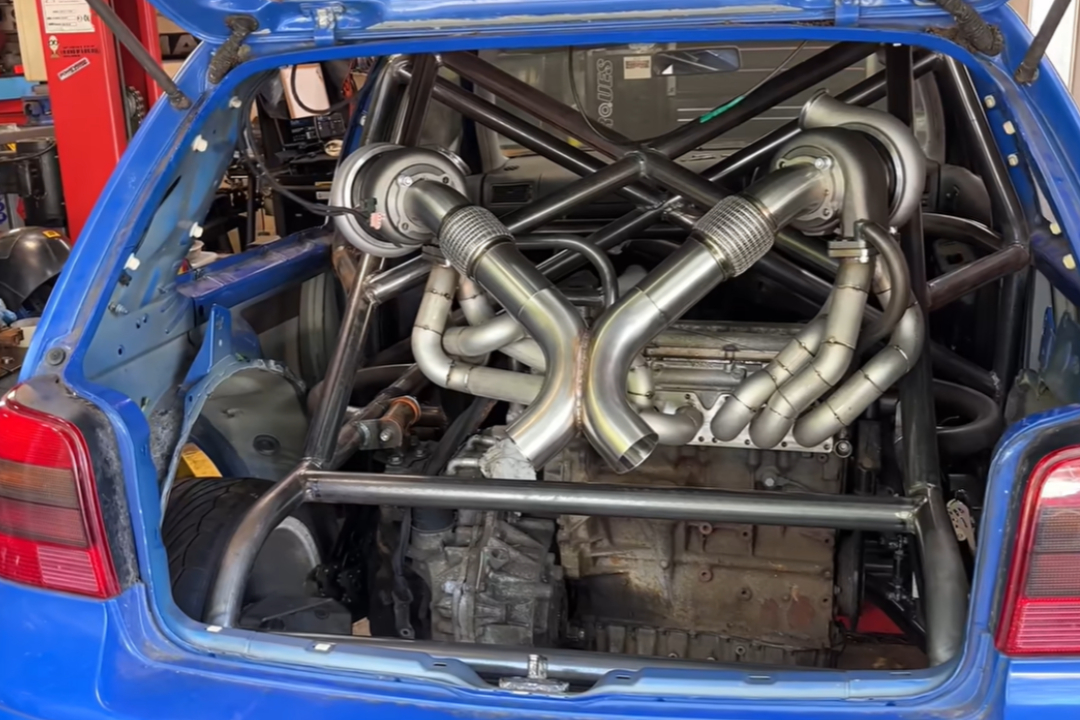
Most kids ask their parents for a new bike or a gaming console. This son asked for a 1,000-horsepower Volkswagen Golf with the engine relocated to where the back seats used to be. His father, a fabricator who runs the Twin Engine Corsa channel, said yes, and eleven weeks later the result is a Mk4 GTI that started life as an abandoned $610 wreck (£450) and now carries a 3.2-liter VR6 mounted in the rear, a full roll cage, and twin turbochargers finally plumbed into a hand-built exhaust system routed out through a replica R32 rear bumper.
The engine itself isn’t running yet. This particular stretch of the build was entirely about the plumbing, the collectors, manifolds, and exhaust routing that connect two turbochargers to six cylinders squeezed into a bay never designed to hold any of it. No commercial manifold exists for a rear-mounted VR6 in a Mk4 Golf, because nobody else has apparently been mad enough to build one. Everything had to be worked out by hand.
Building the Puzzle Piece by Piece
The process started with collectors, the fittings where three exhaust runners from each cylinder bank merge into a single pipe heading to its turbo. Six steel tubes went into a bandsaw jig set to a specific angle, producing two matching three-into-one collectors that were then bolted to thick steel blocks during welding specifically to stop the heat from warping the mounting flanges.
From there it became a genuine jigsaw puzzle, cutting, fitting, and welding individual pipe runners one at a time from each cylinder head port back to the collectors, working around the roll cage, the water jacket, and anything else physically in the way. Some compromises were unavoidable. One runner on the second manifold had to leave a slightly awkward gap specifically so a cylinder head bolt could still be removed later, a tradeoff the builder wasn’t thrilled with but accepted as necessary. Each runner took roughly two hours to complete, and he was upfront that plenty of people could move faster, this was simply his process, along with a preemptive jab at anyone likely to comment that the runners should have been equal length. By his own account, there was no fixed design guiding any of it beyond wanting the finished manifolds to look as good as they performed.
An X-Pipe to Keep One Sensor Honest
With both manifolds tacked together, attention shifted to the exhaust system feeding back from the turbos, which introduced a genuinely tricky problem: running twin turbos off a single lambda sensor risks one cylinder bank running dangerously rich or lean without the ECU ever knowing, since the sensor can only read what’s actually flowing past it. The fix was an X-pipe, a section that merges exhaust gases from both banks together before they reach the sensor, something the builder admitted he’d never actually built before but tackled anyway using 3-inch stainless tubing.
Getting the physical hardware right meant a late-night trip to Shrewsbury at 7:30 in the evening to collect a fiberglass replica R32 rear bumper and side skirts, parts needed simply to know where the exhaust tips would actually need to exit before any more pipework could be finalized. Two off-the-shelf silencer boxes, chosen specifically because building custom ones would have cost more in raw materials than the $68 (£50) units cost outright, got welded together with a deliberate small gap between them to keep both boxes sitting flush and square. Custom 3D-printed spacer blocks, each holding the pipework a precise 20 millimeters off the surrounding structure, kept everything level and symmetrical while the mounting brackets went in.
A Supply Hiccup That Nearly Stalled Everything
Progress hit a real obstacle when V-band flanges ordered online turned out to be plated mild steel rather than the stainless steel they’d been advertised and sold as, a problem that only became obvious once the metal started turning an unexpected gray color mid-weld. Without the correct flanges, there was no way to join the exhaust boxes to the downpipes, stalling the build outright until a friend came through the following day with two genuine stainless replacements, letting work resume roughly a day behind where it otherwise would have been.
Eleven Weeks, Then His Son’s Reaction
With the correct flanges finally in hand, the last pieces came together quickly: both exhaust pipes routed to their exit points, tailpipes fitted, and the whole assembly mounted through the cutouts in the replica R32 bumper. The final reveal was staged specifically for an audience of one. After keeping the finished exhaust hidden, the builder opened the boot and brought his son out to see the completed setup for the first time, the same son whose original idea had set the entire eleven-week project in motion.
His reaction matched the moment. Genuine shock, followed by simple approval that the finished car looked exactly like what he’d originally pictured. For a build built from a wrecked $610 shell, a relocated VR6, twin turbos, and a hand-fabricated exhaust system nobody else has apparently attempted on this specific platform, that reaction was really the only verdict that mattered.
More from Fast Lane Only
- Unboxing the WWII Jeep in a Crate
- 15 rare Chevys collectors are quietly buying
- 10 underrated V8s still worth hunting down
- Police notice this before you even roll window down
*Research for this article included AI assistance, with all final content reviewed by human editors.