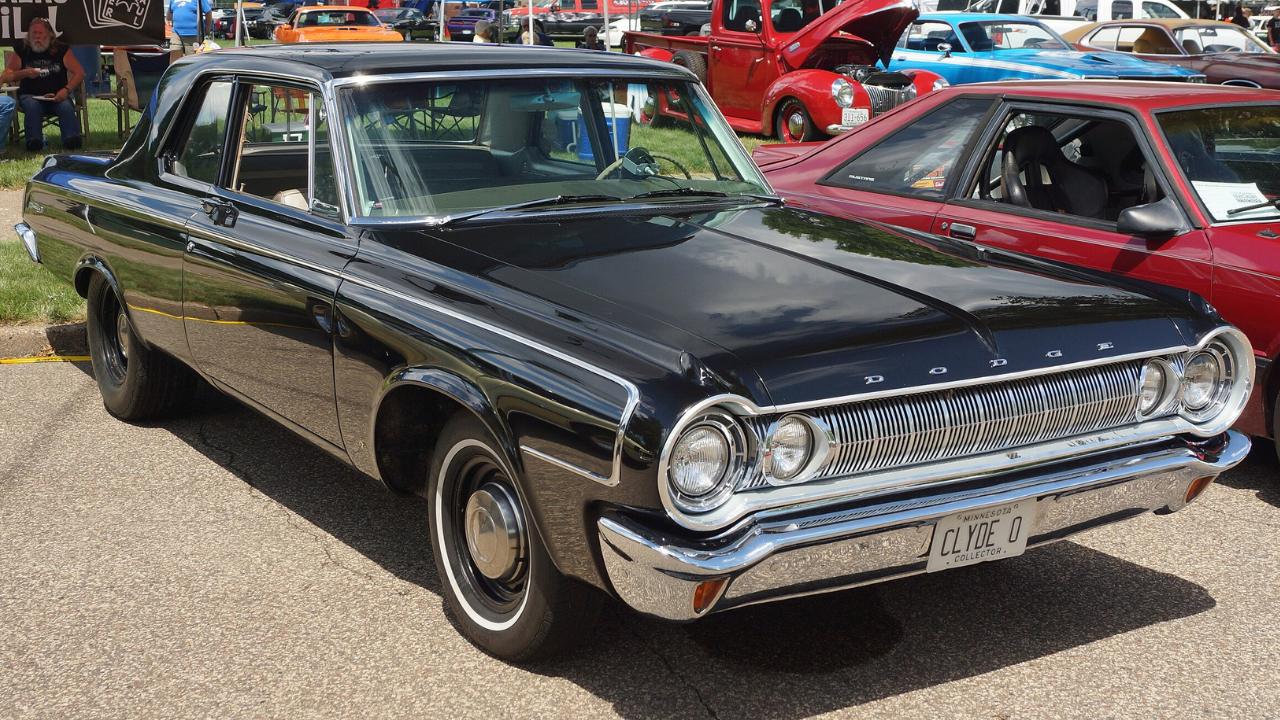
The 1964 Dodge 330 Max Wedge did not bother with show-car shine or boulevard comfort. It left the factory as a bare-knuckle weapon, built so racers could tow it to the strip, run hard, and win. In an era when muscle cars were starting to mix style with speed, this car stayed brutally single-minded about performance.
Born from Ramchargers and factory warfare
To understand why the Dodge 330 Max Wedge felt so uncompromising, it helps to start with the people who inspired it. Everyone in the know on vintage drag racing knows about Ramchargers, the group of Chrysler engineers and hot rodders who treated the quarter mile like a laboratory. Working inside Chrysler, they pushed the company toward purpose-built packages that could dominate sanctioned drag racing.
By the early 1960s, Dodge was locked in a horsepower war with rivals that were stuffing big engines into mid-size bodies. The Max Wedge program was Chrysler’s answer, and the Dodge 330 sedan became one of its sharpest tools. The 330 body was lighter and plainer than the upscale Polara, which made it ideal for racers who cared more about elapsed times than chrome trim. The result was a car that looked like a taxi at a distance but hid serious engineering underneath.
The 426 Max Wedge heart
At the center of the 1964 Dodge 330 package sat the 426ci Max Wedge engine, an evolution of Chrysler’s big-block V8 tailored for high rpm abuse. Technical notes on a period-correct build list the engine simply as the 426ci Max Wedge, with components specific to this program. The cylinder heads, intake, and exhaust were all shaped to move as much air and fuel as possible in the narrow window of a quarter mile run.
The Max Wedge intake was a signature piece. Two Carter carburetors sat on a cross-ram manifold that fed long, tuned runners, an arrangement that helped pack the cylinders at higher engine speeds. Factory literature rated these engines conservatively, but period accounts of the Max Wedge suggest that actual output was far stronger than the brochure numbers. The design philosophy was clear: sacrifice low-speed manners to gain everything at the top end.
That focus mirrored the broader Max Wedge story. The program had started with smaller displacements, then grew into the 426 as Chrysler chased more power. A separate overview of the engine family notes that the introduction of the 426 Hemi in 1964 marked the beginning of the end for the Max Wedge, which had already become a drag racing legend. The Hemi would soon steal the spotlight, but in the first half of that year the Max Wedge still represented Chrysler’s frontline competition engine.
Lightweight and stripped for speed
Factory lightweight versions of the Dodge 330 pushed the performance-first idea even further. One detailed description of a 1964 Dodge 330 Max Wedge Lightweight explains that the car was stripped of options, had the battery relocated to the trunk, and came with a much shorter final drive for better quarter mile performance. According to that account, the combination was tuned so that the car lived in the right gear and engine speed range at the track, with no concern for highway comfort or fuel economy.
The same report describes this Max Wedge Lightweight as a car that effectively left the showroom ready to run in the 10-second or 11-second range at the strip when properly set up. It was not a luxury model and did not pretend to be one. Even sound deadening and trim were treated as unnecessary weight.
That approach had precedent. A video tour of an earlier 1963 Dodge 330 sedan factory lightweight, described as one of only 34 produced, shows how far Dodge was willing to go in the name of weight reduction. The 330 body, already simple, became a canvas for thinner panels, minimal interior equipment, and race-focused hardware. The 1964 cars followed the same basic formula, refining it with the latest Max Wedge hardware.
From the showroom to the staging lanes
On paper, the idea of a car like the Dodge 330 Max Wedge sounds almost too extreme for mainstream buyers. In practice, Dodge did not intend to sell it to everyday commuters. These were “factory drag cars,” built so that a racer could sign paperwork at a dealership on Friday and be competitive at the strip on Saturday.
One modern feature on a 1964 Dodge 330 Max Wedge from Knoxville, Tennessee, lists the owner as Rick Lewis and treats the car as a kind of rolling time capsule. The writeup identifies the model simply as a ’64 Dodge 330 Max Wedge and describes how the car retains period-correct details that were specific to the Max Wedge program. The focus is on authenticity, including the way the engine is built and how the driveline is geared.
Another contemporary look at a 1964 Dodge 440 Lightweight with a 426 cid Max Wedge V8, described as 1 of 4, reinforces how rare these configurations were. That car is presented as a factory drag weapon featuring a cross-ram intake with dual Carter 4-barrel carburetors and a four-speed transmission. The description underlines the same theme: minimal options, maximum power, and a chassis set up for hard launches rather than quiet cruising.
Ramcharger Stage III and the last Max Wedge wave
By mid-1963, Chrysler had introduced the 426 Ramcharger Stage III Max Wedge, a purpose-built drag strip engine that represented the most aggressive version of the package. One modern feature on a tribute car explains that the Ramcharger Stage III arrived for mid ’63 and was specifically developed for quarter mile duty. That engine, with its high compression, big ports, and tuned exhaust, became the heart of the most serious Dodge 330 builds.
The Stage III era bled into the 1964 model year, when Dodge and Plymouth were still selling Max Wedge cars even as the new 426 Hemi loomed. A separate historical account notes that the Stage III Max Wedge could still be ordered at the start of 1964, but once production shifted to the Hemi in mid-year, only a few cars combined the new engine with the existing lightweight bodies. That transition makes the late Max Wedge 330s something of a last stand for the original big-block drag package.
In that sense, the 1964 Dodge 330 Max Wedge sits at a crossroads. It carries the full development of the Max Wedge concept, including the Ramcharger Stage III hardware, yet it also lives in the shadow of the incoming Hemi. For collectors and historians, that tension adds to the car’s appeal.
How the 330 body sharpened the Max Wedge
The choice of the 330 as a base was not accidental. Dodge offered more ornate models, but the 330 sedan was plain and relatively light. That meant less mass for the 426 to move and fewer decorative pieces to remove in the name of performance. In the hierarchy of Mopar drag cars, the 330 often sat below the flashier Polara, yet its simplicity made it a favorite among serious racers.
One social media feature on a Max Wedge Polara describes that car as capable of serious horsepower off the showroom floor, but the same piece makes clear that the lightweight 330 variants took the concept further. By skipping many comfort and appearance options entirely, the 330 Max Wedge Lightweight configuration delivered a sharper tool for the track. The car did not need polish, because its intended audience measured value in trap speeds rather than paint depth.
For context, a video walkaround of a barn find factory lightweight Max Wedge from 1964 shows how spartan these interiors could be. The footage highlights thin seats, basic door panels, and exposed metal that would have seemed unfinished in a regular family sedan. To a racer, that absence of trim meant fewer pounds to carry down the quarter mile.
Living with a Max Wedge today
Modern owners of Dodge 330 Max Wedge cars tend to treat them as artifacts of a more direct era. A Test Drive Tuesday video featuring Harrison and Ian in a 1964 Dodge 330 Max Wedge captures the experience from behind the wheel. The presenters describe the heat, the noise, and the immediacy of the throttle as they work through the gears. The car feels raw compared with later muscle machines, with a driveline that clearly prefers full-throttle pulls to gentle cruising.
That rawness is part of the appeal. Enthusiasts who seek out these cars often aim for period-correct builds, tracking down cross-ram intakes, correct exhaust manifolds, and the right rear gear ratios. The goal is not to make the car more livable, but to preserve the character that made it formidable at the strip in the first place.
Some owners go further, recreating the look of specific historical cars. A modern tribute to a 1964 Dodge 300 Max Wedge in Las Vegas, for example, uses the Ramcharger Stage III Max Wedge specification as a template. The builder leans into the drag-strip identity, keeping the car low on frills and high on mechanical drama.
Max Wedge versus Hemi
Any discussion of the 1964 Dodge 330 Max Wedge eventually runs into the question of how it stacks up against the Hemi that followed. A historical overview of the engine family notes that the introduction of the 426 Hemi in 1964 was the beginning of the end for the Max Wedge. Initially a competition-only engine, the Hemi quickly became the new hero of Chrysler’s racing program, with cylinder heads that flowed even better and a combustion chamber design that supported higher power levels.
Yet the Max Wedge retained a distinct identity. Where the Hemi was celebrated for its hemispherical chambers and broad torque curve, the Max Wedge was remembered for its single-minded focus on high rpm drag racing. Its output was often understated compared to actual dyno results, and its manners on the street could be rough. For purists, that lack of compromise is exactly what makes the Max Wedge era special.
The Dodge 330 Max Wedge captures that character in a way few other models do. It pairs the most aggressive version of the engine with a body that offers almost nothing extra. In an age when performance packages were starting to blend speed with creature comforts, the 330 Max Wedge stayed closer to a purpose-built race car.
Rarity, value, and the “holy grail” factor
Because so many Dodge 330 Max Wedge cars were raced hard, survivors today are rare. The 1963 Dodge 330 sedan factory lightweight highlighted as one of only 34 produced has been described in enthusiast circles as a “holy grail” find. That level of scarcity, combined with the car’s direct link to factory-backed drag racing, helps explain why collectors chase these cars so intensely.
Later 1964 examples, especially those with documented Max Wedge Lightweight packages, command similar attention. Auction listings for cars like Mr. Norm’s 1964 Dodge Polara 330 Hemi factory light configuration show how the market values lightweight Mopars with serious engines. While that particular car combines a Hemi with a 330 body, the pattern is clear: lightweight, big-engine Dodges from this era sit near the top of many wish lists.
More from Fast Lane Only