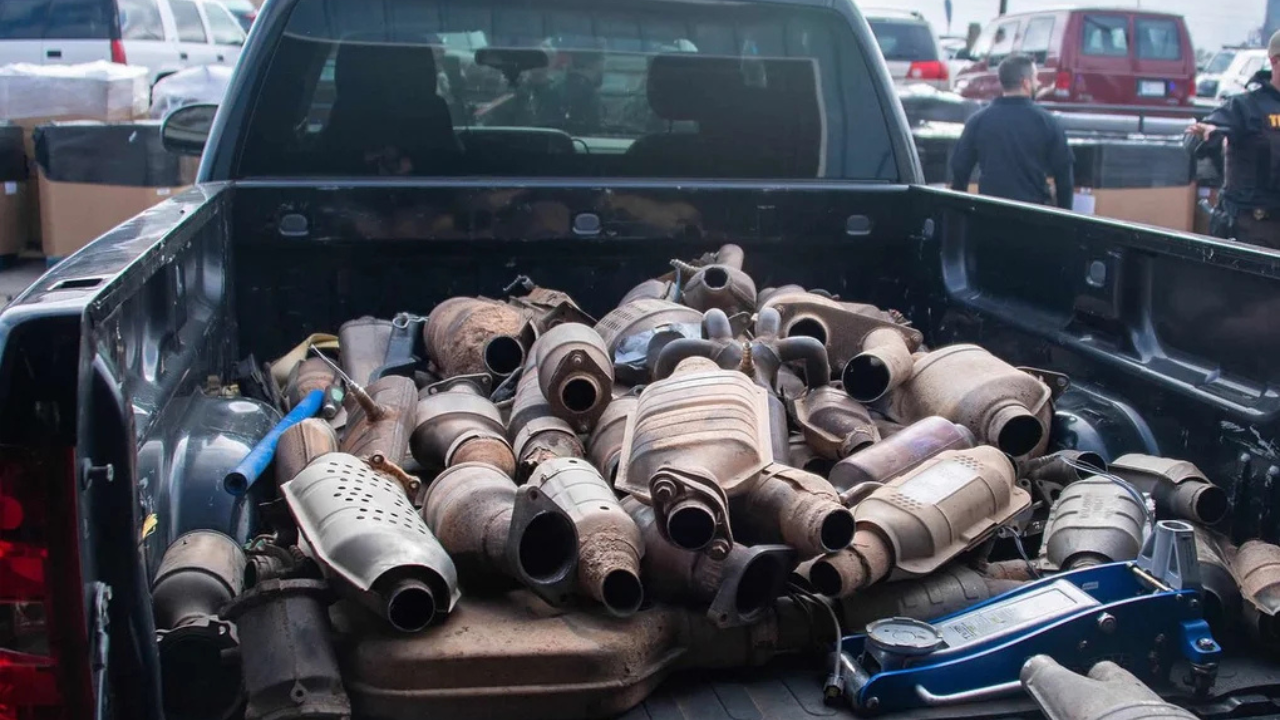
Federal agents say an unassuming East Coast auto business quietly evolved into a national hub for stolen catalytic converters, turning a neighborhood shop into a sprawling side-hustle empire. You see the fallout in your own driveway, when a morning commute is derailed by the guttural roar of a car that has been stripped overnight. What looks like a local nuisance is, in fact, the front end of a highly organized supply chain that has moved hundreds of millions of dollars in metal.
To understand how one regional operation could sit at the center of that trade, you have to follow the trail from street-level thieves to suburban warehouses, encrypted apps, and finally to industrial refineries. Along the way, federal indictments, multimillion-dollar forfeiture demands, and raids on luxury homes have exposed how a single New Jersey business allegedly helped turn stolen parts into a national commodity.
From sleepy Jersey shop to national hub
If you drove past the low-slung buildings and strip malls of Holmdel, New Jersey, you would not immediately suspect that federal agents would one day swarm a property there as part of a catalytic converter trafficking probe. Yet investigators say a New Jersey based buyer became a central clearinghouse, paying cash for stolen parts that had been ripped from SUVs and sedans across the country, then shipping them out in bulk. The business sat close enough to affluent neighborhoods that agents later searched a home on Bucks Mill Lane, a property valued at about $1.7 million, as they traced the money and metal flowing through the alleged ring.
Federal court filings later described how the owner and operator of New Jersey based D.G. Auto Parts, identified as Khanna, admitted that the company bought stolen catalytic converters and shipped them to a metal refinery after processing. According to those documents, Khanna acknowledged that D.G. Auto Parts purchased the parts from thieves and intermediaries, then had the units cut open so the precious metals could be extracted and sold, turning a local scrap operation into a national player. In a plea agreement, Khanna conceded that the New Jersey business was not just another junkyard, but a key node in a broader stolen-goods network.
How a side hustle scaled into a $600 million pipeline
What began as a side hustle for thieves sliding under parked cars turned into a sophisticated logistics chain that federal authorities say generated staggering revenue. From 2020 to 2022, an organized criminal group stole catalytic converters across multiple states and sold them to D.G. Auto Parts, which then resold the material to a refinery. Court records describe how that flow of metal produced hundreds of millions of dollars in revenue for the New Jersey company, with one federal summary pegging the broader theft ring at roughly $600 million.
To keep that pipeline moving, D.G. Auto Parts did not rely on handwritten ledgers or guesswork. Investigators say the company built a dedicated app that gave buyers and thieves real time pricing for different converters, adjusting payouts based on the make and model of the vehicle. That meant a converter from a late model Toyota Prius or a Ford F 250 truck could fetch more than one from an older compact, and the app pushed those numbers directly to customers such as Vang Auto in the Midwest. According to federal descriptions, DG Auto’s software let prices change quickly as metal markets moved, turning what might have been a back alley scrap deal into a data driven commodity trade.
The federal crackdown that followed the money
Once federal agents mapped that flow of parts and payments, they moved aggressively. In one sweeping action, The Department of Justice announced charges against 21 people accused of running a nationwide catalytic converter theft ring, and prosecutors said they would seek more than $545 million in forfeitures tied to the scheme. Those indictments described how stolen converters were funneled from local thieves to regional buyers and then to national aggregators, including the New Jersey hub, before being shipped to a refinery that paid out hundreds of millions of dollars for the material, a pattern detailed in federal charging documents.
Homeland Security Investigations, working with other agencies, framed the case as part of a broader push to dismantle national converter theft networks. In the Eastern District of California Case, a federal grand jury returned a 40-count indictment that charged multiple defendants with conspiracy, interstate transportation of stolen property, and money laundering, among other offenses. That filing, brought in the Eastern District of California, was paired with a related Northern District of Oklahoma Case that targeted buyers and shippers in the middle of the country, illustrating how the same stolen parts could touch multiple jurisdictions as they moved from driveway to refinery. The scope of that 40-count indictment underscored how far the alleged side hustle had spread.
Holmdel raids and the East Coast front door
For East Coast drivers, the crackdown became visible when federal agents descended on properties in New Jersey. At least 21 people were arrested in four states and accused of trafficking stolen catalytic converters to buyers in places like New Jers, where the parts could be aggregated and shipped onward. Local coverage described how the parts, packed into pallets and containers, were worth more than gold by weight because of the platinum, palladium, and rhodium inside, a reality that helped explain why thieves could earn quick cash while buyers quietly built fortunes. Those arrests, which swept up alleged suppliers and middlemen, showed how a regional hub could sit at the center of a four state network.
In Holmdel itself, the scale of the operation came into focus when FBI, Homeland Security Investigations, and IRS agents raided the upscale home on Bucks Mill Lane and other properties tied to the alleged ring. Federal agents confiscated more than $1 million in cash, along with luxury vehicles and even gold bars shaped like catalytic converters, as they searched the $1.7 m residence and related business locations. For neighbors, the sight of FBI, Homeland Security Investigations, HSI, and IRS jackets on a quiet street was a jarring reminder that the same parts being cut from cars in commuter lots were feeding a multimillion dollar enterprise headquartered just down the road, as detailed in $1.7 million seizure reports.
What it means for your car, your street, and your city
For you, the story matters less as a courtroom drama and more as a practical risk. The same economic logic that turned D.G. Auto Parts into a national buyer still drives thefts in apartment lots and cul de sacs, especially for vehicles like the Toyota Prius, Honda CR-V, and Ford F 250 that carry higher value converters. Federal investigators have shown that stolen parts do not linger in local scrap yards; they move quickly through buyers, apps, and shipping lanes to reach industrial refineries that can pay hundreds of millions of dollars for processed metal, a pattern that one federal summary described as a mystery solved for local police who had long wondered where the parts went.
That is why you now see more cameras in parking garages, more welders installing anti theft shields, and more local ordinances that require scrap buyers to log identification and proof of ownership. Federal cases in the Eastern District of California and the Northern District of Oklahoma, along with the New Jersey raids, have made clear that catalytic converter theft is not a petty crime but a national supply chain that can be disrupted only if every link is pressured. For communities along the East Coast, from Holmdel to other towns tied to the alleged ring, the lesson is that a quiet industrial bay or a modest storefront can mask a sprawling operation, whether it is a warehouse, a fenced yard, or even a facility listed in online business directories that looks like any other parts dealer from the street.
More from Fast Lane Only