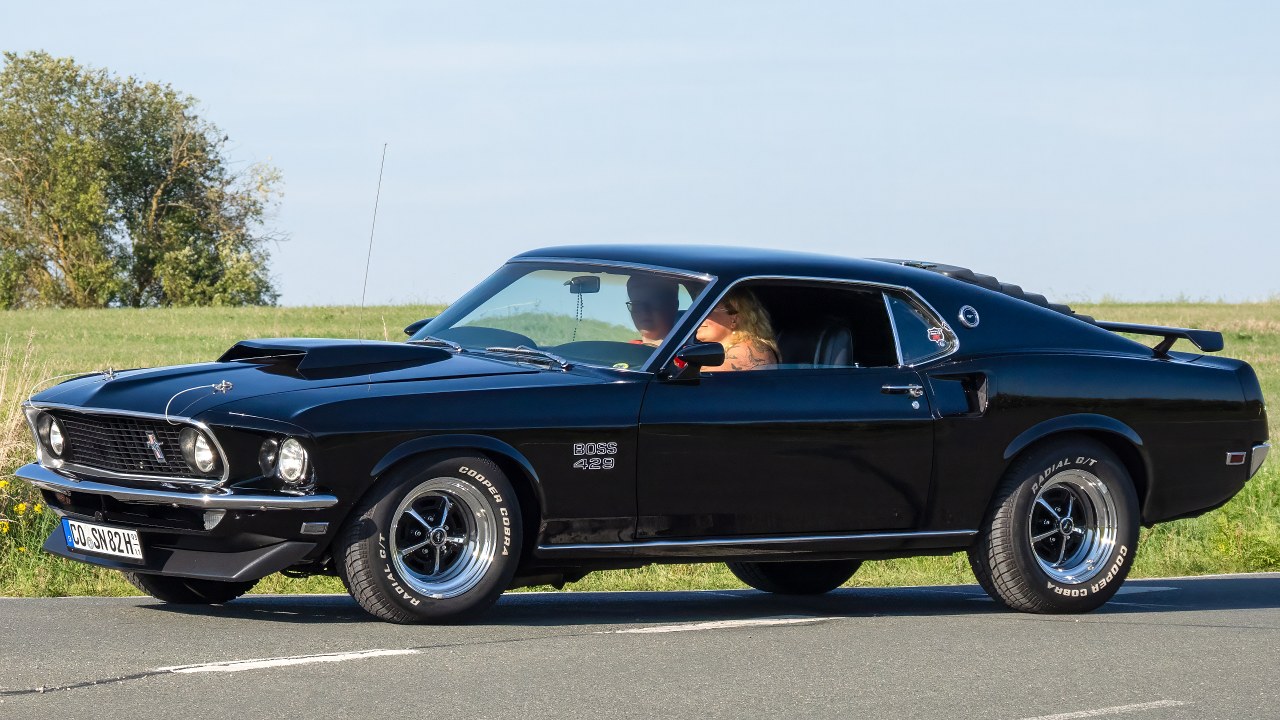
The 1969 Mustang Boss 429 was never meant to be practical. It was a street-legal NASCAR weapon, a car built around an engine so large that Ford had to reshape the Mustang’s structure simply to shoehorn it under the hood. The result was a low-production brute that looked like a pony car but was engineered like a race homologation special.
What emerged from that engineering contortion act is one of the most coveted muscle cars ever built, a machine whose legend rests as much on its hacked-up shock towers and custom mounts as on the ferocity of the 429 cubic inch V8 that created the problem in the first place.
The NASCAR problem that created the Boss 429
The story starts with racing, not with showrooms. Ford was chasing dominance in NASCAR and needed a new big-block that could breathe at high rpm and survive the punishment of long oval races. The answer was the Boss 429 engine, a purpose-built 429 cubic inch V8 with hemispherical-style cylinder heads and massive ports that were closer to race hardware than anything in a typical street Mustang.
On paper, Ford rated this 429 at 375 horsepower. According to period builders and race mechanics, that figure was intentionally conservative. Those same sources describe how the engine was easily worth more than 50 additional horsepower in near-stock form, which puts it well into big-league territory for the late 1960s. The company needed that kind of output to stay in the game against rivals from Chrysler and other manufacturers that were already fielding serious big-block packages.
To get the engine on the track, Ford had to homologate it by installing it in a road car and selling a minimum quantity to the public. That is where the Mustang came in. The decision to use the pony car as the host for the Boss 429 was as much about image as it was about engineering, and it set up the packaging nightmare that followed.
Why the Mustang body was a terrible fit
From a pure engineering perspective, Ford had a better option than the Mustang. Contemporary reports explain that the larger Ford Torino body shell would have made far more sense for a physically enormous engine like the Boss 429. The Torino had a wider engine bay and more generous shock tower spacing, which would have reduced the amount of surgery required.
Marketing and performance image won the argument. Ford wanted its halo NASCAR engine associated with the Mustang, not a mid-size sedan. That decision meant cramming the 429 into a car that had been designed around small-blocks and the occasional big-block 428, not an exotic race-bred unit with gigantic heads and intake runners. The front structure of the Mustang simply was not designed for that kind of girth.
The mismatch between engine and chassis is what gives the Boss 429 its special aura today. The car looks like a slightly more aggressive Mustang, but underneath, the front end was heavily reworked to cope with the engine’s size and weight.
Kar Kraft and the off-site surgery
Ford did not try to handle the conversion in its regular assembly plants. Instead, it turned to an outside contractor with racing experience. Production on the Boss 429 began in Brighton, Michigan, where Kar handled the heavy modifications. Completed Mustang bodies were shipped to this facility, then torn apart and rebuilt to accept the huge engine.
Accounts from the period describe how Ford sent 428CJ Mustangs to the contractor’s plant in Brighton, Michigan, where workers converted them into Boss 429s. In one detailed description of the making of a, the process involved cutting and reshaping the front structure to clear the wider cylinder heads and exhaust manifolds. The work went far beyond a simple engine swap.
The result was a kind of semi-handbuilt Mustang. Cars arrived at the contractor’s facility as regular big-block models and left as NASCAR homologation specials, with new front-end geometry, unique structural reinforcements, and a completely different personality on the road.
Shock towers, inner fenders, and the fight for space
The most dramatic changes were to the Mustang’s shock towers and inner fenders. The stock towers intrude deep into the engine bay to support the front suspension. That layout worked with a 289 or 302 small-block and could be adapted to the 428CJ, but it collided directly with the wide heads of the Boss 429.
To clear the engine, workers at the Brighton, Michigan, plant cut back and reshaped the shock towers, then reinforced them so the front suspension would still have adequate strength. Contemporary technical descriptions of fitting a 429 into a 1969 fastback confirm how tight the clearances were, even in cars that tried to replicate the factory setup. Enthusiasts describe the swap as possible but neither cheap nor easy, which echoes the extensive work Ford commissioned for the original program.
These structural changes did more than make room. They subtly altered the car’s handling, since the front suspension pick-up points and stiffness characteristics changed once the towers were modified. That is part of why the Boss 429 feels different from other big-block Mustangs of the era, even before the engine’s torque comes into play.
Custom mounts that moved the engine
Even after the shock towers were carved back, the Boss 429 still did not quite fit. The solution was a set of unique engine brackets. Period-correct parts listings for Mount hardware describe a pair of Boss 429 motor mount brackets designed specifically to move the engine forward in the chassis so that the block and heads could clear the reworked towers and firewall.
That relocation had several knock-on effects. Pushing the engine forward shifted the weight toward the nose, which is why accounts of the conversion process mention that the changes made the car nose-heavy. It also affected driveshaft length, transmission mount location, and even accessory placement under the hood. The Boss 429 is a reminder that packaging a race engine in a street car often means rethinking everything from the radiator support to the steering linkage.
The need for custom mounts also explains why backyard swaps rarely match the factory cars. Without the exact brackets and structural changes used on the originals, a 429 swap into a 1969 or 1970 Mustang usually involves compromises in steering clearance, header routing, or serviceability.
Suspension and chassis tweaks to cope with the weight
Installing a massive iron big-block ahead of the front axle did not just crowd the engine bay. It also loaded the front suspension far beyond what a small-block Mustang would experience. To cope, the Boss 429 package incorporated specific suspension and chassis upgrades.
Technical discussions of reinforced suspension on these cars describe heavier front springs, revised control arm geometry, and additional bracing to keep the front structure from flexing under cornering loads. The goal was not to create a nimble sports car but to keep the car stable at the high speeds its engine encouraged.
Owners and restorers often comment that a Boss 429 feels heavier on its nose than other Mustangs of the period. That trait is baked into the design. The combination of a tall-deck block, huge heads, and a forward engine location created a weight distribution that favored straight-line stability over quick turn-in. For a car whose primary mission was to qualify an engine for NASCAR, that compromise made sense.
Intake, carburetion, and the “Massive Engine” character
The Boss 429’s physical size was not just about displacement. Its breathing hardware also contributed to the packaging headache. The engine used a large single four-barrel carburetor on a high-rise intake manifold, which increased overall height and complicated air cleaner and hood clearance.
Contemporary performance write-ups describe how the package included a 735 CFM Holley four-barrel carburetor as standard equipment. One analysis of why the 1969 Mustang Boss 429 was a hidden gem highlights that It Had a Massive Engine with a 735 CFM Holley setup that dwarfed the carburetion on other Mustangs of that time. The intake manifold was designed for high-rpm flow rather than low-end drivability, which further reinforced the car’s race-first personality.
All of that hardware had to sit under a production hood, which is why the Boss 429 received its distinctive scoop and specialized air cleaner assembly. The external styling cues that enthusiasts admire today grew directly out of the mechanical constraints of fitting such a tall induction system into a relatively low-profile pony car body.
How many cars, and why collectors obsess over them
Because the Boss 429 existed primarily to satisfy racing rules, production numbers were always limited. One detailed feature on a surviving example notes that only 859 were built for 1969, which immediately set the car apart from the volume Mustangs. The combination of rarity, competition pedigree, and radical engineering changes has made the model a blue-chip collectible.
Modern enthusiasts often refer to the 1969 Ford Mustang Boss 429 as Muscle Car Royalty, a term that reflects both its scarcity and its connection to top-level stock car racing. The fact that each car required extensive handwork at a separate facility only deepens the mystique. These were not simple option packages bolted together on a high-speed assembly line.
Photos and recollections shared in enthusiast communities show how the car’s unique front-end structure, engine bay layout, and even undercarriage details differ from standard Mustangs. Collectors obsess over correct brackets, stampings, and reinforcements because those pieces tell the story of how radically Ford had to alter the host car to make the engine fit.
The cultural memory of a factory hot rod
The Boss 429 has taken on a life beyond its original homologation role. Social media posts and enthusiast videos often highlight how Ford created it as a 1969 Mustang Boss 429 with one mission: to destroy Mopar on the track. Those same posts emphasize that Ford took a regular Mustang and modified the chassis just to make space for this beast, a narrative that has become central to the car’s legend.
Firsthand restoration accounts reinforce the point. One detailed project story about a 1969 BOSS 429 rebuild describes how every aspect of the front structure and drivetrain had to be addressed to remain faithful to the original design. The level of complexity goes far beyond a typical engine swap, which is why genuine cars command such attention and value.
In that sense, the Boss 429 represents a particular moment in American performance history, when manufacturers were willing to bend production processes and reengineer existing models to win on Sunday. The car’s continued presence in shows, auctions, and online communities keeps that era alive for new generations of enthusiasts.
Legacy of the engineering compromise
The legacy of the Boss 429 is not just about raw numbers, although those remain impressive. The 429 displacement, the underrated 375 horsepower rating, and the extra 50 or more horsepower that racers routinely extracted all contribute to its myth. So does the fact that the engine’s size and unique design made it difficult to install in anything smaller than a full-size body, yet Ford insisted on the Mustang as its showcase.
More from Fast Lane Only