
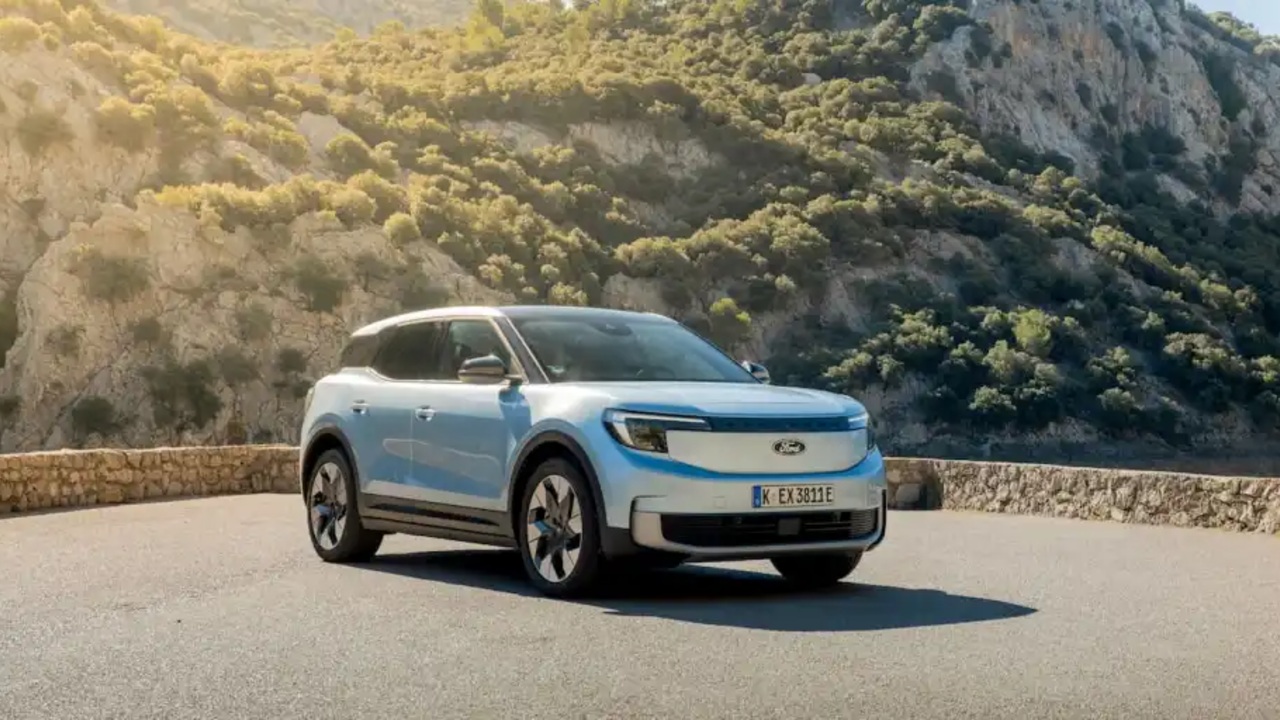
Ford is reshaping its electric strategy around price, practicality, and scale, turning what were once niche experiments into products aimed squarely at mainstream buyers. After years of chasing high-end trucks and performance crossovers, the company is now building a family of smaller, cheaper battery models and hybrids that are designed to undercut used rivals on cost of ownership and blunt the rise of low-cost Chinese competitors.
The pivot is not subtle. Ford is taking a multibillion-dollar hit to walk away from some of its earliest electric bets, while pouring fresh investment into a new platform, cheaper batteries, and a broader hybrid lineup. The result is a portfolio that makes its least expensive electric vehicles harder to ignore, not because they are flashy, but because they are starting to look like the most rational choice in the showroom.
A costly retreat from big EVs, and a bet on smaller ones
Ford has effectively admitted that its first wave of large, expensive EVs was a strategic dead end, and it is paying dearly to change course. The company is taking a $19.5 Billion charge to account for earlier electric investments and will Write Down EV Investments, Will Cancel the electric 150 Lightning pickup. That decision underscores how quickly the economics of big battery trucks have soured as demand cooled and price wars intensified, particularly against cheaper rivals from China and aggressive discounting on used Teslas.
Instead of doubling down on halo products, Ford is redirecting capital to a new generation of compact and midsize EVs that can be built and sold at far lower cost. Reporting on the company’s updated strategy describes a focus on smaller, affordable models and a midsize electric truck built on a fresh electric-vehicle platform, with executives characterizing this shift to lower priced vehicles as nonnegotiable if Ford is to compete with Chinese brands such as BYD and its Atto 3 crossover. The company is effectively trading volume at the top of the market for a chance to dominate the middle, where price-sensitive buyers still want trucks and crossovers but can no longer justify luxury-level EV stickers.
The new platform that makes “cheap” look smart
At the heart of Ford’s push into more attainable EVs is a clean-sheet platform engineered for cost, simplicity, and scale. The company has said that this architecture will underpin several smaller electric models, including that midsize truck, and that it was designed from the outset to be built efficiently in the United States. Internal targets call for a “breakthrough product” that can be sold profitably at a price point that once seemed reserved for gasoline compacts, a goal that depends on wringing out every unnecessary part and process from the vehicle.
Ford executives have described a “breakthrough process” that strips roughly 4,000 feet of wiring from the vehicle and removes hundreds of pounds of weight, a change that cuts both material and assembly costs while improving efficiency. The simplified architecture is also being paired with cheaper LFP battery chemistry, which industry observers note is central to the company’s claim of a major EV breakthrough. By integrating LFP packs into this low cost platform, Ford is positioning its next wave of EVs as not just cheaper to buy, but also cheaper to maintain and operate over time than many used electric crossovers on the market.
Undercutting a used Tesla on total cost
Ford is not only chasing a lower sticker price, it is explicitly targeting the economics of the used EV market. In outlining its affordable EV plan, the company has said that its new models are being engineered to deliver a “lower cost of ownership over five years than a three-year-old used Tesla Model Y.” That is an audacious benchmark, because the Model Y has become the de facto reference point for mainstream electric crossovers, especially in the used market where depreciation has made it more accessible.
To beat a three-year-old Tesla on five-year ownership costs, Ford has to attack every line item that matters to a budget-conscious buyer. The company’s focus on simpler wiring, lighter structures, and LFP batteries is meant to reduce manufacturing costs and improve durability, which in turn should support lower prices and potentially better warranty performance. At the same time, Ford is investing billions into a broader program of cheaper EVs in the roughly $30,000 range, a price band that its leaders have identified as critical for mass adoption. If the company can deliver a compact crossover or truck that undercuts a used Model Y on monthly costs while offering fresh-car warranties and updated tech, it will have created a compelling reason for shoppers to choose new over used.
Hybrids as the bridge, not the fallback
Ford’s cheaper EVs are arriving alongside a significant expansion of hybrids, which the company now treats as a core pillar rather than a stopgap. Executives have acknowledged that the pure EV market will be “way smaller” than early forecasts suggested, and they are retooling factories and product plans to add more hybrid and plug-in hybrid options across the lineup. Reporting on the company’s internal thinking describes a deliberate move to revamp earlier EV-heavy plans, with more resources flowing to hybrids that can deliver better fuel economy and lower emissions without requiring customers to fully abandon gasoline.
That shift is already visible in the product cadence. Ford has announced that its new EV platform will support several smaller electric models, while at the same time it is expanding hybrid offerings in key segments such as pickups and crossovers, a strategy detailed in recent coverage of its cheaper hybrid and EV push. Company leaders have been explicit that they are not “counting out” EVs, but they see hybrids as a pragmatic bridge for buyers who lack home charging or remain wary of range and resale values. In practice, that means a showroom where a customer can cross-shop a low cost EV, a hybrid, and a conventional gasoline model at similar price points, with Ford capturing the sale regardless of how quickly the EV share of the market grows.
A global price war Ford cannot ignore
Behind Ford’s domestic product decisions is a global competitive landscape that is shifting toward smaller, cheaper EVs at a pace that alarms established automakers. Chinese manufacturers, led by companies such as BYD, have used vehicles like the BYD Atto 3 to demonstrate how aggressively priced electric crossovers can be when supply chains, batteries, and platforms are optimized for cost from day one. Ford’s leadership has described the shift to smaller, more affordable EVs as “nonnegotiable” if the company is to withstand that pressure, particularly as Chinese brands eye export markets and potential North American production.
Ford’s response is to localize its own cost-cutting innovations, from LFP battery sourcing in the United States to the streamlined wiring and architecture of its new platform. Internal and external commentary on the company’s “breakthrough” emphasizes that the real innovation is not a single technology, but the integration of cheaper components and simpler designs into a cohesive, low cost product line. By pairing that with a renewed focus on hybrids and a willingness to absorb a Billion Charge on past EV bets, Ford is signaling that it would rather reset now than be outflanked later by rivals that treat affordability as a core feature rather than a late-stage discount.
More from Fast Lane Only


Leave a Reply