
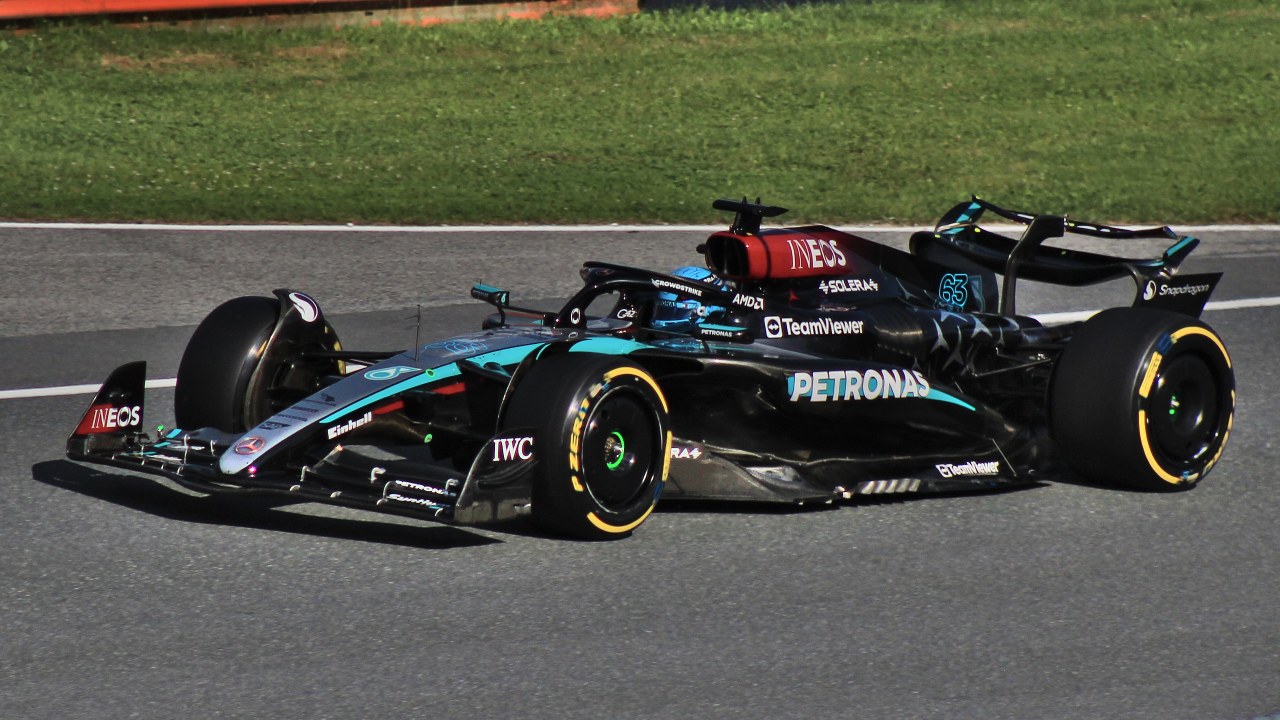
George Russell has lifted the lid on a contract request so extravagant that even Mercedes drew the line, revealing how far a modern Formula 1 driver will go to secure a piece of history. Instead of haggling over the usual perks, he tried to write a full grand prix car into his deal, only to be firmly rebuffed by Toto Wolff. The story offers a rare glimpse into the balance of power between a top driver and one of the sport’s most successful teams.
The audacious bid for a Mercedes F1 car
When George Russell sat down to negotiate his Mercedes deal, he did not limit himself to salary figures or performance bonuses. He has now admitted that he asked for an entire Mercedes Formula 1 car to be included in his contract, a request he knew was ambitious but still felt was worth attempting. Rather than pushing for marginal gains on the usual clauses, he tried to secure a full race machine for his personal collection, a step that underlined both his confidence in his status and his appreciation of the machinery he drives.
Russell has described how he wanted a complete car, not just a showpiece chassis stripped of its secrets, and he framed it as a once in a career opportunity to retain a piece of the team’s engineering. He explained that he raised the idea directly during talks, only for Mercedes to reject it outright, with Toto Wolff making clear that such a concession was not on the table. The Brit has portrayed the exchange with a degree of humour, acknowledging that the request was “big” and that he was effectively told no chance, but the very fact he made it illustrates how drivers now think about legacy and memorabilia alongside results.
Why Mercedes and Toto Wolff said no
From Mercedes’ perspective, Russell’s proposal cut straight across the realities of how modern Formula 1 teams operate. Toto Wolff is reported to have pointed out that current regulations and cost caps mean teams are limited in how many chassis they can build and run, with figures in the region of three or four monocoques per season being typical. Handing one of those rare and extremely expensive cars to a driver would not only be financially painful, it would also complicate logistics and spares planning across a long campaign.
There is also the question of intellectual property, which has become one of the most sensitive issues in the sport. A current or very recent Mercedes car embodies years of design work and competitive advantage, and Wolff is understood to have been unwilling to let a complete example leave the team’s direct control. Even if the power unit and some sensitive components were removed, the chassis and aerodynamic surfaces would still reveal too much. Against that backdrop, his refusal of Russell’s request was immediate, with the team principal making clear that the cars would remain within Mercedes rather than in a driver’s private garage.
How Russell’s request fits F1’s culture of perks
In the context of Formula 1 contract negotiations, Russell’s gambit stands out because it goes far beyond the usual bargaining chips. Drivers and their representatives typically focus on image rights, travel arrangements, and performance-related bonuses, sometimes stretching to details such as private jet usage or the number of personal staff allowed in the paddock. By contrast, asking for a full grand prix car is almost unheard of in the current era, particularly when teams are already constrained by cost caps and strict accounting of every component they build.
Russell has contrasted his own request with the more conventional clauses that dominate most deals, noting that he was not arguing over marginal perks but trying to secure something unique. His attempt reflects a broader shift in how drivers view their careers, with an increasing emphasis on building personal collections that tell the story of their time in the sport. While some former champions have acquired older machinery once it is decommissioned, the idea of writing a contemporary car into a contract, as Russell tried to do with Mercedes, pushes that trend to an extreme that even a leading team was not prepared to accept.
The rarity and value of modern Mercedes chassis
Part of the drama around Russell’s request lies in the sheer scarcity and value of the cars he was targeting. Modern Mercedes machines are produced in very limited numbers, with teams often operating with only a handful of chassis across an entire season. Each monocoque is the product of intensive design and manufacturing effort, and the cost of building and maintaining them is tightly monitored under Formula 1’s financial regulations. Giving one away would not be a symbolic gesture, it would be a material hit to the team’s resources.
Russell has acknowledged that Mercedes typically cycles through a small pool of chassis, with some estimates suggesting that in earlier eras teams might have built 15 to 20 cars across a campaign, whereas now the number is far lower. That historical comparison helps explain why Wolff was so quick to dismiss the idea of handing over a complete car. In a time when every spare front wing and underbody is counted against a cost cap, the notion of transferring an entire chassis to a driver, even one as highly rated as Russell, runs counter to the way teams now manage their assets and protect their competitive edge.
What the failed demand reveals about Russell and Mercedes
For me, the most revealing aspect of this episode is what it says about George Russell’s mindset and his relationship with Mercedes. The request itself shows a driver who is unafraid to test boundaries, comfortable enough within the team structure to float an idea that he suspected would be rejected. It also underlines how seriously he takes the historical significance of the cars he drives, seeing them not just as tools for scoring points but as artefacts worth preserving in his own name. That blend of ambition and self-awareness is consistent with the way he has presented himself since stepping up to the works team.
On Mercedes’ side, the firm refusal from Toto Wolff reinforces the image of a team that guards its machinery and intellectual property with absolute discipline. Even for a driver regarded as a central part of the team’s future, the answer was a clear no, which in turn signals to the rest of the paddock that certain lines will not be crossed in negotiations. Yet the fact that Russell feels comfortable recounting the story, and doing so with a light touch, suggests that the episode has not damaged the underlying trust between driver and team. Instead, it has become a telling anecdote about how far a modern star will go in search of a tangible piece of Formula 1 history, and how firmly a top outfit will hold the line when its cars are at stake.
More from Fast Lane Only

Leave a Reply