
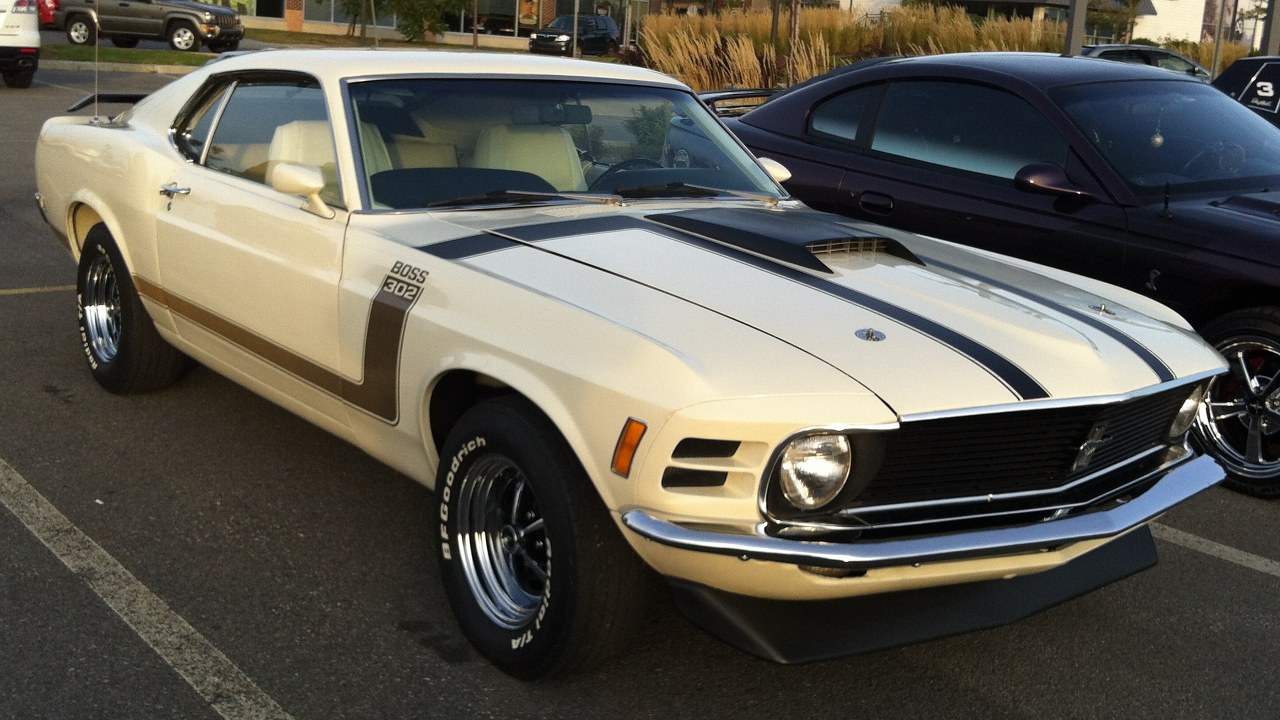
The 1970 Ford Mustang Boss 302 arrived at a moment when Detroit’s muscle wars were defined by quarter-mile bragging rights, yet it quietly rewrote the rules for how a street car could handle, rev and survive daily use. Instead of chasing ever-bigger displacement, it fused a high-strung small-block with road-race suspension tuning and purposeful styling that made track engineering part of mainstream performance culture. That mix of civility and aggression helped set the template for modern street machines that are expected to corner as hard as they accelerate.
By pairing a competition-bred chassis with a relatively compact V8, the Boss 302 showed that a car could be Born to Race, Built for the Streets without sacrificing reliability or basic comfort. Its influence still echoes in today’s factory track packages and retro-inspired specials that promise race-ready capability straight from the showroom.
Trans-Am rivalry and the birth of a street-legal road racer
The Boss 302 did not emerge in a vacuum; it was Ford’s answer to a very specific problem on the racetrack and in the showroom. Chevrolet’s Camaro Z/28 had carved out a niche as a nimble Trans-Am contender, and Ford watched Z/28 sales climb from 602 units in 1967 to 7,199 in 1968. There was no Mustang that could match that blend of race credibility and street usability, so Ford greenlit a homologation special that would satisfy Trans-Am rules while enticing buyers who wanted something sharper than a standard pony car.
To make that happen, Ford turned to designer Larry Shinoda, a former GM talent who understood both racing and showroom drama. Shinoda shaped The Boss 302 Mustang into a car that looked ready for a grid spot, deleting fake rear-quarter scoops and tightening the stance so the body matched the car’s competition intent. The resulting Mustang was not just another stripe-and-badge package; it was a street-legal extension of Ford’s Trans-Am program, built to carry race-bred hardware into everyday traffic.
The high-revving heart that redefined small-block muscle
Where many muscle cars of the era leaned on sheer displacement, the Boss 302 staked its reputation on a compact, high-winding V8 that behaved more like a race engine than a boulevard bruiser. The 302 M small-block was engineered to spin hard and breathe freely, a configuration that let the car trade low-rpm laziness for a top-end rush that rewarded drivers who kept the tach needle climbing. That character helped prove to street buyers that a smaller, more sophisticated engine could feel just as thrilling as a big-block when driven with intent.
Under the hood, The Boss used a solid-lifter small-block topped by the largest carburetor Ford bolted to a production engine at the time, a 780-cfm Holley four-barrel that fed the high-revving 302 M through a carefully tuned induction system. Contemporary reporting notes that this combination was deliberately underrated for insurance purposes, a common tactic in the period that masked the engine’s true capability while keeping premiums manageable. By pairing that aggressive fuel delivery with durable internals, Ford created a powerplant that could survive daily commuting yet come alive on a back road or road course, reshaping expectations for what a streetable performance engine could be.
Suspension, gearing and the move from straight-line to cornering performance

The Boss 302’s most lasting contribution to street performance may be the way it shifted attention from dragstrip launches to apex speed. Instead of treating handling as an afterthought, Ford built a chassis that could exploit the engine’s rev-happy nature, encouraging drivers to carry momentum through corners rather than simply hammering the throttle in a straight line. That philosophy helped normalize the idea that a serious performance car should be judged as much by its lap times and steering feel as by its quarter-mile slip.
To achieve that, The Boss 302 Mustang received a suspension package that supplemented the standard Mustang layout with competition-minded upgrades, tightening body control and sharpening turn-in so the car felt at home on a road course. Period accounts describe how the model’s stance and geometry were revised to support higher cornering loads, a setup that contrasted sharply with the softer, drag-oriented suspensions common on other muscle cars. When paired with a close-ratio 4-speed manual and a Hurst shifter, the Boss rewarded precise inputs and high-rpm driving, nudging street enthusiasts toward a more European-style appreciation of balance and grip.
Design, identity and the visual language of factory performance
Styling played a crucial role in how the Boss 302 changed expectations for a performance Mustang. Rather than relying on chrome excess or nonfunctional add-ons, the car’s visual identity was tightly linked to its mechanical purpose. That approach helped teach buyers to associate certain cues, like a lowered stance or deleted fake vents, with genuine performance rather than mere decoration.
Larry Shinoda’s work on The Boss 302 Mustang stripped away the gimmicks that had crept into earlier pony cars, removing the rear-quarter fake air scoops and emphasizing clean lines that suggested speed without clutter. Contemporary descriptions of the 1970 Boss 302 highlight how its graphics, spoilers and functional hood elements were integrated to support cooling and stability rather than simply to attract attention. That philosophy, echoed in later retrospectives like the Ultimate Muscle Car Guide, helped codify a visual language in which race-inspired details on a street Mustang signaled authentic engineering upgrades, a pattern that modern factory performance packages still follow.
From “Born to Race, Built for the Streets” to modern track-focused Mustangs
The Boss 302’s tagline, Born to Race, Built for the Streets, captured a dual mission that has since become standard practice for performance divisions. In 1970, that balance was unusual: most muscle cars were either stripped-out drag specials or plush cruisers with big engines and soft suspensions. By contrast, the Boss 302 delivered a car that could run hard on a circuit one day and still function as a daily driver the next, a concept that has shaped how manufacturers pitch high-performance models to enthusiasts.
Later analyses of the 1970 Mustang Boss 302 emphasize how thoroughly Ford committed to that dual-role idea, describing the car as more than a straight-line machine and highlighting its road-course focus in pieces like Built for the Road Course. Modern driving impressions, including a detailed look at a well-preserved example stored at Garage 42 in Acton Massachusetts, underline how contemporary the car still feels when pushed, with its 302 M engine eager to rev and its chassis communicating clearly through the steering wheel. That enduring competence on both road and track shows how fully the Boss 302 anticipated the expectations now placed on cars like the Mustang Boss and other track-pack Mustangs that promise circuit-ready performance without abandoning everyday usability.
Looking back, I see the 1970 Boss 302 as a pivot point where American street performance began to absorb lessons from organized road racing instead of focusing almost exclusively on drag racing. By combining a high-revving 302 M small-block, a carefully tuned suspension and a design shaped by Larry Shinoda, Ford created a Mustang that treated handling, braking and engine response as a unified package. That holistic approach, captured in period guides that still describe the car as Born to Race, Built for the Streets, helped redefine what enthusiasts expect from a fast road car and laid the groundwork for the track-focused street machines that dominate today’s performance landscape.



Leave a Reply