
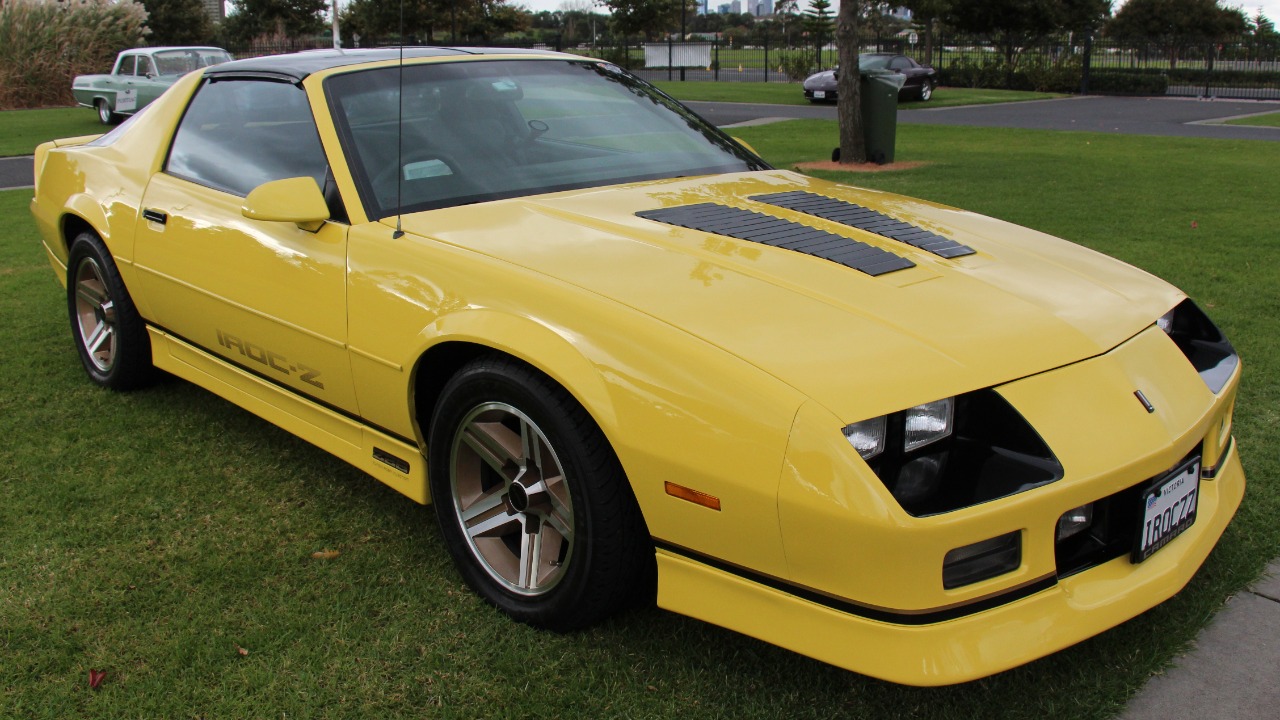
The 1985 Chevrolet Camaro IROC-Z did not just arrive in showrooms, it rewrote what an American street car could look and feel like in the middle of a performance comeback. You still see its wedge profile, deep chin spoiler, and bold graphics in your mind the moment someone says “’80s muscle,” because this car fused racing pedigree, new technology, and pop culture timing in a way rivals never quite matched. To understand how it became a street icon, you have to look at the racing series that gave it a name, the engineering that made it genuinely quick, and the cultural wave it rode all the way from suburban cul‑de‑sacs to modern Cars & Coffee meets.
The racing roots that gave the IROC-Z its name
Long before you saw an IROC-Z prowling your local boulevard, the International Race of Champions was already building its legend on track. Starting in the mid 1970s, the series pitted top drivers from different disciplines against each other in identically prepared cars, at first using the Porsche Carerra RSR as its weapon of choice. When the Camaro stepped into that role, the IROC name carried serious credibility, and Chevrolet leaned into it by creating a road car that would honor the International Race of Champions in both branding and hardware.
By the time the third generation of the Camaro arrived, Chevrolet was ready to turn that racing connection into a full street statement. The 1985 Chevrolet Camaro IROC-Z was explicitly part of the third‑gen lineup and was specifically designed to honor the International Race of Champions, often shortened to IROC or even IRO in period shorthand. That is why you see the name spelled out proudly on the rocker panels and rear bumper, and why later descriptions still emphasize that the Camaro IROC-Z was named after the International Race of Champions rather than being just another appearance package.
From showroom option to must‑have F‑body
When the IROC-Z hit dealerships for 1985, you were looking at more than a new trim level, you were seeing the Camaro reclaim its swagger after a difficult 1970s. Enthusiasts quickly realized that this was the F‑body to have, and period accounts describe how, by 1985, the IROC-Z “hit the scene” and quickly became the must‑have F‑body. That surge in demand was not accidental; it reflected how the car’s mix of performance, price, and image lined up perfectly with what young buyers wanted in the mid‑’80s.
Chevrolet kept building on that momentum through the late 1980s, and the IROC-Z became a fixture of the third‑generation Camaro story. Later retrospectives describe the 3rd generation Chevrolet Camaro IROC-Z, produced from 1985 to 1990, as a performance icon that defined ’80s muscle. Within that run, the 1985 Chevrolet Camaro IROC-Z28 is often singled out as the debut of one of the most iconic third‑generation Camaros ever built, which is why collectors still chase clean early cars today.
Engineering a street‑legal track car
If you drove an IROC-Z in period, what struck you first was how composed it felt compared with earlier muscle cars that relied mostly on raw displacement. Chevrolet did not just bolt on a body kit; engineers reworked the suspension, fuel injection, and anti‑roll bars to sharpen the way the car turned and stopped. Accounts of the 1985 Camaro Z28 and its close relatives note that Chevrolet upgraded suspension tuning and anti‑roll hardware to significantly enhance handling, and the IROC-Z took that philosophy even further with performance‑oriented shocks and springs.
Under the hood, the IROC-Z tapped into the same small‑block V8 renaissance that was transforming the Corvette. By the mid‑1980s, the siren song of a fuel‑injected small‑block Corvette was again being heard, with the 1988 245HP 350 and its Tuned Port Injection system setting the tone for GM performance. The Camaro IROC-Z benefited from that same technology, using Tuned Port Injection on its V8 to deliver strong mid‑range torque and a more modern driving feel, which is why later descriptions emphasize that the 1985 Chevrolet Camaro IROC-Z blended modern technology with aggressive performance and sharp styling as a true Chevrolet Camaro IROC legend.
Styling that shouted “’80s muscle”
Even if you never popped the hood, the IROC-Z sold you the moment you saw it. The car sat lower than a standard Camaro, with a deep front air dam, side skirts, and a rear spoiler that made it look like a street‑legal race car. Contemporary and modern write‑ups alike describe the 1985 Chevrolet Camaro IROC-Z as a legendary ’80s machine, and one account of a custom 4‑door wagon concept still calls the original coupe a legendary ’80s Camaro that defined Chevy classic style. The signature IROC-Z graphics along the rocker panels and the specific wheel designs turned every grocery run into a small car show.
That visual drama was not just for posters on bedroom walls; it was part of how the car communicated its racing link to everyday drivers. Later enthusiasts note that the Camaro IROC-Z was designed to dominate streets and racetracks with bold styling, and that the Camaro was named after the International Race of Champions to underline that intent. When you see modern restorations and tributes, from faithful coupes to imaginative wagon renderings, they almost always keep the IROC-Z body kit and graphics intact, because those cues are inseparable from the car’s identity.
Handling, tech, and the “rebel” personality
What really cemented the IROC-Z’s reputation was how it drove compared with other ’80s performance cars that were starting to soften. While some competitors leaned into luxury, the Camaro IROC-Z kept its edge, with enthusiasts later describing how The Camaro IROC-Z was not just another ’80s muscle car but a rebellion on wheels. Chevy injected Corvette‑inspired technology and paired it with performance shocks for razor‑sharp handling, which meant you could feel the car’s racing DNA every time you turned into an on‑ramp.
That focus on dynamics echoed a broader trend in performance engineering, where manufacturers were tuning suspension systems for racing rather than simply chasing straight‑line numbers. You can see the same philosophy in earlier Camaros that received a suspension system tuned for racing, and the IROC-Z carried that idea into the 1980s with its own sport‑tuned setup. Later descriptions of the 1985 Chevrolet Camaro IROC-Z emphasize that it was a street‑ready muscle icon that brought serious performance and 1980s flair to the road, and that the Chevrolet Camaro IROC name was not just a trim but a statement about how the car was meant to be driven.
More from Fast Lane Only


Leave a Reply