
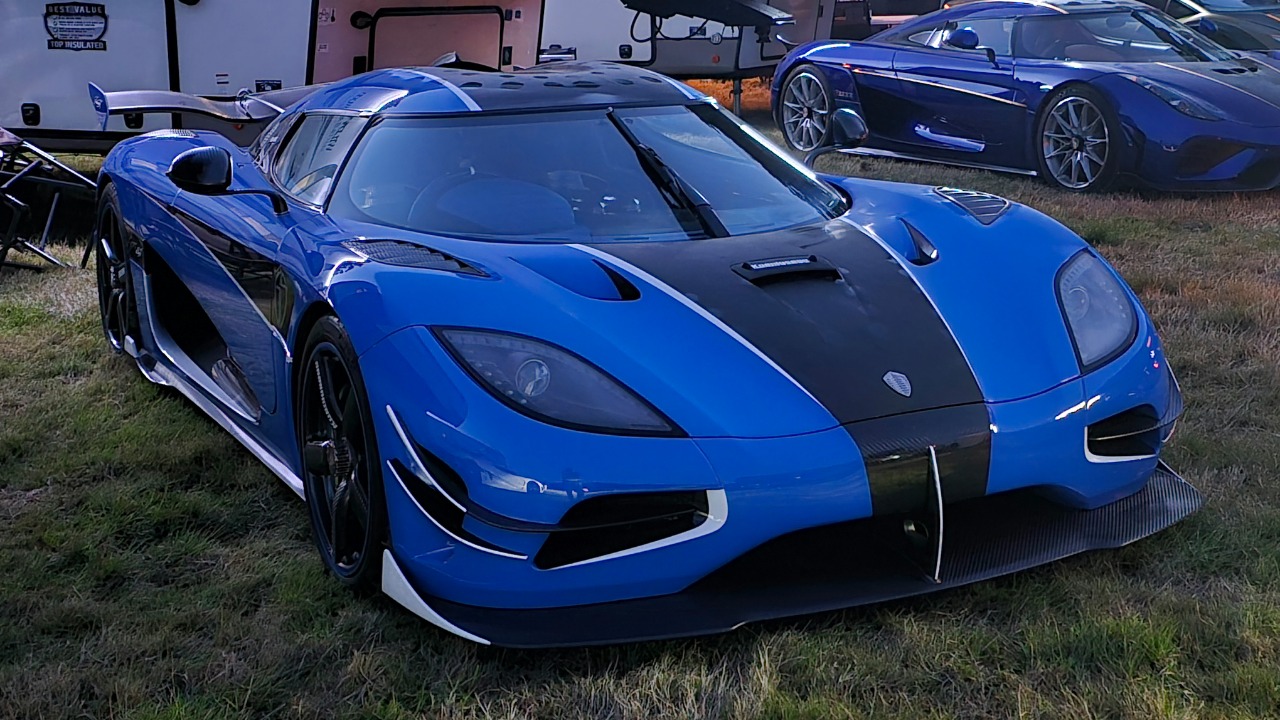
The Koenigsegg Agera RS did not stumble into the record books by accident. It arrived there through a ruthless focus on speed, stability, and usable performance that turned a niche Swedish hypercar into a benchmark for what a road‑legal machine can do. To understand how it became one of the fastest cars ever built, I need to trace how its engineering, design, and record runs all locked together into a single, very deliberate story.
That story starts with a simple idea: take the already ferocious Agera platform, strip out weight, add power and control, and then prove the result in public. The Agera RS is not just a spec sheet trophy, it is a car that translated extreme numbers into repeatable runs on real roads, and that is what sets its legend apart.
The Agera lineage that set the stage
Before the Agera RS could chase records, Koenigsegg had to build a foundation with the original Agera family. The early car evolved from a 4.7-litre V8 concept into a production machine that, by 2013, was already pushing supercar norms with a twin‑turbo V8 and a focus on both Engine and transmission development that prioritized compact packaging and brutal torque. That base architecture gave Koenigsegg room to keep turning the wick up without redesigning the car from scratch every time.
Alongside the standard Agera, the company refined its hardware through variants like the Agera R, which used a Koenigsegg aluminum 5,0L V8 with 4 valves per cylinder, DOHC, titanium connecting rods and dry sump lubrication, all detailed in the Agera R Internal Combustion Engine specifications. By the time engineers were ready to create the RS, they had years of data on how that layout behaved at the limit, which materials survived repeated high‑load runs, and where they could safely shave mass or add boost. The RS is often described as a new model, but I see it more as the sharpest point of a long, carefully forged spear.
Power, aero and weight: the numbers behind the speed

What truly separates the Agera RS from its predecessors is how aggressively Koenigsegg pushed its core hardware. In factory form, the AGERA RS SPECIFICATIONS list 1150 BHP Output on standard petrol, with an optional 1360 BHP Output through the so‑called MW upgrade, backed by 1280 Nm Max Torque that arrives with a violence few road cars can match, all laid out in the official specifications. Those figures are not marketing fluff, they are the raw numbers that made it possible for the RS to keep pulling hard well past the point where most supercars are gasping against the wind.
Power alone would have been useless without stability, so Koenigsegg leaned heavily on aerodynamics and chassis tuning. The RS generates 485 Kg Downforce at 250 km/h, a figure that jumps off the page because it shows how much the bodywork, wings and underfloor are doing to glue the car to the road at speeds where a small lift could be catastrophic, as detailed in the same factory Agera RS data. At the same time, the company kept curb weight low, using carbon fiber construction and lessons from its track‑focused projects so that the RS could translate every bit of that power and aero into acceleration rather than simply hauling mass.
From Agera R to RS: learning from ENHANCED evolution
When I look at the RS, I see a car that learned directly from the Agera R and the even more extreme One:1. The RS program took the basic Agera layout and applied technique refined on the One to cut mass, resulting in a car that, at around 3000 lbs, is lighter than the already lightweight Agera R, a detail highlighted in performance analysis that credits those methods with helping the RS in setting new world records for top speed, as noted in research on the Agera One. That weight advantage matters just as much as horsepower when you are trying to accelerate a car from a standstill to triple‑digit speeds in a handful of seconds.
Koenigsegg also treated the RS as an ENHANCED evolution rather than a stripped‑out science project. Official descriptions of Agera RS enhancements talk about advanced aerodynamics and chassis upgrades, but they also emphasize Practicalities inherited from the Agera R and S programs, including a usable luggage compartment and a detachable hardtop that can be stored in the car, all wrapped into the upgraded Agera package. That balance between everyday usability and outrageous performance is part of what makes the RS so compelling: it is not a fragile one‑lap wonder, it is a road‑legal GT that just happens to be capable of speeds that once belonged only to land‑speed record specials.
Design and layout: making extreme speed feel natural
Numbers tell one side of the story, but the way the Agera RS looks and feels is just as important to how it achieves its speed. The exterior design leans heavily on the Agera R, yet it sharpens almost every surface, with a front end that channels air into the radiators and over the splitter, and a rear that is dominated by a large wing and diffuser, a combination that enthusiasts have praised as The Incredibly Impressive Design that still traces its roots back to the original Agera, as reflected in commentary that notes how Although Koenigsegg based every element of the exterior design on the Agera R, the RS adds more aggressive details at the front and rear, a point captured in analysis of the Agera. That visual aggression is not just for show, it is the visible expression of the airflow management that keeps the car planted.
Under the skin, the Koenigsegg Agera RS uses a mid‑engined layout that places its 5.0L Twin Turbocharged V8 just behind the cabin, driving the rear wheels, a configuration that balances weight between the axles and gives the driver a stable platform at very high speeds, as laid out in technical breakdowns of the car’s Engine and chassis Layout. That Mid‑engined architecture, combined with rear‑wheel drive and a stiff carbon tub, lets the RS communicate clearly through the steering and suspension, which is crucial when you are threading a car through bumps and crosswinds at more than four times typical highway speeds.
The record runs that cemented its legend
All of this engineering would have meant little if Koenigsegg had not taken the Agera RS out into the real world and put its reputation on the line. The defining moment came when the car was driven on a closed public highway and recorded an Averaging two‑way top speed of 277.9 m mph, with a peak run that hit 284.7 m mph, figures that led many to describe The Koenigsegg Agera RS Is Now the Fastest Production Car Ever Made and to treat it as the fastest car in the world at that time, as documented in detailed coverage of The Koenigsegg Agera RS Is Now the Fastest Production Car Ever Made. Those numbers did not come from a single, wind‑assisted blast, they were the average of runs in opposite directions, which is the standard used to validate serious speed records.
The RS did not stop at one headline figure either. Over the same period, The Koenigsegg Agera RS claimed five speed records in total, including a high‑speed run that finally surpassed Mercedes‑Benz’s near 80‑year record for a public‑road top speed, a feat that was captured in reports on how The Koenigsegg Agera RS performed during its north‑westerly run. Later breakdowns of All Records Broken by the Koenigsegg Agera RS list The High Top Speed for a Production Vehicle as just one of several achievements They credit to the car, underscoring how the RS turned its engineering into a suite of benchmarks rather than a single party trick, as summarized in retrospectives on All Records Broken.
Why the Agera RS still matters in a changing hypercar era
Looking back now, in an era when electric hypercars are chasing their own acceleration and top‑speed milestones, I find the Agera RS stands out as a kind of last word for the traditional combustion‑driven missile. It distilled years of Koenigsegg experimentation with turbocharged V8s, from the early 4.7-litre concepts to the mature 5,0L units, into a package that could be driven to a test site, run at more than 270 mph, and then driven home again without feeling like a fragile prototype, a continuity that ties the RS back to the original technical philosophy of the Agera line. That blend of everyday function and outrageous speed is something even the most advanced battery‑powered hypercars are still trying to replicate in their own way.
For me, that is why the Agera RS still looms so large over the performance‑car landscape. It is not just that it set The High Top Speed for a Production Vehicle or that it carried the AGERA badge into the history books, it is that it did so while remaining recognizably a road car, with Practicalities like luggage space and a removable roof sitting alongside 1360 BHP Output and 485 Kg Downforce at 250 km/h. In a world where speed records can feel abstract, the Agera RS made extreme velocity tangible, and that is what will keep its story alive long after newer machines chase its numbers.


Leave a Reply