
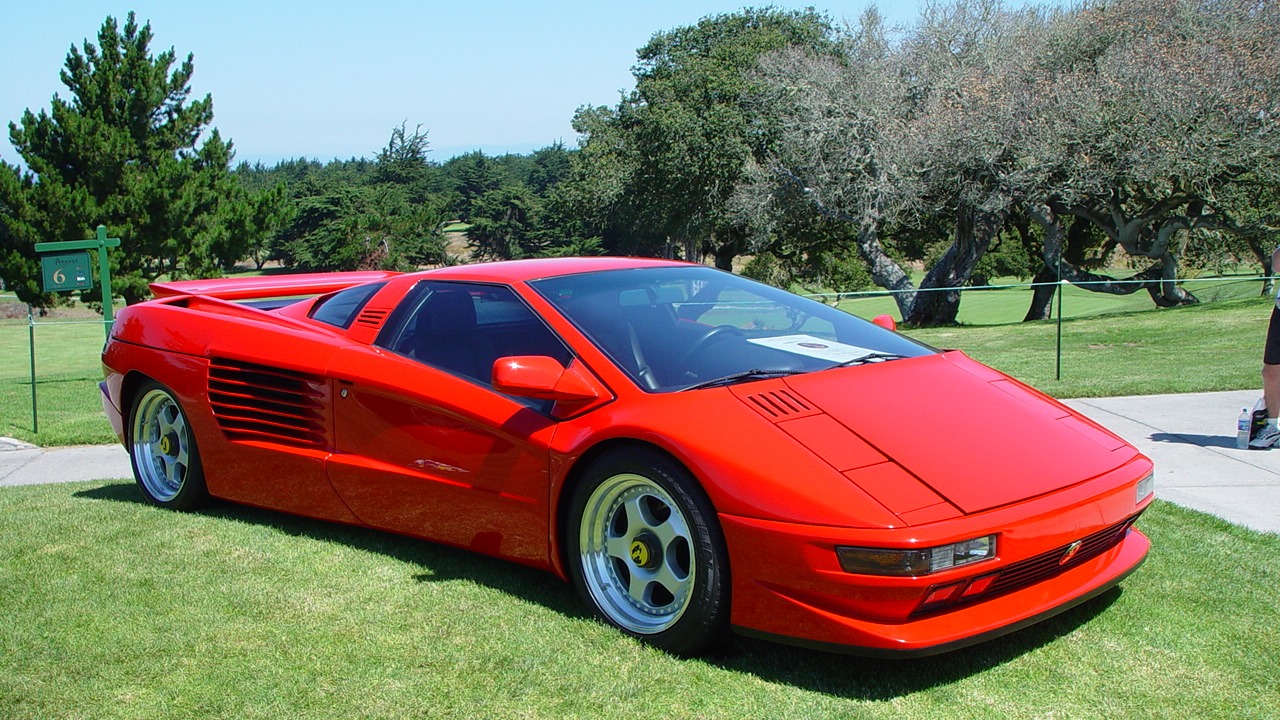
The Cizeta V16T did not tiptoe into the late‑80s supercar scene so much as swagger in, loudly announcing that Twelve cylinders were for people who lacked imagination. It was a wedge-shaped fever dream with twice the pistons, twice the drama and roughly half the business plan of its Italian rivals. Hollywood, naturally, fell in love with it, even as the rest of the world mostly scratched its head and bought something sensible like a Diablo instead.
What emerged was a car that looked like a rejected movie prop, sounded like a racing launch sequence and lived a life that felt scripted by a slightly unhinged producer. The result is that the Cizeta V16T has become Hollywood’s strangest supercar, a machine whose real story is somehow even wilder than its spec sheet.
The wild idea: a 16‑cylinder wedge for the VHS era
I like to think of the Cizeta V16T as the moment the 1980s looked in the mirror and decided it needed more cylinders. The project grew out of THE STORY OF CIZETA: THE 16-CYLINDER SUPERCAR, a plan by a former Lamborghini engineer to build something that made even the Countach look shy. The Cizeta was conceived as a rolling monument to excess, with a transverse sixteen‑cylinder engine, a low, knife‑edge body and the sort of presence that made Testarossas look like rental cars.
Under the rear deck sat the real punchline, a 540 bhp V16 that enthusiasts still describe as effectively two V8s joined together, a layout that made the car well over two metres wide and gloriously impractical for anything involving parallel parking. Period coverage loved to point out that Twelve cylinders were not enough for this crowd, and that the V16T’s silhouette, first shown in Los Angeles, looked like a more aggressive take on a design that Lamborghini had passed on, a detail that only deepened its outsider mystique for Hollywood types who liked their toys a little controversial.
Moroder, Gandini and the most Italian Hollywood crossover
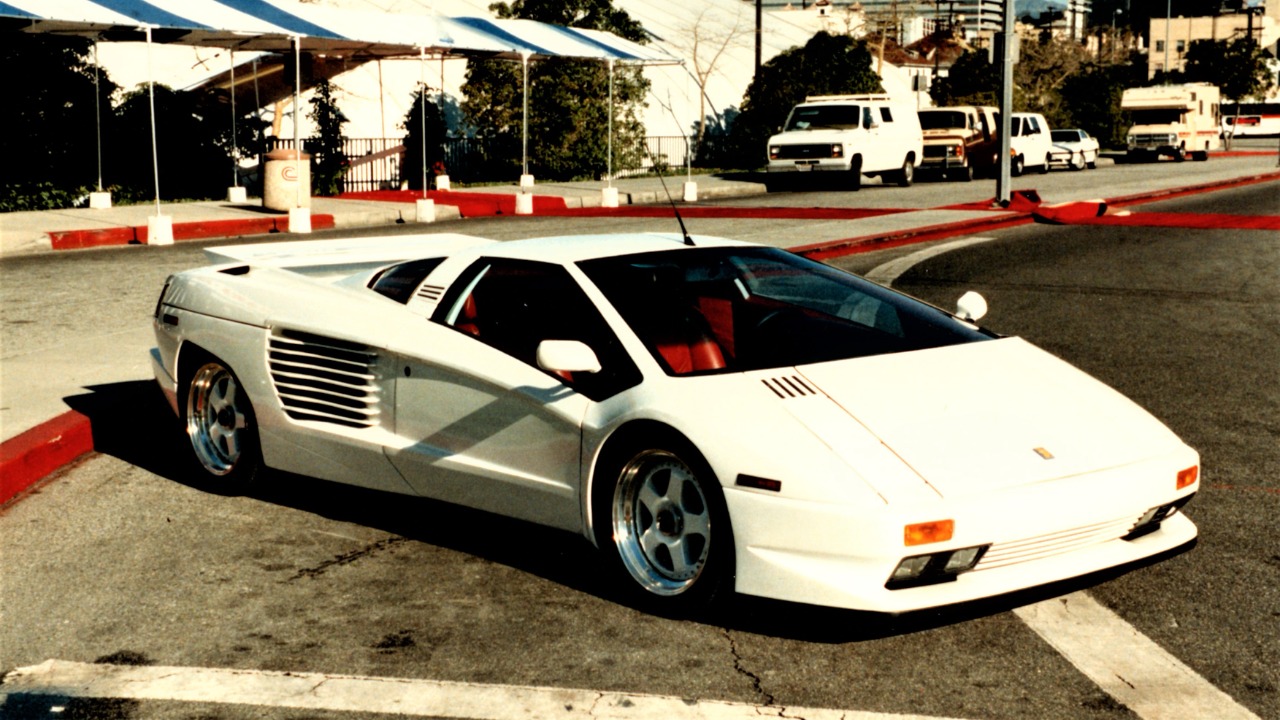
If you were casting a movie about a rogue supercar, you would probably start with a charismatic producer and a legendary designer, which is exactly what reality delivered. The Cizeta’s early identity was tied to Giorgio Moroder, the music producer whose name helped create The Cizeta brand in its first phase, and whose partnership with its engineering mastermind gave the project instant showbiz sparkle. That alliance did not last, and by 1990 both Moroder and Zampolli had gone their separate ways, leaving Moroder to focus on music and the car to continue under a simplified name that still carried his early influence.
On the styling side, the production car wore the sharp lines of Marcello Gandini, the designer whose work on the Miura and Countach had already defined the poster‑car era. The Cizeta was billed as the next great Italian supercar, a step up on all those eight‑ and 12‑cylinder pin‑ups of the 198, and Gandini’s angular surfaces and stacked headlights made it look like a Countach that had spent a semester abroad in Los Angeles. Later reporting has underlined that Marcello Gandini did the design, and that the car’s proportions and detailing were closely linked to a concept that Lamborghini had declined, which only made it more appealing to Hollywood buyers who liked the idea of driving the “what if” version of Sant’Agata history.
Engineering insanity: two V8s, one soundtrack
From a technical perspective, the Cizeta V16T was the automotive equivalent of ordering every topping on the menu and insisting the chef stack them sideways. The engine sat in a “T” configuration, with the crankshaft transverse and the gearbox mounted longitudinally, a layout that made the rear of the car look like a small apartment block when viewed from underneath. Period descriptions of THE STORY, CIZETA, CYLINDER, SUPERCAR stress how unusual this arrangement was, and how it gave The Cizeta a mechanical layout unlike anything else on the road.
That oddball packaging produced a soundtrack that owners still describe as part racing prototype, part industrial accident, a noise that made even hardened Lamborghini fans look up from their espresso. Technical write‑ups note that this engine is highly unusual, with its V16 mated to a ZF 5‑speed transmission in that distinctive “T” layout, resulting in an entirely unique soundtrack that echoed off canyon walls and studio backlots alike, a detail captured in depth in Above Image features that dissect the car’s chassis and drivetrain.
Hollywood dreams, Brunei money and real‑world problems
For all its engineering bravado, the Cizeta V16T’s real superpower was attracting exactly the sort of buyers who treat a car like a supporting character. The Sultan of Brunei is frequently cited as a key client, with reports detailing how The Cizeta V16T was built for his collection, a garage already famous for swallowing up rare Lamborghinis and Ferraris like popcorn. That connection helped cement the car’s reputation as a toy for the ultra‑wealthy, a status symbol that could sit comfortably between a one‑off Ferrari and a private jet, as chronicled in deep dives into The Cizeta and its clientele.
Hollywood, meanwhile, embraced the car less as daily transport and more as rolling set dressing. The V16T’s width, its stacked lamps and its unapologetically 80s stance made it a natural for music videos, photo shoots and the sort of late‑night boulevard cruising that doubles as unpaid marketing. Yet behind the glamour, the business case was wobblier than a stunt car on bald tires. Analyses of why the V16T fell flat point out that it cost roughly double a Diablo without offering the same dealer support or brand recognition, a mismatch that one breakdown of cool but obscure machines sums up with a blunt “So why’d it ( V16T ) fall flat? Well, aside from being literally double the price of a Diablo without offering consumer confidence.”
Flop, legend, and the comeback tease
Commercially, the Cizeta-Moroder V16T flopped with a kind of theatrical commitment that almost deserves applause. Production numbers stayed tiny, orders were sporadic and the company never came close to challenging the established Italian brands it had set out to upstage. Retrospectives are blunt that The Cizeta-Moroder V16T is easily one of the most memorable supercars ever conceived, despite its essential obscurity, and that only a handful were ever available to be ordered new, a verdict laid out in detail in analyses of why Moroder and his four‑bank monster never quite found their market.
Yet as with any good cult classic, failure only burnished the myth. Enthusiast pieces now celebrate the car as an ultra‑rare icon, asking, with a straight face, “What do you get when you cross a rejected Lamborghini design, a ridiculous engine and the backing of one of the world’s most famous producers?” The answer, of course, is the Cizeta V16T, a car whose story is Giorgio Moroder as much as it is Gandini and Zampolli, a point driven home in features that invite readers to What the V16’s return might mean for modern supercars.
The strange afterlife: YouTube fame and a possible sequel
In the streaming era, the Cizeta has found a second life that feels oddly appropriate for a car born in the age of VHS. Longform videos now treat the Cizeta-Moroder V16T as a “Max Lambo,” a sort of alternate‑universe flagship that shows what might have happened if Sant’Agata had leaned even harder into excess. One deep dive from Mar features extended drives, close‑ups of the cabin and the kind of giddy commentary that only a 16‑cylinder startup special can provoke, a tone captured perfectly in the Mar video that has helped introduce the car to a new generation of fans who were not alive when it debuted.
At the same time, the brand itself refuses to stay buried. Reports earlier this decade revealed that Cizeta is coming back with a new V16‑powered supercar, with Gandini still part of the story and the company’s founder, Claudio Zampolli, remembered as a former Lamborghini test driver whose dream never quite died. That coverage notes that Gandini is far from Cizeta’s only Lamborghini connection, and that the company was founded by Claudio Zampolli, a former Lambor employee, a lineage that keeps the car firmly tied to the Italian supercar establishment even as it continues to orbit just outside it.
Why Hollywood’s strangest supercar still matters
So why does this oddball still loom so large in the imagination, especially in Hollywood, where attention spans are shorter than a lease term? Part of it is sheer audacity. The Cizeta V16T took the idea of a supercar and dialed every parameter past sensible, from the cylinder count to the styling to the price, then wrapped it all in a story that involved producers, designers and clients who already lived in the spotlight. That combination made it irresistible to a town that loves a good origin myth, a point that comes through clearly in retrospectives that frame THE STORY OF CIZETA: THE 16-CYLINDER SUPERCAR as a kind of automotive biopic, a narrative reinforced in pieces like the that trace its journey from sketch to cult object.
The other reason is that the Cizeta neatly captures a moment when supercars were still allowed to be a little unhinged. Modern hypercars are faster, cleverer and vastly more usable, but few feel as gloriously unnecessary as a 540 bhp V16 that is well over two metres wide and built in tiny numbers for people who already owned everything else. Enthusiast breakdowns of how Cizeta’s 540bhp V16T almost made it into the mainstream, and how Twelve cylinders were not enough for its creators, underline that sense of what‑might‑have‑been, a theme that runs through coverage of Feb and its maverick engineering. In the end, that is why I keep circling back to it: the Cizeta V16T is not just a strange Hollywood supercar, it is a reminder of what happens when ambition outruns practicality and somehow, for a brief, glorious moment, the cameras keep rolling anyway.


Leave a Reply