

The Mitsubishi 3000GT VR-4 arrived in the 1990s as a blunt-force answer to the Japanese performance wars, less a sports car than a rolling technology demo aimed squarely at rivals. Instead of chasing purity, it stacked systems, sensors, and servos until the spec sheet looked like something from an aerospace brochure. That decision shocked competitors, delighted gadget-obsessed buyers, and left a complicated legacy that still divides enthusiasts today.
Where the Mazda RX-7 and Toyota Supra leaned on singular mechanical brilliance, the 3000GT VR-4 tried to win by overwhelming the field with electronics and all-wheel everything. I see it as the moment Mitsubishi decided that if it could not build the most charismatic engine, it would build the most advanced machine, and in doing so it redefined what a Japanese grand tourer could be.
The tech-first answer to RX-7 and Supra
From the outset, Mitsubishi positioned the 3000GT VR-4 as a technological counterpunch to the era’s icons rather than a copy of them. While the Mazda RX-7 had a Wankel rotary engine and the Supra had a legendary engine that would become tuner folklore, Mitsubishi leaned into electronics, forced induction, and driveline trickery to stand out. The company effectively admitted that the 3000GT did have one of the most advanced drivetrains of its time, but never the most engaging, and built its identity around that contrast with the RX-7 and Supra instead of trying to outdo them on feel alone, a point underscored in detailed retrospectives on the car as a Technological Marvel.
That strategy turned the VR-4 into a kind of rolling manifesto for Mitsubishi’s engineering department. Twin turbochargers, all-wheel drive, and four-wheel steering were not optional extras but core to the car’s identity, a deliberate attempt to out-spec competitors that relied on simpler rear-drive layouts. In period, the message was clear: if the RX-7 and Supra represented the pinnacle of traditional sports car thinking, the 3000GT VR-4 was the future-facing alternative that tried to win with silicon and software as much as steel and displacement.
All-wheel everything and the “Tour and Sport” brain
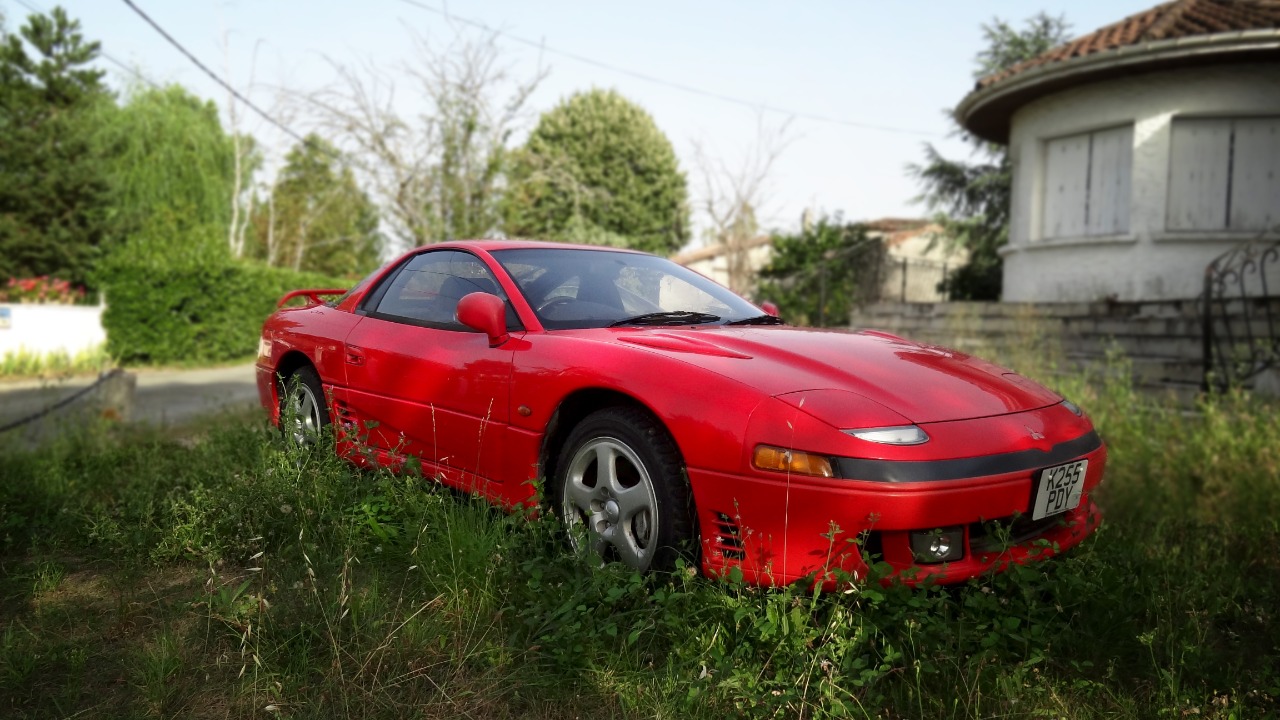
The most obvious expression of that philosophy sat under the skin, where the 3000GT VR-4 combined all-wheel drive, four-wheel steering, and electronically controlled suspension into a single package. Instead of asking drivers to choose between comfort and control at the dealership, Mitsubishi built a car that could change its character on the fly. The electronically controlled suspension, for example, offered two distinct settings, Tour and Sport, that altered damping behavior at the touch of a button, a feature that contemporary coverage highlighted as central to the VR-4’s appeal and described in detail when noting that the 3000GT VR-4 also incorporates an electronically controlled suspension that has two settings, Tour and Sport, while it rides on performance tires on 16×8-inch wheels in period tests of All–Wheel Everything.
Layered on top of that adjustable suspension was a full-time all-wheel-drive system and four-wheel steering that subtly turned the rear wheels to sharpen responses. In practice, the car tried to think for the driver, shuffling torque and tweaking geometry to keep its considerable mass in check. Where a Supra driver might feel every nuance through a simpler chassis, the VR-4 owner interacted with a network of control units that filtered and optimized each input. That approach made the car feel planted and secure at speed, but it also fed the perception that Mitsubishi had built a computer-controlled missile more than a traditional sports coupe.
Active Aero and the fighter-pilot cockpit
If the drivetrain made the 3000GT VR-4 feel like a science project, the bodywork and interior doubled down on that impression. Beyond the basic coupe shape, the VR-4 was given an Active Aero package that physically altered the car’s profile at speed, lowering the front chin spoiler and changing the angle of the rear wing to increase stability. This was not a static styling flourish but a functional system that moved in response to driving conditions, a detail that contemporary features emphasize when noting that, beyond its core hardware, the VR-4 was given an Active Aero package that adjusted the front and rear elements as part of a broader tech extravaganza that created a true fighter-pilot cockpit feel for drivers described in depth in coverage of the car’s Active Aero.
Inside, the theme continued with a dashboard crowded by gauges, switches, and displays that made the driver feel more like a systems operator than a casual commuter. The effect was immersive, especially in an era when many rivals still relied on simple analog clusters and minimal electronics. I see that cockpit as the logical extension of Mitsubishi’s philosophy: if the exterior and chassis were going to morph and adapt, the driver’s environment had to signal that this was a machine constantly thinking and adjusting in the background, not just a pretty shell wrapped around a big engine.
“Technological overdose” and the weight penalty
All of that sophistication came at a cost, and not just on the balance sheet. Commentators have described the 3000GT VR-4 as a case study in what happens when engineers keep adding systems without ruthlessly trimming them back, arguing that it is not about more ingredients, just about the right ingredients. All of that technology pumped the weight of the car to a level that blunted some of its dynamic potential, turning what could have been a razor-edged sports car into more of a high-speed GT that excelled on highways but felt heavy in tight corners, a criticism that has been explored at length in analyses of Mitsubishi’s technological overdose.
The irony is that the very systems that made the VR-4 headline-grabbing also contributed to its reputation as less involving than its peers. The all-wheel drive and four-wheel steering helped mask the mass, but they could not erase physics, and the electronics sometimes dulled the feedback that purists craved. In that sense, the 3000GT VR-4 anticipated a broader industry trend, where layers of technology improved objective performance while raising questions about whether something intangible was being lost in the process.
Evolution, GTO heritage, and modern reappraisal
Over its production run, the Mitsubishi 3000GT evolved visually and mechanically as the company tried to keep its tech flagship fresh. The redesign of the second generation 3000GT brought it up to date, especially through the loss of pop-up headlights and the front fascia changes that gave the car a smoother, more contemporary face. That update, along with incremental tweaks to its systems and equipment, reflected Mitsubishi’s effort to keep the car aligned with shifting tastes and regulations, a process documented in the broader history of the Mitsubishi 3000GT.
Enthusiasts today often look back at the VR-4 through the lens of its Japanese-market identity and its relationship to modern performance sedans. For some reasons, the 3000GT or GTO VR-4 reminds one detailed commentator a lot of the W206 C63 AMG, drawing a line between Mitsubishi in the 80s, when it had the idea to build a tech-laden halo car, and Mercedes-Benz’s later decision to stuff complex powertrains and electronics into a compact sedan. That comparison, which explicitly name-checks the GTO and AMG, underlines how the VR-4’s blend of brute force and gadgetry feels surprisingly contemporary when viewed alongside today’s turbocharged, software-heavy performance cars, a point made vividly in enthusiast discussions of the GTO VR-4 and AMG.
Why the VR-4’s shock still matters
Looking back, I see the Mitsubishi 3000GT VR-4 as a preview of the trade-offs that define modern performance cars. It shocked rivals not just because it was fast, but because it treated technology as the main event rather than a supporting act, from the Tour and Sport suspension logic to the Active Aero and four-wheel steering. That mindset is now standard practice across the industry, where even modest hot hatches rely on drive modes, adaptive dampers, and complex stability systems to juggle comfort and speed.
The VR-4’s legacy is therefore less about lap times and more about philosophy. Mitsubishi proved that a Japanese sports coupe could be a laboratory on wheels, even if that meant carrying extra weight and sacrificing some purity. In an era when cars are increasingly defined by software updates and configurable everything, the 3000GT VR-4’s technological gamble looks less like an outlier and more like an early, audacious step toward the high-tech performance landscape we now take for granted.

Leave a Reply