
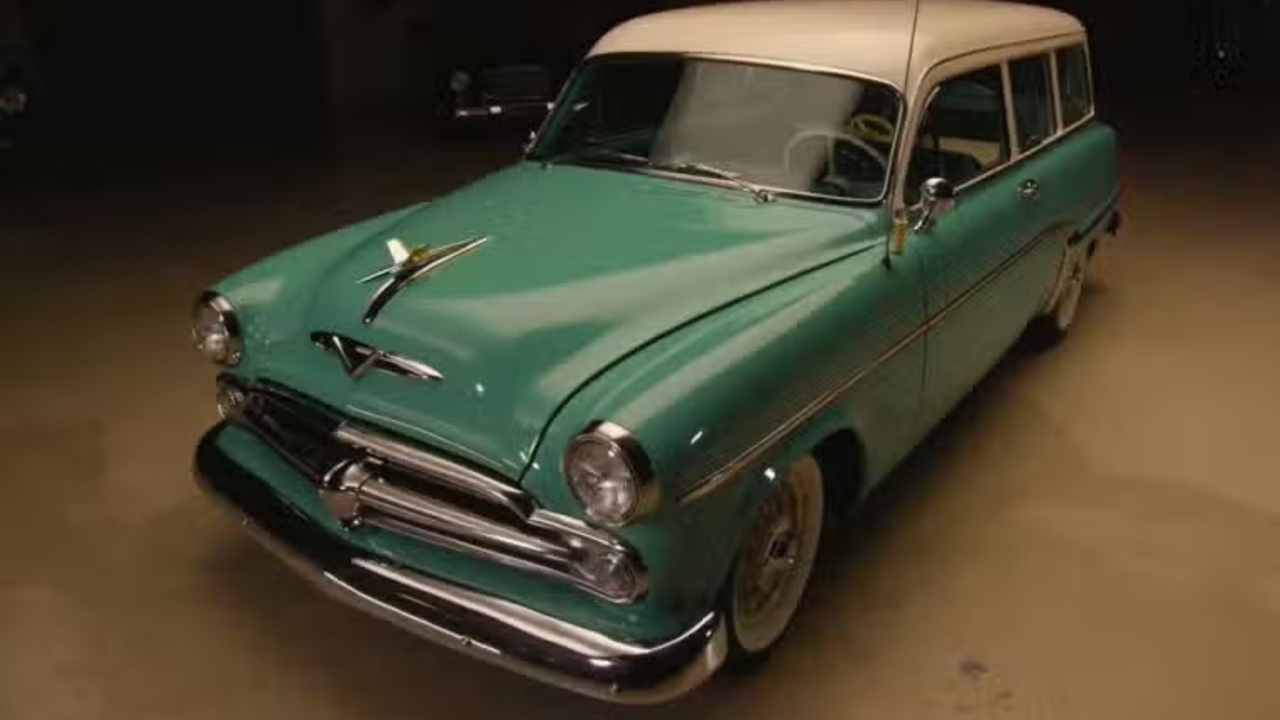
Jay Leno has turned a midcentury family hauler into a quiet rebuke of the anonymous crossover. By putting a 1954 Dodge wagon back on the road, he has shown how a long-roof built for carpool duty can project more presence and personality than many of the wind-tunnel-shaped utilities filling today’s parking lots.
The car in question is not a restomod caricature but a carefully preserved Dodge Coronet wagon that still looks ready to haul kids, luggage, and camping gear. Its mix of subtle styling, early Hemi power, and honest practicality underlines how much character buyers have surrendered in the shift from station wagons to crossovers.
A family wagon with real presence
The starting point for Leno’s case against the modern crossover is the basic shape of his 1954 Dodge wagon. Long, low, and glassy, it stretches its roofline without the bulk and height that define current utility vehicles, yet it still reads instantly as a family car. Dodge offered six station wagon configurations that year, including the Coronet Sierra Four-door with seating for six or eight, so the body was always meant to serve real households rather than niche collectors.
That practicality is not theoretical. Period brochures described how You could order the Coronet Sierra Four with different seating layouts to balance passenger space and cargo room, and the car Leno drives follows that template with a full-length cabin and a generous rear load area. Instead of plastic cladding and exaggerated wheel arches, the visual drama comes from the long beltline, the upright greenhouse, and the restrained chrome that frames the side glass. It is a silhouette that would not be mistaken for anything else in a crowded lot, which is more than can be said for many current crossovers that share near-identical rooflines and window shapes.
The “friendliest” Hemi hiding under the hood
What truly separates this wagon from today’s family transport is what sits under its hood. Leno’s car uses Dodge’s early Red Ram Hemi V8, a compact engine that helped introduce hemispherical combustion chambers to everyday buyers. In this configuration it displaces 241 cubic inches and is rated at around 150 horsepower, figures that sound modest next to modern turbocharged fours but were remarkable in a family wagon of the period.
The character of that Red Ram Hemi matters as much as the numbers. Contemporary accounts describe it as smooth and eager rather than intimidating, which is why some enthusiasts have called it the “friendliest” Hemi. In a car that weighs roughly as much as other midcentury full-size wagons, that 241 cubic inch engine provides relaxed acceleration and a deep, unforced exhaust note that modern small-displacement turbo engines rarely match. Leno’s focus on this powertrain highlights how performance and civility once coexisted in family cars without resorting to drive-mode menus or artificial sound enhancement.
Details that make nostalgia feel modern
The wagon’s visual details do as much work as the engine in making it feel cooler than a contemporary crossover. Period-correct stickers on the glass, whitewall tires, and factory-style wire wheels give the car a lived-in authenticity that separates it from over-restored trailer queens. Those whitewalls and old-school wire wheels sit within relatively narrow tires, which keep unsprung weight down and contribute to a supple ride that many stiffly sprung crossovers struggle to match.
Inside, the cabin leans into color and texture rather than the grayscale minimalism that dominates current dashboards. Reports on Leno’s car and its close relatives describe teal seats and bright interior trim that make the space feel more like a rolling living room than a mobile device dock. Accessories from the Period, such as simple add-on mirrors and roof hardware, are functional rather than decorative, yet they also reinforce the sense that this is a machine designed to be used and enjoyed, not just leased and replaced.
Rarity, risk, and the appeal of the Dodge Suburban
Leno’s affection for this era of Dodge wagons extends beyond a single Coronet. He has also highlighted a 1954 Dodge Suburban, a closely related long-roof that is rare enough that he has said he has never met anyone else who owns one. That scarcity is not the product of limited production alone. Contemporary observers note that survival into the present day was a challenge for these cars, which were often driven hard as family workhorses rather than preserved as collectibles.
The Dodge Suburban underscores how different the safety conversation was in the mid 1950s. Leno has pointed out the complete lack of safety features in this kind of car, from the thin steering wheel to the absence of crumple zones, and has mentioned that one of the few modern concessions he considers essential is adding seatbelts. In a vehicle that can still reach highway speeds with a Hemi under the hood, that decision is less about diluting authenticity and more about acknowledging that a 1950s structure was never engineered for contemporary crash standards. The contrast with today’s crossovers, which are packed with airbags and electronic aids, is stark, yet it also highlights how much of the driving experience has been handed over to software rather than the person behind the wheel.
Jay Leno’s Dodge Coronet Sub and the case against anonymity
The specific car that has drawn so much attention in Leno’s garage is often described as a Dodge Coronet Sub, a shorthand for a Coronet-based Suburban wagon that blends the family-friendly body with the Red Ram Hemi hardware. Leno has taken a deep dive into this “innocent-looking” vehicle, emphasizing how its unassuming exterior hides a direct link to the broader Dodge Hemi legacy. To casual observers it might appear to be a simple midcentury grocery-getter, yet the mechanical specification tells a more interesting story.
That duality is precisely what makes the car feel more compelling than many modern crossovers. Where current utility vehicles often advertise their performance with aggressive grilles and oversized wheels, the Dodge Coronet Sub keeps its capabilities quiet. The styling is almost gentle, but the drivetrain connects it to a lineage of American V8 engineering that still resonates with enthusiasts. By choosing to drive and showcase this car, Leno is effectively arguing that family transport does not have to be visually loud to be genuinely special.
More from Fast Lane Only

Leave a Reply