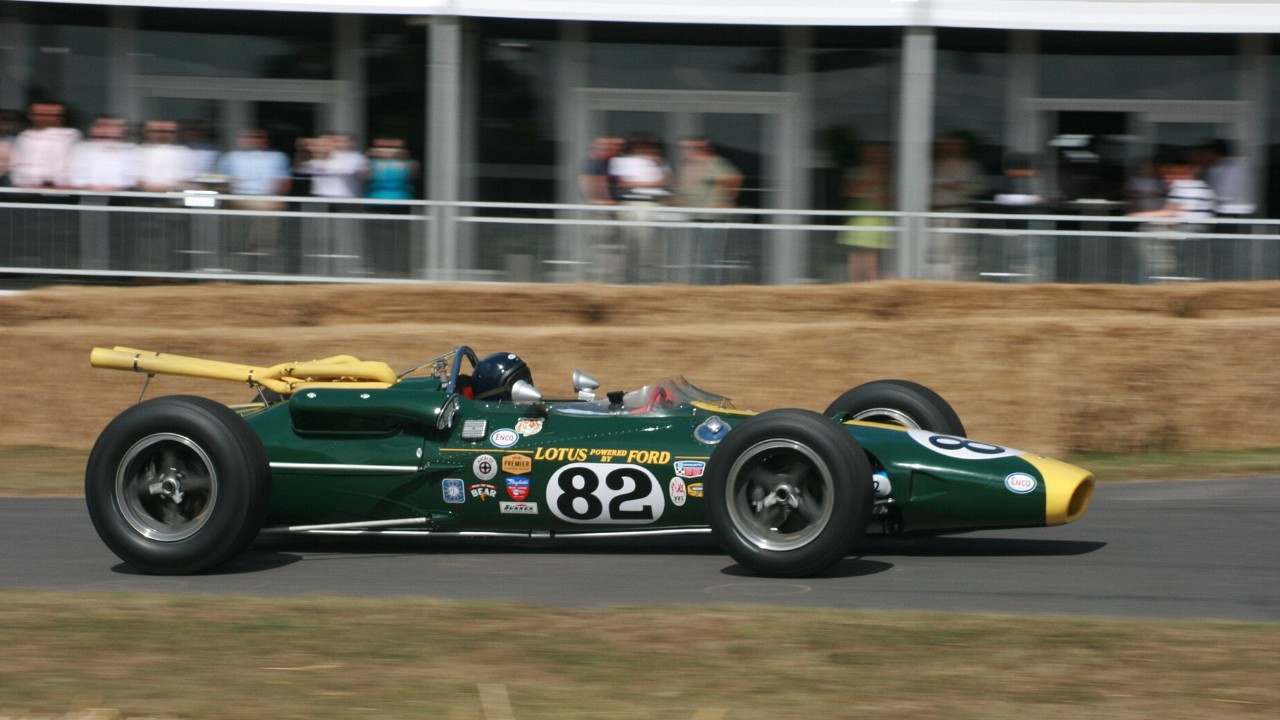
On May 31, 1965, Jim Clark drove a Lotus 38 to victory in the Indianapolis 500. He led 190 of the 200 laps, and his car carried its Ford V8 behind the driver rather than in front. No rear-engined car had won the race before.
The Scotsman came to the Speedway from Formula 1. However, Indianapolis was a different world, built around big front-engined roadsters. Clark and the small British team from Lotus changed that in one afternoon.
Here is the story of the car, the engine Ford built for it, and the day it rewrote the rules at the Speedway.
How the Lotus 38 came together

For 1965, the team wanted a stiffer car. According to a 2010 feature in Motor Sport magazine, designer Len Terry drew the Lotus 38 while team boss Colin Chapman was away racing in the Tasman Series. Terry told the magazine the job took about four months.
Instead of the team’s earlier “bathtub” chassis, Terry built a single rigid hull. It had an opening for the driver and two sponsons behind it to carry the V8. Chapman did not like the full monocoque at first, Motor Sport says, because it made the mechanicals harder to reach.
The car was also built for left turns only. Motor Sport reports that the body sat three inches to the left, which helped even out the loads on an oval. By contrast, The Henry Ford’s record credits the chassis to Group Lotus and its design to Colin Chapman, so the two sources split the credit differently.
The Ford four-cam V8
The power came from Dearborn. According to The Henry Ford’s record for the car, Ford built the double-overhead-cam V8 in Dearborn, Michigan. The museum lists it at 256 cubic inches, with a 2.76-inch bore and 2.87-inch stroke.
The museum also rates the engine at 495 horsepower at 8,800 rpm. Meanwhile, the whole car weighed 1,250 pounds, which works out to 2.5 pounds per horsepower in the museum’s own figure. Power went through a two-speed manual transmission, and the wheelbase measured 96 inches.
Motor Sport’s 1965 race report also singled out the engine. It credited the win to the latest four-camshaft Ford V8, with Firestone tires on the car.
Fuel, and a faster pit stop
Refueling mattered as much as speed. Under new 1965 USAC rules, only gravity fueling was allowed, according to the 2010 Motor Sport feature. So Terry fitted a fast-flow funnel and two filler pipes, which raised the flow by about a third.
That way the team could put in 50 gallons in 19 seconds, the magazine says. Motor Sport also reports that the car ran on gasoline rather than the usual Indy methanol, which meant fewer stops. That last detail comes from a single source, so treat it as Motor Sport’s account.
Race day: 190 laps out front
A.J. Foyt took pole at 161.233 mph, and he too drove a Lotus-Ford. Clark qualified second at 160.729 mph, according to Motor Sport’s 1965 race report. Dan Gurney was third fastest.
Once the race began, Clark controlled it. The official Indianapolis Motor Speedway results show him leading 190 of the 200 laps in car No. 82. His winning average was 150.686 mph, a record at the time. In fact, Motor Sport’s 2010 feature calls it the first 150-mph average in the race’s history.
Parnelli Jones finished second in the No. 98 Agajanian Hurst car, a Kuzma-Lotus with Ford power. Then came a rookie named Mario Andretti, third in a Brawner-Ford. Motor Sport noted that Andretti also won the prize for best newcomer.
Why the Lotus 38 win mattered
The 2010 Motor Sport feature lists several firsts from that day. The Lotus 38 became the first rear-engined car to win the Indy 500. It was also Ford’s first win there, and the first British car to win the Borg-Warner Trophy.
Motor Sport’s 1965 report added another. It called Clark the first overseas driver to win the 500 since 1916. Other references count the gap differently, so that claim belongs to the magazine.
The prize was large, too. Clark and Chapman, as driver and entrant, shared well over £50,000 in prize money, according to the 1965 report. Above all, the win changed the shape of the cars. The Henry Ford says no traditional front-engined car won the race again after Clark’s victory.
Where to see the winning car today
Ford Motor Company donated the car to The Henry Ford, according to the museum’s record. Motor Sport identified it in 2010 as chassis 38/1. Clive Chapman of Classic Team Lotus identified it from details such as small marks on the seat back.
That year, Classic Team Lotus restored the car so it could run at the Goodwood Festival of Speed. Originality came first, Motor Sport says. Only the front lower wishbones, hydraulic lines and O-rings were new, and the original parts were to return to the museum afterward.
Today the museum lists the 1965 Lotus-Ford as on view at the Henry Ford Museum, in its Driven to Win: Racing in America exhibit.
More from Fast Lane Only
- Unboxing the WWII Jeep in a Crate
- 15 rare Chevys collectors are quietly buying
- 10 underrated V8s still worth hunting down
- Police notice this before you even roll window down
This article was created with the help of AI and was reviewed and edited by Fast Lane Only editors before publication.