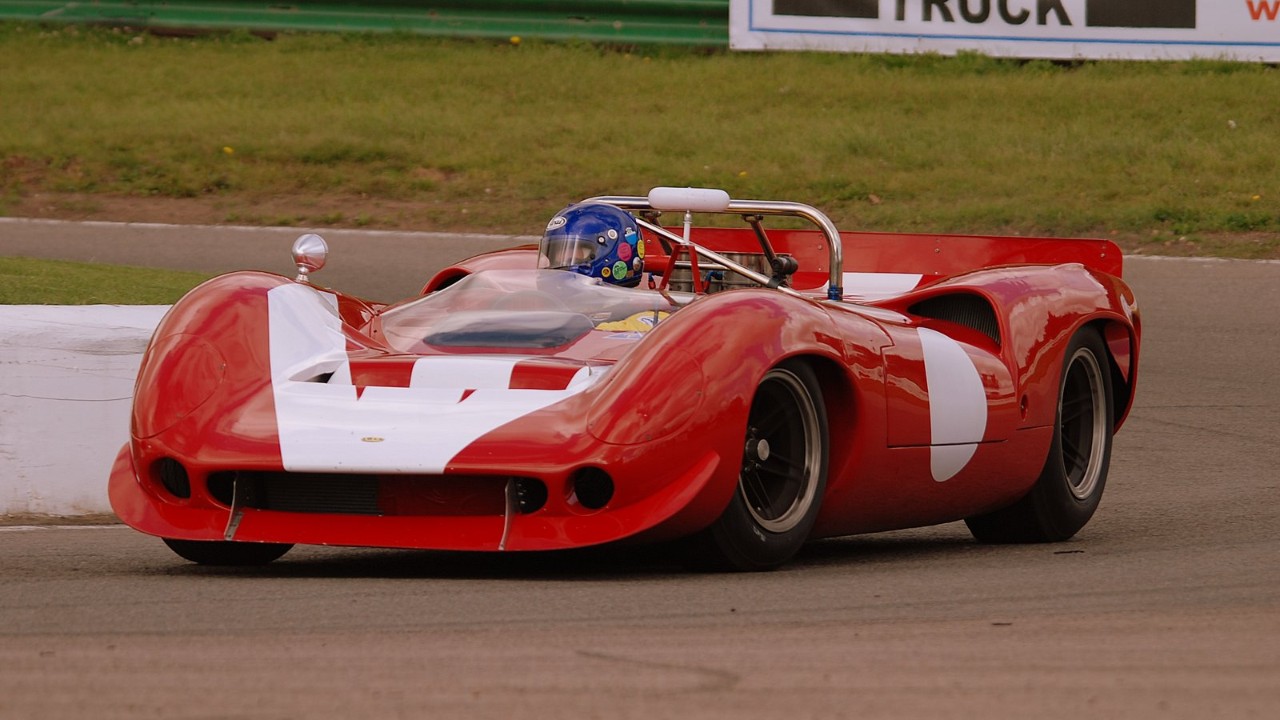
The Lola T70 won the very first Can-Am championship in 1966, and John Surtees drove it there. He ran the car with his own small team, a Chevrolet V8 behind his back and an aluminum tub around him. In fact, T70s won five of the six races that first season.
Surtees was already a Formula 1 world champion when he arrived. Even so, this title came the hard way. He hauled his car across North America with a van, a trailer and a single mechanic, and he won the crown at the final race in the Nevada desert.
Here’s what made the British-built Lola so good, and how Surtees turned it into the first champion of America’s wildest sports car series.
Eric Broadley’s Lola T70

Lola Cars founder Eric Broadley designed the T70, and it arrived in 1965 as the successor to the Lola Mk6. According to Hagerty UK, it rode on an aluminum monocoque chassis. In other words, the body shell itself carried the loads instead of a separate tube frame.
Broadley also had a head start. Writing in Motor Sport, Keith Howard notes that his work on the Ford GT40 grew out of the Lola Mk6 GT. Broadley then designed the T70 to take a range of production-based American engines.
Most buyers chose Chevrolet. Hagerty UK says the usual engine was a 327-cubic-inch small-block, good for about 420 bhp and 400 lb-ft in its strongest form. The open Mk II Spyder weighed 726 kg, roughly 1,600 pounds. Lola eventually built more than 100 T70s, including the later Mk III and Mk IIIB coupes.
Surtees and the T70 before Can-Am
Surtees knew the car from the start. Simon Arron’s 2016 interview in Motor Sport explains that he tested Broadley’s new T70 while he was still driving for Ferrari. Enzo Ferrari agreed, but only if the program did not clash with Ferrari’s own. He also insisted that Surtees race it under his own name.
So Team Surtees ran a T70 from 1965. Team Surtees also joined Lola Cars to form Lola Racing Ltd, a works development arm, and Surtees refined the car there. He also did much of Firestone’s tire testing for the T70 program, according to Howard. On the Chevy engines, his verdict was simple: “I actually think the Chevy engines were great.”
A two-man team chasing the first Can-Am title
The Canadian-American Challenge Cup was new for 1966. Its rules had no maximum engine size and no minimum weight, and it offered big prize money. Surtees told Motor Sport that Can-Am “promised good starting money.” In fact, he expected to earn more from it that year than from his 1964 Formula 1 title.
Still, his team was tiny. Surtees bought a Chevy van and towed the T70 on a trailer. Meanwhile, Malcolm Malone from Lola drove between races and worked as the mechanic. For 1966, the car used a Traco-built 5.9-liter Chevrolet V8.
How the Lola T70 won the 1966 season
First, the opener at St. Jovite, the Mont-Tremblant circuit in Quebec, went perfectly. Motor Sport’s 2001 account, “Nevada nirvana,” says Surtees won from pole. Bruce McLaren and Chris Amon followed him home in McLaren-Elvas.
Then the middle of the season turned rough. At Bridgehampton, Surtees retired on lap 17 with a broken oil pipe, and Dan Gurney won in another T70. Next, at Mosport, a first-corner tangle ended Surtees’ race early. Mark Donohue won that race in Roger Penske’s T70.
Laguna Seca ran as two heats. Surtees finished fourth in the first, but he could not finish the second. As a result, Phil Hill won on aggregate in a Chaparral, the only race a T70 did not win that year. Going into the last two rounds, Hill led the standings 18 points to 9.
However, Surtees struck back at Riverside. He won by about 16 seconds after the Chaparral suffered fuel vaporization. That left Surtees and Hill level on 18 points before the finale, with Donohue one point behind.
The Stardust finale in Las Vegas
The last round ran at Stardust Raceway in Las Vegas. Jim Hall and Hill had qualified their winged Chaparrals fastest, according to Sports Illustrated’s race report. However, both cars failed in the race. Surtees started on the second row and took the lead at once.
He won the 70-lap, roughly 210-mile race in his red-and-white Lola-Chevrolet at an average of 109.25 mph. McLaren finished second, and Donohue took third, a lap down. Only 11 of the 33 starters finished. Meanwhile, Gurney’s drive shaft broke on lap 37.
The win made Surtees the first Can-Am champion. Sports Illustrated listed $19,250 for the series title and $7,500 for the race win. Motor Sport later put the total value of his title at about $70,000.
What the Lola T70 did next
The T70 kept winning after Can-Am moved on, and it found new success in endurance racing. For example, Hagerty UK notes that the Sunoco Lola T70 of Mark Donohue and Chuck Parsons won the 1969 Daytona 24 Hours. Can-Am, meanwhile, grew into an arms race, and McLaren’s own cars soon ruled it, as our story on the McLaren M8B’s perfect 1969 season shows.
Surtees never forgot the Lola, either. He told Motor Sport that he rated Broadley’s cars alongside Colin Chapman’s Lotus designs. Lola later replaced the T70 with the lighter T160, but by then the T70 had already claimed the first Can-Am crown, won by Surtees in 1966.
More from Fast Lane Only