
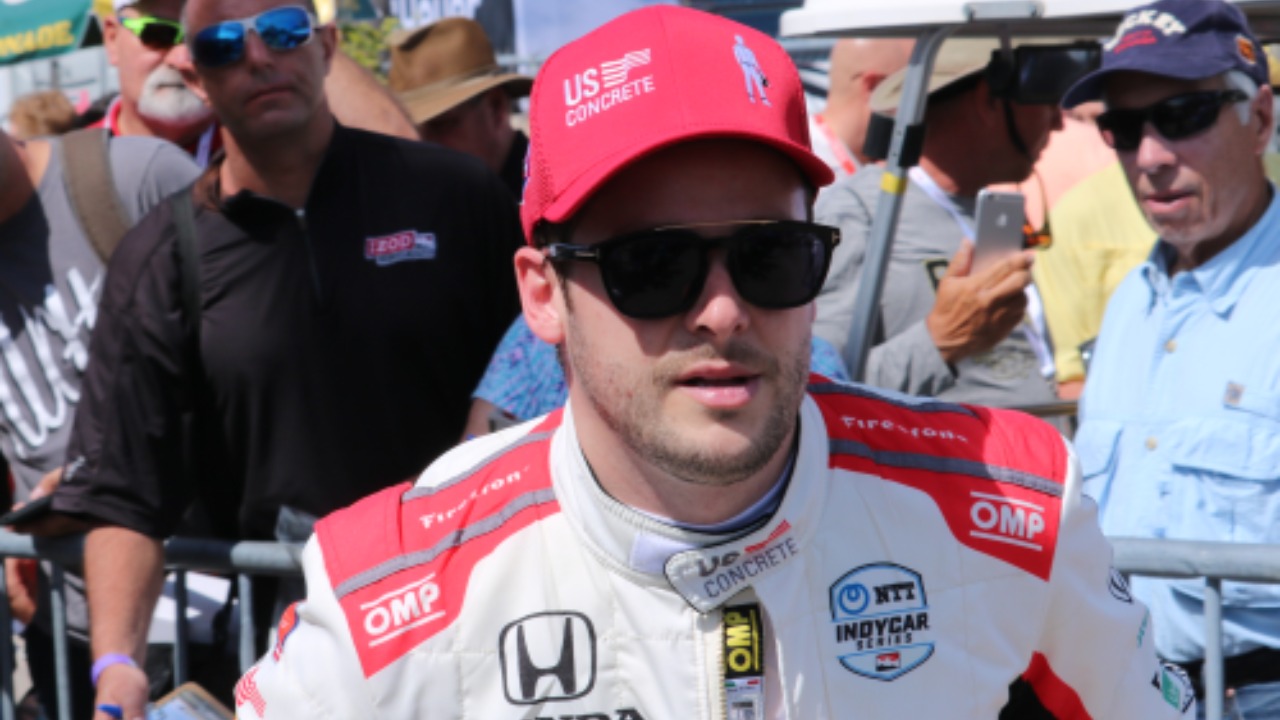
Marco Andretti entered big-time American open-wheel racing with a last name that already carried a full history of triumph and heartbreak. His path from prodigy to retired veteran traces not only a personal career arc but also the weight of a family legacy that shaped how every lap he turned was judged. To understand why expectations clung to him so tightly, it helps to look at where he came from, how quickly he rose, and how the sport measured him against a standard few drivers in any era could match.
Born into Nazareth and a name that already meant something
Marco Michael Andretti did not step into the paddock as a blank slate. He was born in Nazareth, Pennsylvania, as part of a dynasty that had already defined generations of American open-wheel racing. His grandfather Mario Andretti was a global star, and his father Michael Andretti was both a front-line driver and later a major team owner, so Marco’s earliest racing steps were taken in an environment where success was assumed, not hoped for. From the start, he was framed less as a young driver learning the craft and more as the next chapter in a story that fans and teams already felt they knew.
That context meant that even his junior results were interpreted through the lens of inevitability. Marco Andretti climbed through the American open-wheel ladder and then into the Ind series with the expectation that he would extend the family’s record in various categories of racing, not simply participate in them. The fact that he was an American prospect in a period when the series was hungry for homegrown stars only intensified that focus, because every promising run was treated as confirmation that the Andretti name would keep anchoring the sport’s identity.
The 19-year-old prodigy and the early IndyCar spotlight

When Marco Andretti reached the top level, he did it at a speed that matched the hype around him. He debuted in the Ind series at the age of 19, driving for his father’s team that would later be known as Andretti Global, and immediately became a focal point of the paddock. The combination of youth, family ownership and a car capable of winning meant that his learning curve unfolded in full public view. There was no quiet apprenticeship in midfield machinery, only the expectation that he would contend from the moment he strapped in.
That expectation crystallized around the Indianapolis 500. As a 19-year-old in the 500, Marco Andretti came within sight of victory, and many observers assumed it would be only a matter of a year or two before he added his name to the list of family winners at Indianapolis. The near miss at the Brickyard was treated less as a heartbreak and more as a preview, a sign that the third-generation Andretti would soon convert potential into the kind of results that had already defined the family in global motorsports. From that point on, every May was framed as another chance to fulfill what his debut had promised.
Growing up fast in a family business
The speed of Marco Andretti’s rise was not accidental. His early life and career beginnings were steeped in racing, with structured steps through junior categories that were designed to prepare him for the demands of top-level competition. Accounts of his formative years describe a driver who was immersed in the sport from childhood, with his development shaped by the same family that had already produced champions. Those early experiences, captured in profiles of his early life and career beginnings, reinforced the idea that he was being groomed for the spotlight rather than stumbling into it.
By the time he was a teenager, Marco Andretti was already navigating the dual reality of being both a developing driver and a public figure. A feature on the 19-year-old Andretti described life in the chain of racing Andrettis, capturing how he was trying to prove himself while still being seen as the youngest member of a long-running enterprise. That piece, which framed him as part of the family business, underscored how little separation there was between his personal growth and the expectations attached to his surname. He was not just learning how to race; he was learning how to be an Andretti in public.
Talent, pressure and the impossible comparison
From the outside, it was easy to assume that Marco Andretti’s path was paved with advantages. Inside that world, the pressure was its own burden. Commentators have noted that none of us can imagine the intense pressure he faced from the time he could crawl, given his grandfather’s status and the way fans expected the next Andretti to match that standard. One reflection on his career put it bluntly, saying that none of the outside observers truly understood what it meant to grow up under that spotlight, or how hard it was to live up to that pressure every time he climbed into the car.
At the same time, few serious observers doubted his raw ability. Fans and insiders have pointed out that his hands, car control and reaction time were as good as it gets, even if the results did not always translate into championships. In one extended discussion of his career, supporters argued that his talent was real, even if he was never as statistically dominant as Mario and Michael. That tension between evident skill and the impossibly high bar set by his own family is at the heart of why expectations around him always felt so heavy.
Results, reinvention and a different kind of legacy
Over time, Marco Andretti’s career settled into something more nuanced than the early predictions of instant stardom. He became a fixture in the series, a third-generation driver who carried the family name into a new era while carving out his own set of achievements. Official series profiles highlighted that he came from a legendary racing family, noting that his grandfather Mario won 52 races, but they also emphasized Marco’s own story at the Brickyard and beyond. He was not just a placeholder in the record books; he was the bridge between eras, the driver who kept the Andretti presence active on the grid while the sport evolved around him.
His competitive arc included high points that justified the early excitement. Marco Andretti won Ind series races at Sonoma Raceway and at Iowa Speedway, results that confirmed he could convert speed into victories when the pieces aligned. Later in his career, he also stepped into other disciplines and became the 2022 SRX Series champion, a reminder that his skill set translated beyond a single championship. Those milestones, documented in his career record, showed a driver who kept finding ways to compete at a high level even as the narrative around him shifted from “future champion” to “veteran presence.”
Retirement and what his career ultimately represents
When Marco Andretti announced that he was stepping away as a full-time driver, it marked the end of a specific chapter in both his life and his family’s story at Indianapolis. The official announcement framed it as Marco Andretti Announces Retirement as a Driver, and it underscored that he had spent roughly two decades in the Ind series, with wins at Sonoma and Iowa anchoring his résumé. His decision to scale back his driving commitments did not erase the near-misses or the seasons where expectations outpaced results, but it did invite a more measured look at what he actually accomplished in a long, demanding career.
That reassessment has highlighted how much of the story was shaped by anticipation. The excitement around another American star was heightened when he took his first win at Sonoma, and commentary on his retirement noted how that early success fed the belief that he would soon become a dominant force. One analysis of his departure from full-time competition described how the anticipation of another American superstar never fully aligned with the reality of his results, even as he remained a fixture at the 500 for the foreseeable future. In that gap between hope and outcome lies the real story of his path: a talented driver who carried a famous name, delivered genuine highlights, and spent his entire career being measured against a standard that almost no one could realistically match.
Why expectations followed him, and what they say about racing
Looking back, the expectations that trailed Marco Andretti were not just about his own potential, they were about what fans wanted the sport itself to be. The Ind series has long relied on iconic families and American heroes to anchor its identity, and the Andretti name sits at the center of that mythology. When Marco arrived as a teenager, already polished from his early life in Nazareth and his structured climb through junior categories, he became the vessel for those hopes. The narrative that he would quickly win the Indianapolis 500, then stack up titles like his grandfather and father, was as much a projection of the sport’s nostalgia as it was an evaluation of his actual trajectory.
In that sense, his career is a reminder that dynasties can inspire and distort in equal measure. Marco Andretti did not match Mario’s 52 wins or Michael’s peak dominance, but he did extend the family’s presence into a new generation, kept the name on the grid through eras of change, and carried a level of scrutiny that few of his peers ever faced. The writers who once assumed that, as a 19-year-old in the Indianapolis 500, he was only a year or two away from victory were not wrong to see his talent; they simply underestimated how complex a racing career can be when every result is weighed against a family legacy and a sport’s longing for the next great American star.




Leave a Reply