
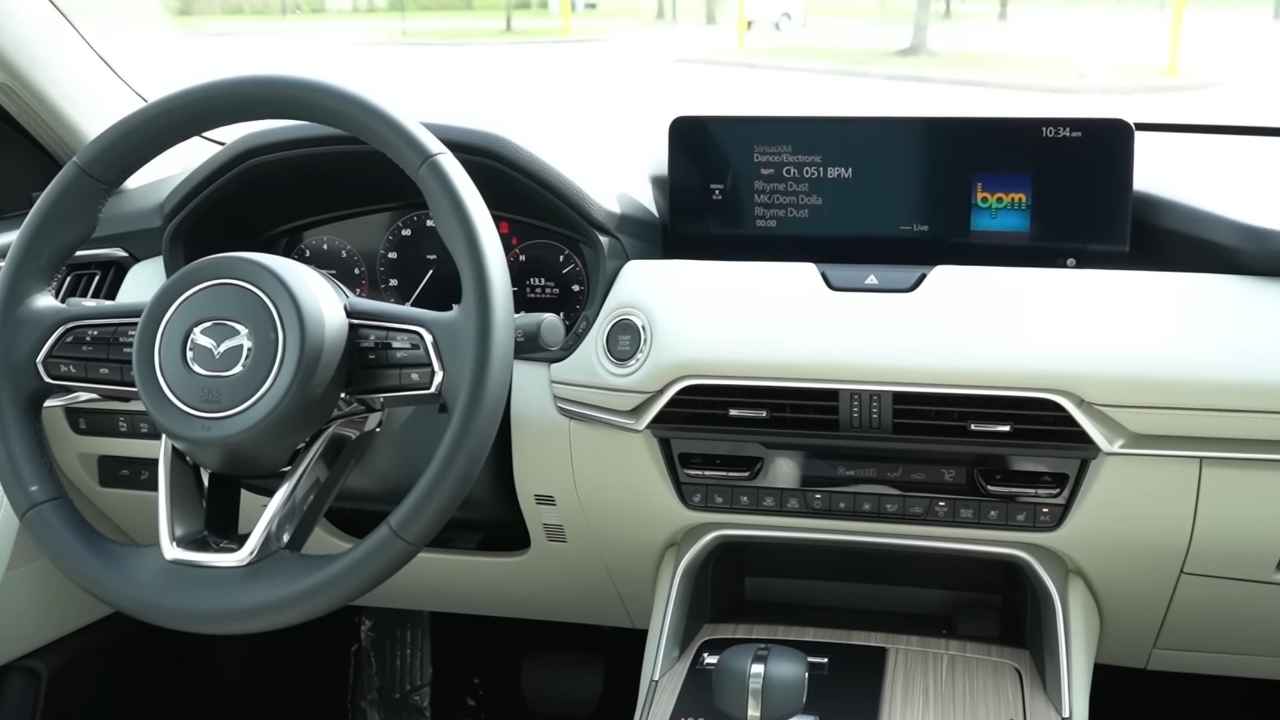
Mazda is again under federal scrutiny after owners of its flagship CX-90 reported steering problems even after receiving a recall repair that was supposed to eliminate the risk. The renewed complaints have prompted safety regulators to open a fresh probe into whether the original fix worked as advertised or left a dangerous defect lurking in thousands of family SUVs. At stake is not only the safety of CX-90 drivers and passengers, but also public confidence in how automakers handle safety recalls that are meant to close the loop on serious defects.
From initial recall to renewed alarm
The CX-90’s steering saga began with a defect that regulators linked to a faulty component inside the steering system, a worm gear that could cause the steering wheel to feel heavy, stick off center, or suddenly change direction. Mazda responded with a recall of its three-row SUV, targeting tens of thousands of vehicles built after the model went into production in December 2023, and promising that a repair would prevent loss of steering assist and reduce the risk of a crash. The recall covered 43,752 CX-90 vehicles, a figure repeated in multiple safety notices, and was framed as a straightforward mechanical remedy to a clearly identified problem in the steering assembly.
Owners were told that once the recall work was completed, their vehicles would be safe to drive, yet a subset of drivers later reported that steering issues persisted or reappeared. Those accounts described “sticky steering” and unexpected resistance at the wheel even after the recall remedy had been performed, raising doubts about whether the fix fully addressed the underlying defect. The pattern of post-repair complaints is what ultimately drew the attention of federal investigators and set the stage for the latest inquiry into Mazda’s handling of the CX-90 steering defect.
Inside the new federal investigation
The Office of Defects Investigation, a unit within the National Highway Traffic Safety Administration, has now opened a recall query focused on the CX-90 steering repair. According to an ODI summary, regulators have received 26 complaints along with several Early Warning Reporting Field Repo submissions that describe steering problems in vehicles that had already undergone the recall service. The agency notes that in each of these cases, the reported incident occurred after the remedy was completed, which is a critical detail because it suggests a potential defect in the repair process itself rather than in unrepaired vehicles alone.
Investigators are examining whether the original recall remedy was properly designed and executed, and whether Mazda’s instructions to dealers were sufficient to ensure a consistent and durable fix. The ODI recall query is a formal step that allows regulators to demand detailed information from the automaker, including engineering analyses, field reports, and warranty data, to determine if the remedy is failing or if additional action is needed. If the probe confirms that the steering defect can still cause loss of control after the recall work, regulators could require Mazda to develop a new repair, expand the scope of the recall, or in extreme cases consider more aggressive enforcement measures.
What owners are reporting behind the wheel
Owner complaints describe a driving experience that is at odds with what they expected after a safety recall, with some CX-90 drivers reporting that the steering wheel can feel as if it momentarily locks or resists input before suddenly freeing up. In several accounts, the steering is said to stick slightly off center, requiring extra effort to keep the vehicle tracking straight, and then to release abruptly, which can cause the SUV to drift or lurch within its lane. These symptoms echo the original defect description tied to the worm gear inside the steering system, which regulators warned could lead to a sudden and unexpected change in steering angle and increase the risk of a crash.
What makes the current wave of complaints particularly troubling is that they are coming from owners who believed their vehicles had already been made safe. Reports submitted to regulators and referenced in the ODI summary specify that the recall remedy had been completed prior to the incident, yet the drivers still experienced sticky steering or a loss of steering assist. For families who rely on the CX-90 as a primary vehicle, the idea that a known defect might persist after a dealer visit undermines trust not only in Mazda’s fix but in the broader recall system that is supposed to catch and correct such hazards before they lead to serious collisions.
How Mazda’s recall strategy is being tested
Mazda has faced multiple safety campaigns involving the CX-90 and its closely related CX-70, which together form the core of the brand’s new large-vehicle lineup. In addition to the steering defect tied to the worm gear, the company has recalled 81,000 CX-70 and CX-90 SUVs over a software issue that affected vehicle systems and required an update at dealerships. Owners were directed to contact Mazda at 800-222-5500, option 6, with the recall number 7124J, and to use their vehicle identification number to confirm whether their SUV was covered. The steering recall for the CX-90, identified separately with the internal code 6542A, focused on the mechanical assembly and was intended to prevent power steering loss.
Regulators and safety advocates often point out that recalls are not inherently a sign of failure, and that they can demonstrate that the system is working when automakers identify problems and move to correct them. In the CX-90 case, however, the new investigation into the effectiveness of the steering repair puts Mazda’s recall strategy under a harsher spotlight. If the remedy is found to be incomplete or inconsistently applied, it would suggest that the company either underestimated the complexity of the defect or did not ensure that dealers followed the repair procedure precisely, both of which could have serious implications for how future recalls are designed and monitored.
What CX-90 drivers should do now
For current CX-90 owners, the renewed probe is a reminder that recall notices are not paperwork to be ignored, but critical safety communications that require prompt action. Drivers who have not yet had the steering recall performed should check their vehicle identification number through the National Highway Traffic Safety Administration’s online recall lookup tool or contact Mazda directly to confirm their status. Those who have already received the repair but are experiencing any unusual steering behavior, such as sticking, heaviness, or sudden changes in direction, should document the symptoms, stop driving if the vehicle feels unsafe, and schedule an inspection with a dealer as soon as possible.
Regulators will continue to gather data as the ODI recall query proceeds, and depending on the findings, Mazda may be required to notify owners of additional steps or a revised remedy. Until then, CX-90 drivers are left balancing the assurances of a completed recall against the unsettling reports that some repaired vehicles still exhibit the very defect the campaign was meant to eliminate. The outcome of the investigation will not only determine whether Mazda must return to the drawing board on its steering fix, it will also signal how rigorously federal authorities intend to police the quality of recall remedies when complaints resurface after the work is supposedly done.
More from Fast Lane Only




Leave a Reply