
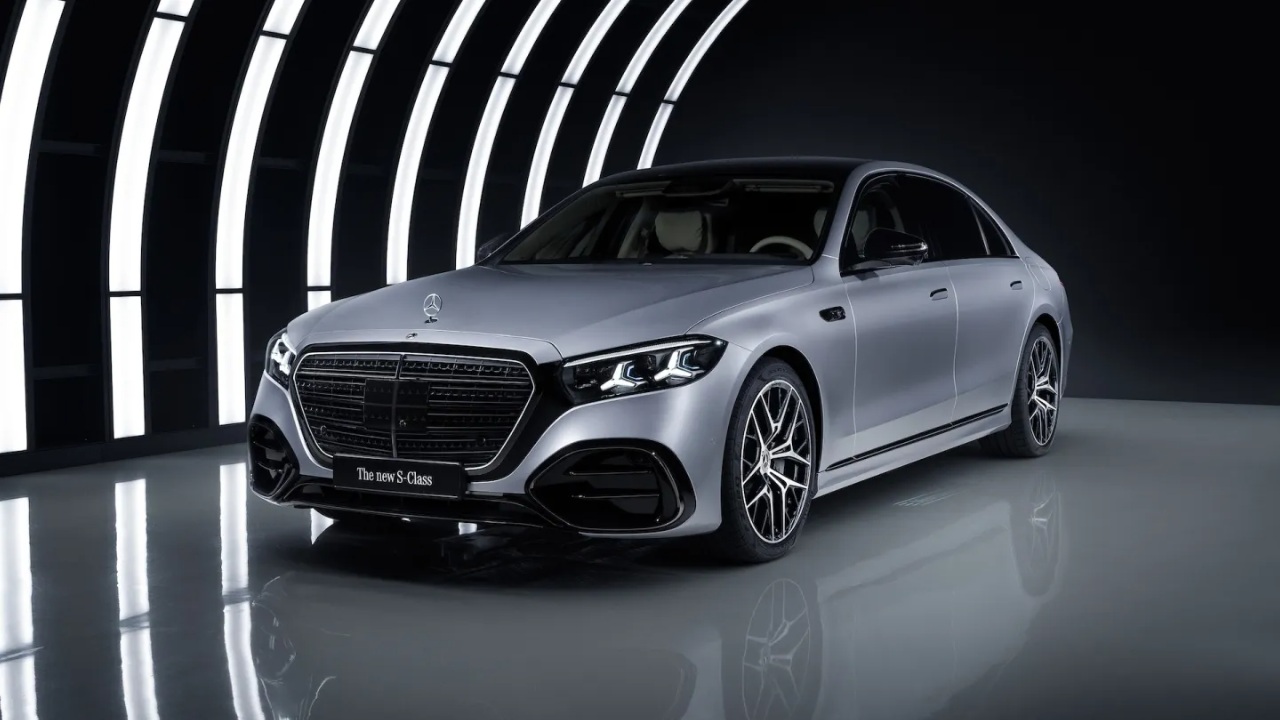
The latest Mercedes-Benz S-Class has been engineered less like a traditional luxury sedan and more like a flagship device, a kind of smartphone you occupy rather than hold. Its cabin is organized around screens, software and connectivity, with comfort and safety systems orchestrated by a central operating system that treats every journey as a data-rich, personalized session.
That shift does not abandon the S-Class heritage of quiet power and indulgent materials, but it reframes those qualities through interfaces and algorithms. From the moment the car recognizes a driver’s digital key to the way it manages climate, entertainment and even semi-autonomous driving, the S-Class now behaves like a high-end piece of consumer tech that just happens to have four wheels.
A superscreen at the center of everything
Open the door of the new S-Class and the first impression is not of wood or leather, but of glass. The dashboard is dominated by a sweeping display array that merges instrument, central and passenger screens into a single visual plane, a layout Mercedes-Benz describes as the MBUX Hyperscreen or, in its latest form, the MBUX Superscreen. In the 2027 S-Class, that setup includes a 14.4-inch central display flanked by twin 12.3-inch driver and passenger screens, all under one seamless surface that stretches across the cabin.
This architecture turns the car’s interior into a digital workspace where navigation, media, vehicle settings and comfort functions live side by side like apps on a tablet. Earlier S-Class generations already used a large portrait display, but the new configuration, with its 14.4-inch center and 12.3-inch companion panels, makes the screen the organizing principle of the cockpit rather than a single feature. Icons on the central touchscreen can be rearranged, mirroring the way users customize a phone’s home screen, and the system is designed so that frequently used functions surface contextually instead of forcing drivers to dig through menus.
MBUX as the operating system of the car
If the glass is what the occupants see, MBUX is what they feel. The latest generation of the Mercedes-Benz User Experience system runs on a dedicated software platform, MB.OS, that treats the S-Class as a connected device with its own operating system. At its core is a central touchscreen that acts as the primary interface for navigation, media, vehicle settings and connected services, much as a smartphone screen anchors a mobile ecosystem.
MBUX has evolved beyond simple voice commands into a Virtual Assistant that uses generative AI to handle more natural, multi-turn conversations. Instead of memorizing fixed phrases, drivers can speak in everyday language to adjust climate, set a destination or change ambient lighting, and the assistant interprets intent in context. The system learns preferences over time, from seat positions to favorite routes, and surfaces suggestions proactively, echoing the predictive behavior of modern mobile operating systems that anticipate user needs based on past behavior.
From app to automobile: a continuous digital session
The S-Class does not confine its intelligence to the cabin. It extends into the driver’s pocket through the Mercedes-Benz app, which effectively turns the smartphone into a remote control and status panel for the car. Owners can pair their vehicle, activate services and then manage charging, access protection and trip planning from afar, with features like Wallbox integration allowing them to start charging, monitor home and public charging history and manage access with a few taps.
That same ecosystem supports Smart Mobility Highlights such as Digital Key Access, which lets a smartphone or smartwatch unlock and start the car, and Real-time Vehicle Control, which enables remote operations like locking, climate preconditioning or checking vehicle status. The result is a continuous digital session that begins on the phone, continues as the driver approaches and enters the S-Class, and persists after the journey ends, with the app handling tasks like locating the car, scheduling service or managing charging schedules.
Comfort and safety as background apps
While the screens and software draw attention, the S-Class still earns its reputation through comfort and safety, now managed like background processes in a device. True to S-Class form, comfort takes center stage, with features such as Heated front seatbelts that warm occupants from the moment they buckle in, and Digital Vent Control that automatically adjusts airflow based on temperature settings and occupancy. Massage functions, ambient lighting and advanced rear-seat entertainment systems are coordinated through the central interface, allowing each passenger to tailor their environment as if configuring a personal profile on a tablet.
On the safety side, the car layers traditional driver assistance with more advanced capabilities. The S-Class with DRIVE PILOT uses a sophisticated array of sensor technology and redundant systems to support conditional automated driving in specific scenarios, such as controlled highway conditions. These systems monitor surroundings, lane markings and traffic, and are designed to handle sudden events like a lane blockage while keeping the driver informed and ready to resume control. In practice, this turns high-stress segments of a commute into managed experiences, with the car’s software stack handling the complexity in the background much like a phone’s operating system manages network connections and security without demanding constant user input.
The S-Class as a rolling entertainment and productivity hub
Mercedes-Benz has also leaned into the idea of the S-Class as a place to work and unwind, not just travel. The Hyperscreen and Superscreen layouts support streaming services and rich media, with rear-seat passengers gaining access to advanced entertainment systems that can run apps, video and interactive content. Reports on the 2027 S-Class highlight support for platforms such as Disney+ and Sony’s RideVu, turning the back seat into a cinema or gaming lounge while the car is parked or, in some markets and conditions, while automated driving features are active.
For those using the S-Class as a mobile office, the combination of large displays, voice control and connectivity allows for navigation planning, calendar integration and communication management without reaching for a separate device. The central 14.4-inch display and the 12.3-inch instrument and passenger screens can show different content simultaneously, so a driver can focus on navigation and vehicle data while a front passenger manages media or productivity tools. This division of digital labor mirrors multi-screen desktop setups, reinforcing the sense that the car is less a vehicle and more a shared, networked workspace that happens to move at highway speeds.
More from Fast Lane Only


Leave a Reply