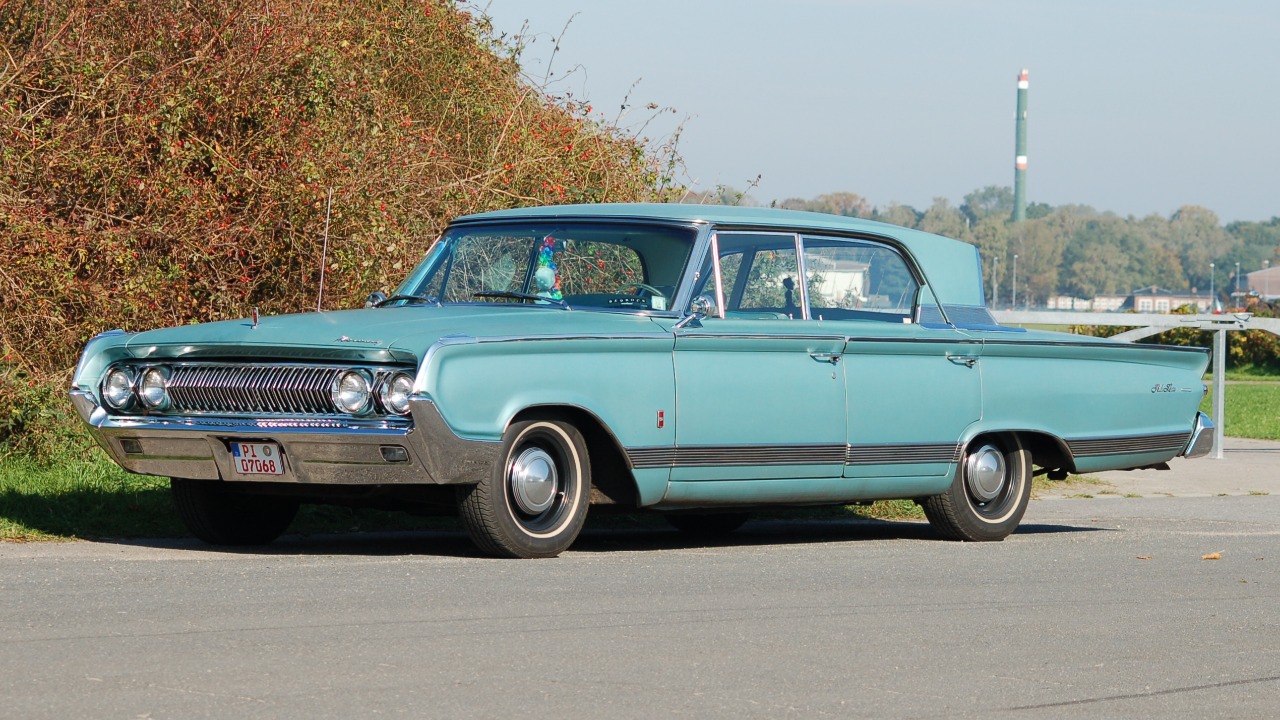
The 1964 Mercury Park Lane arrived at a moment when Detroit was learning how to hide its muscle under cleaner, more formal sheet metal. Mercury’s top full-size model wrapped serious V8 power, long-haul comfort, and a hint of NASCAR swagger in a suit that looked more executive than outlaw. Six decades later, it stands as a case study in how a big American car could be both restrained and unapologetically strong.
Instead of shouting about performance with wild fins or garish trim, the Park Lane relied on subtle cues, careful proportions, and quietly advanced hardware. The result was a car that could run hard on a four-speed highway blast, then glide home with the air of a country club sedan.
The new top line: Park Lane takes the flagship role
Mercury’s full-size range for 1964 was organized in two series, each with its own level of luxury and performance, and the new top-line series carried the name Park Lane. Positioned above other full-size Mercurys, it was intended as the most luxurious expression of the brand’s big-car formula, with more standard equipment, richer trim, and the strongest engines.
Period literature framed Park Lane as the car that combined the division’s most advanced engineering with an upscale cabin and a long list of comfort features. Far from being just a dressy version of a lower model, it sat at the top of Mercury’s lineup as a distinct series with its own identity and options.
Body styles and that “cleaner suit” of sheet metal
The 1964 Park Lane arrived with a full spread of body styles that mirrored American family and enthusiast needs of the time. According to contemporary specifications, body styles included a sedan, 2- and 4-door hardtop fastbacks, and a convertible with a glass rear window, and pricing ranged from just over 3,000 dollars for the entry models to higher figures for better equipped cars, as detailed in period data. That spread let Mercury court both conservative buyers and those who wanted a sleeker profile.
Designers worked toward a smoother, more linear look than the flamboyant fin era that had just ended. The sides were largely unadorned, with crisp character lines instead of heavy chrome spears. Rooflines on the hardtop fastbacks flowed gently into the rear deck, visually lowering the car and helping it look more athletic without resorting to gimmicks.
Trim details were carefully controlled. Brightwork framed the grille and windows, but large flat surfaces were left clean. The result was a big car that read as substantial and modern rather than flashy. Enthusiasts today often describe the 1964 Mercury Parklane as a blend of Full Size Elegance with V8 Muscle, a phrase that captures how luxury and performance coexisted in the design language and that is echoed in a period enthusiast post on the 1964 Mercury Parklane.
Inside, comfort first, but with a driver’s edge
Open the door of a Park Lane and the emphasis on comfort becomes clear. Bench seats in sedans and some hardtops were wide and deeply padded, while bucket seats were available in sportier configurations. Materials and patterns were richer than in lower Mercury lines, with extra attention on door panels and dash trim.
Factory literature and later guides highlight amenities such as a padded instrument panel, quality carpeting, and available power accessories that underscored the car’s premium intent. The layout of the controls and gauges favored clarity over novelty, which suited the car’s restrained image.
Yet this was not a purely soft, isolated cabin. The driving position placed the wheel and shifter where an enthusiast would want them, particularly in cars ordered with the four-speed manual. That balance between plushness and control mirrored the broader mission of the Park Lane: to offer a car that could be driven briskly without sacrificing long-distance comfort.
Under the hood: big-block power dressed in manners
The Park Lane’s cleaner styling did not signal any retreat from serious V8 power. Engine specifications from a detailed MMP Rating guide list the base Engine Specifications with an Engine of 390 CID V8, a configuration that gave the big Mercury the torque it needed to move decisively. That 390 figure placed the Park Lane squarely in big-block territory.
Performance-focused versions went further. In the Park Lane Marauder Convertible, one documented specification notes that the car was Powered by a 390-cubic inch V8 engine, it produced 330 horsepower, delivering smooth acceleration and a comfortable driving experience, a combination that is detailed in a dedicated Marauder profile. That 330 horsepower figure, paired with the car’s gearing, made the Park Lane a serious performer by early 1960s standards.
High-performance setups paired the big V8 with dual four-barrel carburetors, solid lifters, and a high-performance valvetrain, and they were often combined with a four-speed manual transmission. These configurations were closely linked to Ford’s racing program and aimed at buyers who wanted full-size speed. A later enthusiast account notes that the Park Lane stood at the top of Mercury’s lineup and that some configurations were faster than any Ford of the era, a claim that underscores how far Mercury was willing to go with its flagship and that is captured in a detailed performance overview.
Marauder: the performance face of Park Lane
Within the Park Lane family, the Marauder name signaled the most aggressive intent. The 1964 Mercury Marauder Park Lane combined the long, formal body with performance-oriented details, including fastback rooflines that improved high-speed stability and gave the car a racier silhouette.
Video walkarounds of surviving cars, such as a 1964 Mercury Marauder Park Lane filmed in Milford Michigan in a detailed showroom tour, show how the Marauder treatment sharpened the Park Lane’s presence without abandoning its upscale character. In that clip, posted by McKenzie, the host notes the car’s rarity and the way its 390c.i. 4-Speed setup transforms it from a cruiser into something closer to a full-size muscle car, as seen in the 1964 Mercury Park feature.
Another surviving example, described as One very rare survivor on an enthusiast channel called Hot Lap and Hotlap, is introduced with the comment that a hot lap in the car is so fast it would really make your head spin, a vivid summary of what a well-tuned Marauder-spec Park Lane could do. That sentiment is captured in a separate Hot Lap profile that focuses on the 1964 Mercury.
Racing roots and the quiet influence of NASCAR
The Park Lane’s mechanical choices were not made in isolation. Ford’s broader racing program in the early 1960s shaped the hardware that found its way into Mercury showrooms. High-performance versions of the 390 and related big-blocks were developed with stock car competition in mind, then adapted for street use.
The fastback Marauder roofline, for example, was more than a styling flourish. Its smoother shape helped airflow at high speeds, which mattered on NASCAR superspeedways. While Mercury’s direct racing involvement fluctuated, the engineering lessons filtered down to production Park Lanes that buyers could order with substantial horsepower and four-speed gearboxes.
Enthusiast retrospectives that connect the Park Lane to Ford’s racing program underline how the flagship model benefited from this trickle-down development. The same dual four-barrel carburetors and high-performance valvetrain that worked on the track gave street cars a level of responsiveness that set them apart from typical big sedans.
Everyday luxury: options and features
Beyond raw power, the Park Lane distinguished itself through equipment. Factory options lists show power steering, power brakes, automatic transmissions, and air conditioning, along with radios and upgraded interior trims. Many of these features were either standard or more commonly ordered on Park Lanes than on lower Mercury lines, reinforcing the flagship image.
The MMP guide points to exterior features such as a reverse-slanting power rear window on some body styles, a detail that combined visual flair with genuine ventilation benefits and is highlighted in the Mercury Park Lane. Such touches helped the car stand out in a crowded full-size market.
Inside, buyers could specify premium radios, additional gauges, and trim upgrades that made the cabin feel more like a personal luxury car than a simple family sedan. The padded instrument panel mentioned in period specs was both a safety feature and a visual sign of modernity.
From showroom star to survivor: how the Park Lane ages
Today, the 1964 Park Lane occupies a niche in the classic car world that blends luxury appeal with performance credibility. It is less common than contemporary full-size Fords or Chevrolets, which adds to its allure among collectors who want something distinctive.
Survivor stories show how these cars can sit for decades yet still respond to careful revival. One account describes a son arranging for a professional cleaning of his father’s long-stored 1964 Mercury, a car that had not moved an inch since it was parked and that is chronicled under the description Son Calls a Detailer: His Dad’s 1964 Mercury Gets Washed for the First Time in 30 Years. That rediscovery, detailed in the feature titled Son Calls a Detailer: His Dad’s 1964 Mercury Gets Washed for the First Time in 30 Years, can be seen in an autoevolution report that highlights how deeply these cars can be tied to family history.
Other survivors are showcased by enthusiasts such as Lou on My Ca, who introduces a 1964 Mercury Park Lane Marauder nicknamed The Midnight Marauder with the line the midnight marauder puts you back in the seat, followed by the phrase we are off to Mercury, and a greeting of hi I am Lou with another episode of My Ca. That personal enthusiasm, captured in a dedicated Midnight Marauder video, reflects how the Park Lane still resonates with drivers who appreciate a blend of comfort and power.
How enthusiasts view the 1964 Park Lane today
Among collectors, the 1964 Park Lane is often praised for its balance. It is large and comfortable enough for long-distance touring yet has the drivetrain and chassis to make spirited driving enjoyable, especially in Marauder and four-speed configurations. The car’s cleaner styling has aged well, avoiding the excesses that can date some contemporaries.
Online groups dedicated to classic American cars frequently highlight the 1964 Mercury as an example of Full Size Elegance with V8 Muscle, a phrase that appears in enthusiast posts about the Mercury Parklane and that captures the car’s dual nature. In one such group, members describe the car as featuring bold, futuristic lines paired with the kind of V8 performance that draws crowds at a classiccarshow and carshow, and they tag posts with usacars and cars to underline its American identity, as seen in the enthusiast discussion.
Technical reference sites that compile Mercury Park Lane Specifications list multiple engine choices, including options that reached up to 425 HP (312.8 KW), reinforcing the idea that the car could be tailored from comfortable cruiser to near muscle car. Navigation tools on these sites, labeled Mercury Park Lane Navigation, often organize information into Article sections, Image galleries, Valuation data, and detailed Specifications, as seen in the dedicated specification archive.
More from Fast Lane Only