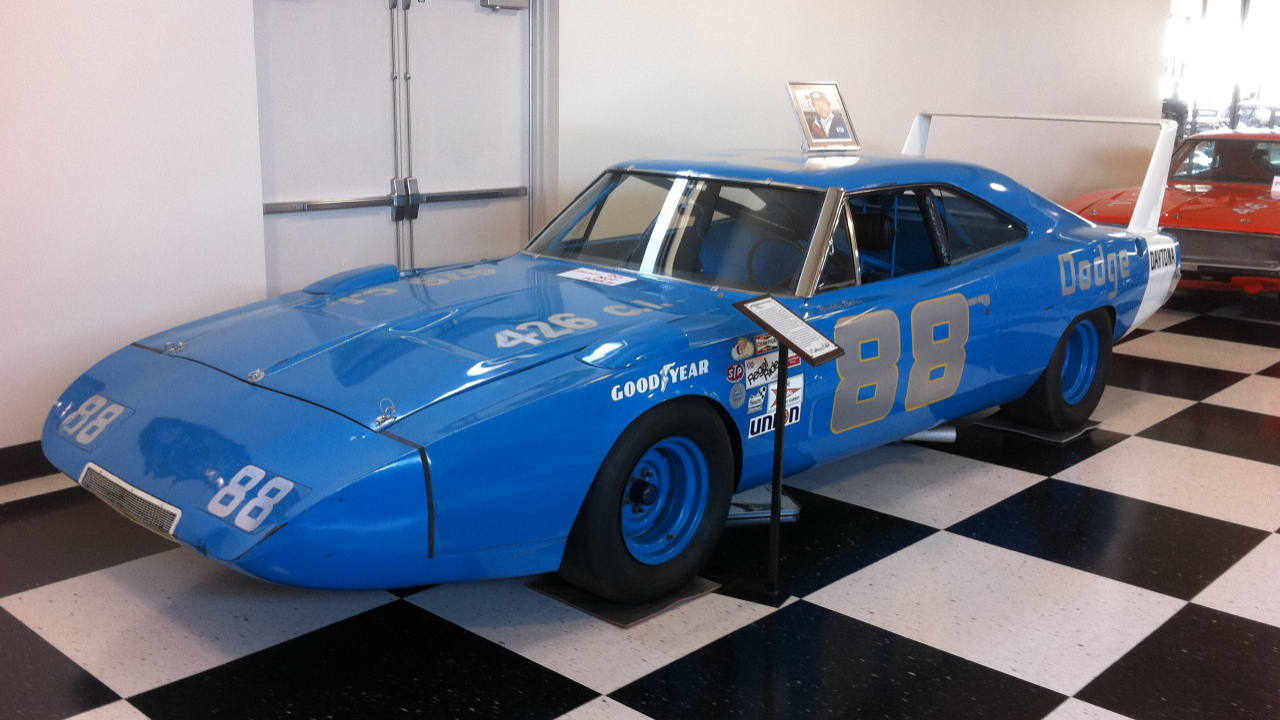
The 1969 Dodge Charger Daytona exists because of a rulebook. When NASCAR demanded that race cars stay rooted in production reality, Dodge answered with a machine so extreme that it rewrote speed records and forced the rulemakers to rethink what “stock” should mean. The result was a wedge-shaped outlaw that went over 200 MPH on a closed circuit and turned a bureaucratic requirement into one of the wildest success stories in American racing.
How NASCAR’s own rules lit the fuse
In 1969, NASCAR rules were written to keep competition close and cars recognizably tied to the street models sitting in dealer showrooms. Manufacturers had to sell a minimum number of examples to the public before they could run a body style in competition, which meant every outrageous idea also had to survive on the open market. For Dodge, those rules turned into both a problem and an opportunity.
After Dodge struggled through a disappointing 1968 NASCAR season, the company needed a way to claw back speed on the big ovals. The standard Charger looked muscular but pushed too much air. At high speed, it lifted rather than planted, which left Dodge teams chasing sleeker rivals. Engineers responded with a radically altered version of the car conceived specifically to dominate the series, a project that only made sense because NASCAR insisted the race car remain a production-based machine. As one period summary put it, “After Dodge” saw its 1968 campaign falter, the brand committed to a wilder solution that still met the letter of the stock car rules, a move that allowed fans to buy the same basic shape that would soon terrorize the superspeedways in NASCAR.
A Charger stretched into a missile
The result of that rule-driven rethink was the Dodge Charger Daytona, a car that took the familiar Charger profile and stretched it into something closer to a purpose-built missile. In 1969, Dodge introduced the Charger Daytona as a specially modified version of the standard Charger, built specifically to dominate NASCAR racing. The car wore a pointed nose cone that extended the front of the body and sliced through the air, along with a tall rear wing that stood well above the decklid to catch clean airflow and press the rear tires into the track.
Contemporary descriptions stress how radical the transformation was. Unlike a standard 1969 Charger, the Charger Daytona carried an extended front clip, a flush rear window plug in place of the recessed backlight, and that towering wing. One detailed overview notes that the Charger Daytona of 1969 was engineered as a high-performance version of the Charger model, created with both NASCAR competition and dragstrip dreams in mind, a combination that gave it a unique place among late 1960s muscle cars in Charger Daytona lore.
The shape was not styling theater. Engineers obsessed over airflow, using wind tunnel testing and track feedback to reduce drag and generate stability at speeds that were starting to push beyond what the original NASCAR rulebook authors had imagined. One technical retelling describes how this pursuit of speed turned into one of the most fascinating chapters in motorsport history, as Dodge’s aerodynamicists used every trick they could to bend the rulebook without breaking it in Aero tricks that transformed the Charger into a true “aero warrior.”
Homologation: the loophole that put wings on the street
NASCAR’s insistence on production-based cars meant Dodge had to sell the Charger Daytona to regular buyers, not just race teams. The only reason the public could buy this wild machine was to satisfy the series’ homologation requirement, which demanded that the same basic body and aero package be available at dealerships.
That rule produced one of the strangest sights in American car culture: a limited run of street-legal Chargers wearing race-bred nose cones and high-mounted wings. One enthusiast account notes that the car in a period image is a 1969 Dodge Charger Daytona, described as a limited edition, high-performance version of the second-generation Charger that today can sell for over $1 million, a testament to how that NASCAR loophole accidentally created one of the most coveted muscle cars in Aug Dodge Charger history.
Fans sometimes forget that this was not a vanity project. Without those production numbers, NASCAR would not have allowed the Charger Daytona to race. The same rule that was meant to keep the series grounded in showroom reality instead pushed Dodge to bolt race car hardware onto street machines, all in the name of compliance.
On track: fast, then faster
Once the Charger Daytona reached the superspeedways, the effect was immediate. In 1969, NASCAR rules were already under strain as speeds climbed, and the new Dodge quickly showed why. One retelling describes how the Dodge Charger arrived as a surprising force in shaping series history, with the Daytona’s debut marking a turning point in what some fans now call the “aero wars” in Unknown Story One lore.
The car’s most famous moment came slightly later, when the development work paid off in a record that still defines its legend. On March 24, 1970, Buddy Baker drove a Dodge Charger Daytona at Alabama International Motor Speedway, better known as Talladega Superspeedway, and broke the 200 MPH barrier on a closed circuit. An archival account of that day notes that the 1969 Dodge Charger Daytona became the first stock car ever to go over “200 M” on a closed course, with Buddy Baker using the car’s refined aerodynamics to reach that historic mark on the Dodge Charger Daytona.
Another detailed summary of Talladega’s history reinforces how central that run was. Talladega Superspeedway is still described as NASCAR’s Fastest Track, with Buddy Baker and Bill Elliott both associated with speed records there, and Baker’s run in the Charger Daytona cited as the moment when a stock car first went beyond the 200 MPH mark on a closed course in Jun Talladega Superspeedway history.
Later retellings of that day emphasize the same figure. One fan recap of Buddy Baker’s Talladega heroics notes that Buddy Baker broke “200 M” at Talladega in 1970, describing how that single moment reshaped racing history and cemented the Charger Daytona as a landmark in NASCAR performance in Jul Buddy Baker.
The aero tricks that kept it glued at 190 mph and beyond
Raw speed tells only part of the story. The Charger Daytona did not just go fast in a straight line; it stayed planted while doing it. One technical breakdown of the car’s behavior at speed explains that its reputation came not only from its top speed but also from its stability while cornering at over “190 m,” with the combination of rear wing downforce and a carefully shaped nose keeping the car settled even as it sliced through the turns at speeds that would have been unthinkable a few seasons earlier in Aug 190 m.
That stability was not accidental. The Charger Daytona’s engineers and the race teams that campaigned it kept refining the setup to exploit every aerodynamic advantage they had created. One detailed race team account describes how running the car with the nose down helped reduce lift, which in turn pushed the front tires harder into the asphalt. That aggressive rake caused the front wheels to rub the fender tops at high speed, so the crew cut out the offending sheet metal to keep the tires from binding, a practical tweak that showed how far teams were willing to go to make the most of the aero package on the Running They Charger Daytona driven by Buddy Baker.
Later commentary on the car’s development also highlights how a single clever adjustment could unlock more speed. One retrospective video asks what happens when a streetcar designed for cruising boulevards is handed to engineers and told to go “200 m” in 1969, then credits a mechanic’s “weird” trick with helping the Dodge reach that goal, a reminder that even a purpose-built aero body still needed smart tuning in Nov Dodge 200 form.
The first stock car to 200 m, and a rulebook that blinked
For NASCAR officials, the Charger Daytona’s success created a dilemma. On one hand, the series had always rewarded innovation within its rules. On the other hand, the speeds recorded by the winged cars were starting to outstrip what many tracks and safety standards had been designed to handle. One summary of the Charger Daytona’s legacy notes that NASCAR eventually had to stop this car not because it cheated but because it was too fast, describing it as the first stock car ever to go over “200 m” and framing its ban as a reaction to performance that had simply gone beyond what the sanctioning body was comfortable managing in Jan 200 m.
The broader family of “Winged Warriors” faced a similar fate. A period discussion of the Charger Daytona and its close relatives points out that the 1969 Dodge Charger Daytona was banned by NASCAR along with the Plymouth Superbird, and that series officials later introduced engine size limits and other constraints that effectively sidelined these extreme aero specials. One enthusiast, David Dusterberg, summarized the situation by explaining that “David Dusterberg, yes and no, there needed to be the modifications that you stated: The ‘Winged Warriors’, as they were affectionately known, were eventually reined in by new rules that cut into their advantage and made such radical designs unnecessary in Jan David Dusterberg’s future seasons.
Another overview of the aero era notes that the “aero warriors were flying high” until, with the stroke of NASCAR chief Bill France’s pen, they were grounded. A new rule required manufacturers to build cars by the hundreds of thousands rather than in small homologation batches, a change that effectively ended the business case for exotic nose cones and sky high wings in Jul then, the NASCAR era stock car racing.
NASCAR’s fastest track and the mythmaking of Talladega
The Charger Daytona’s legend is inseparable from Talladega Superspeedway. The massive oval, described as NASCAR’s Fastest Track, provided the stage for Buddy Baker’s 200 MPH breakthrough and for the broader aero wars that followed. Later fan accounts frame Talladega as the place where the Dodge Charger Daytona debuted as a fearsome weapon, leaving an indelible mark on automotive history and turning Baker into a symbol of the series’ high-speed frontier.
Another historical snapshot focuses on March 24, 1970, at Alabama International Motor Speedway, when Buddy Baker arrived with the 1969 Dodge Charger Daytona and broke through the “200 M” barrier on track. The retelling notes how that single run confirmed what engineers already suspected: the Charger Daytona was capable of speed that outpaced both its rivals and the assumptions behind the existing safety rules in Feb Dodge Charger lore.
More from Fast Lane Only