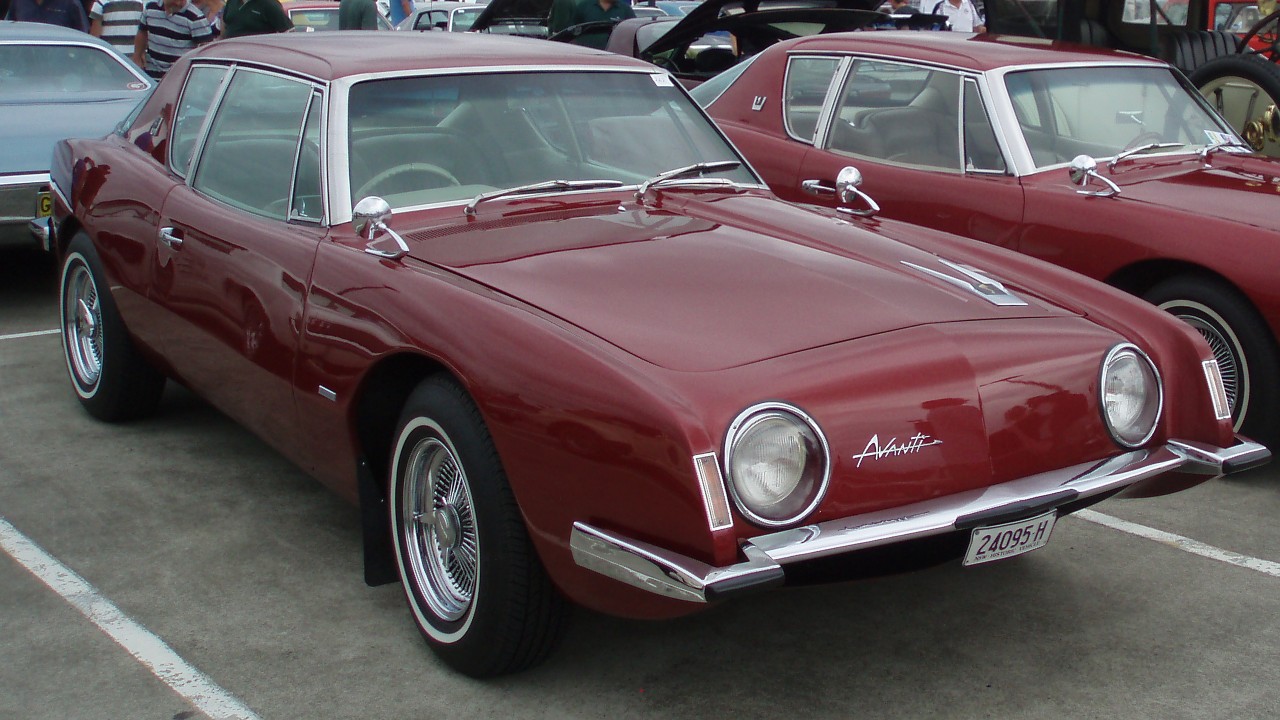
The 1963 Studebaker Avanti arrived as a last-ditch rescue plan for a struggling independent automaker and promptly ignored almost every rule of Detroit common sense. It was a fiberglass, four-place personal coupe with no grille, a supercharged V8, and styling that looked like it came from another decade entirely. On paper, it should have been a niche curiosity. Instead, it became one of the most persistent cult cars in American history, a machine whose contradictions turned into its greatest strength.
Almost nothing about the Avanti lined up neatly with the era’s expectations, from its crash development schedule to its unconventional engineering. Yet those same misfit qualities created a car that enthusiasts, collectors, and even later manufacturers refused to let die long after Studebaker itself disappeared.
A moonshot from a company on the brink
By the early 1960s, Studebaker was a small player squeezed by the Big Three, and company leadership understood that incremental updates would not reverse the slide. Company president Sherwood Egbert responded by commissioning an all-new flagship performance coupe, a personal luxury car that could command attention and higher prices in one stroke. The result was The Studebaker Avanti, a model that the Studebaker Corporation produced only from 1962 to 1963, yet which reshaped the brand’s image in a way no conventional sedan refresh could have matched.
Egbert turned to industrial designer Raymond Loewy, who assembled a compact team and retreated to a Palm Springs house to create the car in a whirlwind 40-day sprint. That compressed schedule, referenced in enthusiast histories and period recollections, explains much of what made the Avanti feel so different. With little time for corporate committees or focus groups, the team leaned on instinct and Loewy’s mid-century modern sensibility rather than the cautious curves that dominated American showrooms.
Studebaker then set expectations sky high. The Avanti would be a personal luxury coupe that could run with the hottest performance cars of its day, and it would arrive as a halo product to lift the entire lineup. According to one detailed fact sheet, the 1963 Studebaker Avanti was offered only as a four-place coupe, with Four Engine Choices that ranged from a naturally aspirated V8 to a supercharged R2 package aimed at serious speed.
Shape from another planet
The design still looks like a provocation. The Avanti’s complex body shape dispensed with a traditional grille and instead used one of the first bottom breather front fascias, where cooling air entered from under the nose rather than through an opening above the bumper. That decision, outlined in technical descriptions of the car’s front end, gave the Avanti a clean, almost beak-like front profile that had more in common with European concept cars than with contemporary American coupes.
Building that shape in steel would have been slow and expensive. Studebaker, already short on cash, chose fiberglass instead. A detailed museum display on The Avanti notes that the intricate curves would have been prohibitively costly in stamped metal, so the company followed the path pioneered by the Corvette and turned to composite panels. This choice added its own headaches, including fit issues and production delays, but it also signaled that the car was not bound by the usual Detroit toolkit.
Viewed from the side, the Avanti combined a long hood, a short rear deck, and a fastback roofline that refused to mimic anything else in Studebaker’s catalog. At the rear, the car narrowed and tucked inward, with thin bumpers and sculpted taillights that emphasized the fiberglass bodywork. Contemporary observers either saw a design masterpiece or something too strange to succeed. A recent discussion that framed the 1963 Studebaker Avanti as either a design triumph or a disaster captured that split, with enthusiasts comparing it directly to icons like the Mustang and the Cor and arguing that the Studebaker Avanti simply pushed too far for mass-market tastes.
Engineering that did not follow the script
Under the skin, the Avanti mixed familiar Studebaker hardware with genuinely advanced features. The most headline-grabbing option was the R2 engine, a 289 cubic inch V8 equipped with a Paxton supercharger and rated at 290 horsepower, which meant the car achieved more than one horsepower per cubic inch. A detailed enthusiast breakdown of the 1963 Studebaker Avanti R2 describes this package as part of Studebaker’s desperate gamble to save itself, pairing big power with a relatively light body.
Even the standard R1 models delivered strong performance for the period, and the company did not hesitate to prove it. Andy Granatelli and the factory team took Avantis to Bonneville and set 29 speed records, with heavily tuned R3-powered cars pushing toward 170 mph and 200 mph in headline-grabbing runs. That record program reinforced the idea that the Avanti was not just a styling exercise but a serious high-speed machine.
The chassis specification reinforced that message. The Avanti used front disc brakes as standard equipment, with conventional drums at the rear, which made it one of the first American production models to adopt discs as standard fitment. Period documentation and later museum summaries emphasize how unusual that was in an era when even performance cars still relied on drums at all four corners.
Transmission choices also reflected a tension between performance intent and customer preference. A detailed feature on an original 1963 Studebaker Avanti notes that a three-speed manual was standard equipment, yet many buyers gravitated to automatic transmissions, and the base three-speed proved unpopular. The Avanti thus sat in an awkward spot: engineered for enthusiasts who wanted control and speed, but sold in a market that was rapidly embracing convenience.
Built fast, then built too slowly
If the design and engineering seemed bold, the production story was almost self-sabotaging. Studebaker promoted the Avanti heavily and gathered strong early interest, but then struggled to build cars quickly enough to meet demand. One in-depth historical analysis explains that Studebaker’s problem was not a lack of orders, but an inability to fill them. Fiberglass complexity, supplier issues, and the company’s fragile finances combined so that actual deliveries lagged far behind the marketing.
That gap between promise and reality hurt the car’s commercial momentum. Customers who had placed deposits grew impatient and either canceled or redirected their money to rivals that could deliver immediately. The same historical account notes that while Studebaker talked about building thousands of cars, the company managed only a fraction of that number before production stopped.
More precise figures emerge from later enthusiast research. A detailed walkaround of a 1963 Studio Baker Avanti model R1 describes it as one of 4,647 cars built by Studio Baker between May of 62 and December of that year. The video refers to the company as Studio Baker, but the figure of 4,647 has become a touchstone for Avanti production, highlighting just how rare the original run was compared with mass-market competitors.
A personal luxury coupe that refused to be typical
In concept, the Avanti belonged to the emerging personal luxury segment, a space that would soon be dominated by cars like the Ford Thunderbird and later the Mustang. Yet Studebaker’s entry did not behave like a typical boulevard cruiser. The Studebaker Avanti was marketed as a personal luxury coupe, but its combination of supercharged power, fiberglass construction, and record-setting ambitions put it closer to a limited-production sports car.
That dual identity helped and hurt. For buyers who wanted something different from the Big Three, the Avanti offered exclusivity and technology that mainstream brands had not yet embraced. For others, the car’s unconventional styling and relatively high price compared with rivals such as the Corvette made it a tough sell. A detailed enthusiast post notes that the Avanti cost more than a Corvette when new, yet never achieved the same broad recognition, which helps explain why it remains curiously underappreciated even among 1960s performance cars.
Inside, the car continued to mix luxury cues with functional instrumentation. Bucket seats for four, a full array of gauges, and aircraft-inspired switchgear supported Studebaker’s pitch that this was a sophisticated personal coupe. At the same time, the relatively compact footprint and performance-oriented suspension kept it from feeling like a traditional big American luxury barge.
The car that would not die
Studebaker’s financial troubles ultimately overwhelmed the Avanti’s promise. The company shut down its South Bend assembly operations in 1963, an event that locals still recall vividly. One enthusiast from South Bend wrote that The Studebaker plant dominated the downtown area, and that after it closed in 1963 a small group of investors tried to keep the Avanti alive outside the original corporate structure.
The story did not end with the last factory-built cars. A detailed Facebook history notes that The Studebaker Avanti, originally produced by the Studebaker Corporation from 1962 to 1963, later returned under new ownership. After Studebaker exited, the design and tooling passed to entrepreneurs who created the Avanti Motor Corporation and resumed production in small numbers. These continuation cars evolved over time, but they preserved the core silhouette and concept, turning the Avanti into a boutique brand that outlived its parent company.
Later coverage of the model’s legacy leans into this idea of persistence. One video introduction describes the Avante as the car that would not die and characterizes it as Studebaker’s last harrah, calling it their moon shot attempt to change the company’s fate. That same piece highlights how the design and nameplate continued to reappear in different forms long after the original assembly lines fell silent.
From Birmingham to internet debates
Today, original Avantis appear at shows where they often sit alongside later iterations that carried the badge into new decades. A recent event on Old Woodward in Birmingham featured four beautiful examples, with the host starting the walkaround at an original 63 Avanti and then moving through later cars that showed how the design evolved. That gathering underlined how a car built in such small numbers could sustain an entire subculture of owners and restorers.
Online, the debates continue. A discussion titled 1963 Studebaker Avanti: Design masterpiece or ahead of its time disaster? on a popular car forum opened with the observation that Everyone knows the Mustang and the Cor, but far fewer recognize the Studebaker Avanti, even though it offered comparable performance and arguably more daring styling. Commenters argued over whether the car’s looks doomed it or whether buyers simply were not ready for a fiberglass, grille-less coupe from a company already perceived as vulnerable.
Detailed technical threads dissect the differences between R1 and R2 cars, the impact of the Paxton supercharger, and the significance of the Avanti’s early adoption of front disc brakes. Others focus on restoration challenges, from sourcing correct fiberglass panels to dealing with the quirks of a low-volume production car whose parts support never matched that of the Big Three.
Why the contradictions worked
Seen from a distance, the Avanti looks like a collection of contradictions. It was a personal luxury coupe that chased Bonneville records, a fiberglass experiment from a conservative Midwestern company, and a car conceived in a 40-day design sprint yet produced too slowly to satisfy its earliest fans. Those contradictions, however, are exactly what gave it staying power.
More from Fast Lane Only