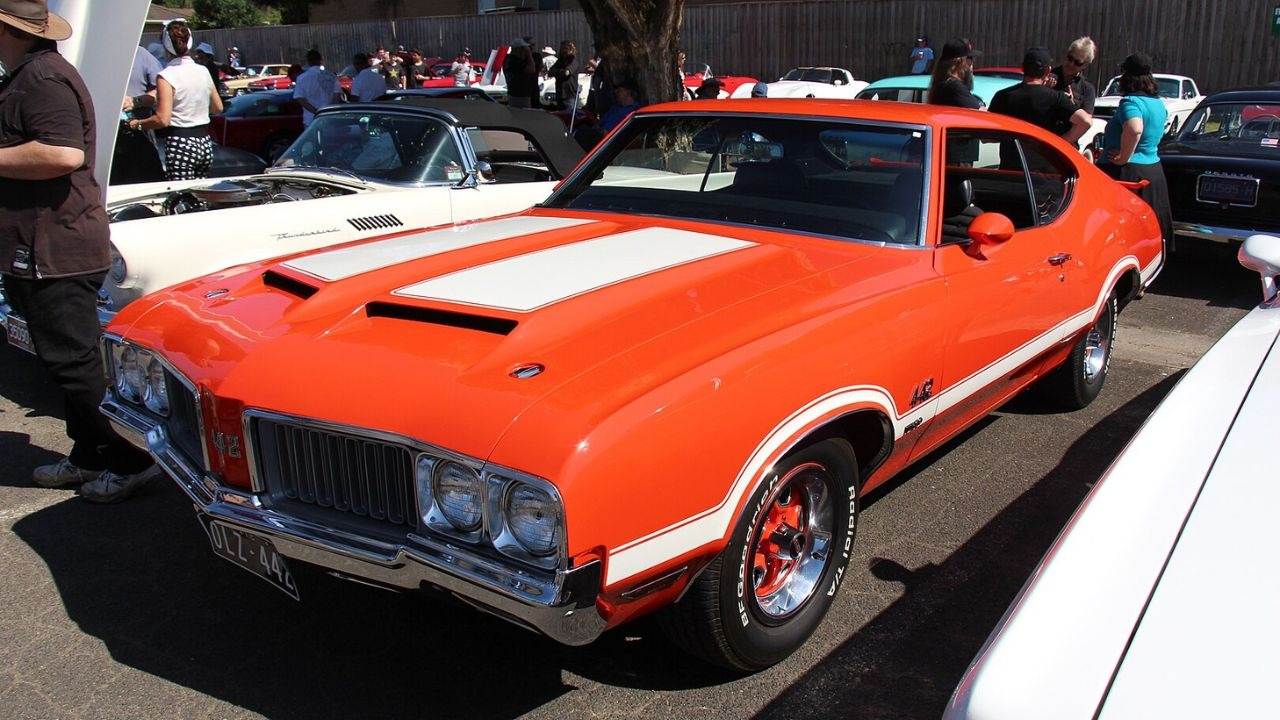
The Oldsmobile 442 W-30 looked like a gentleman’s muscle car, but its most interesting engineering work happened where casual observers rarely glanced. Under the paint and chrome, Oldsmobile hid a network of ducts, plastics, brackets, and tuning choices that turned a comfortable Cutlass into one of the sharpest street-and-strip packages of its era. The result was a car that many drivers recognized for its badges and burble, yet only a fraction understood in terms of how thoroughly it had been reworked.
The sleeper with a factory race kit
By 1970, Oldsmobile had refined the 442 into a high performance flagship that still carried the brand’s restrained styling. Enthusiasts often describe the 1970 Oldsmobile 442 W-30 as one of the crown jewels of the muscle car era, a car designed to combine brute power with a level of finish that fit Oldsmobile’s image of quiet quality. Period coverage and later fan groups point out that the 442 badging and conservative Oldsmobile sheetmetal made the W-30 a sleeper compared with flashier rivals like a Charger or a Chevelle SS, especially when the car was ordered in subtle colors and without wild stripes.
Under that calm exterior sat a very serious powertrain. Factory test sheets list the W-30’s ENGINE as an OHV V8 with a 4.125-in bore and 4.250-in stroke, displacing 455 cubic inches. Official figures rated the big-block at 370 horsepower at 5,200 rpm and 500 lbs of torque at 3,600 rpm with 10.50:1 compression. Those numbers echoed Oldsmobile’s broader “Rocket” V8 story, with enthusiasts later repeating that the 455 could produce 370 hp and 500 lb-ft while still feeling refined enough for daily use.
What separated the W-30 from a standard 442 was not just raw displacement. The Package added a hotter camshaft, high flow induction hardware, and a trunk relocated battery, elements that came straight from factory drag racing experience. Earlier in the option’s history, Oldsmobile had already experimented with outside air induction via bumper scoops, a more aggressive camshaft, and high-tension valve springs on the 1966 W-30, and the 1970 version carried that philosophy forward with more subtle but better integrated hardware.
Cold air, hidden in plain sight
Most drivers who saw a 442 W-30 in traffic noticed the twin snorkel fiberglass hood. Far fewer understood how thoroughly Oldsmobile reworked the path between those scoops and the carburetor. The W-30 performance package used a functional fiberglass hood scoop system that fed cooler, denser air to the engine, with carefully sealed ducting and a specific air cleaner assembly designed to match the hood openings. That system helped push the W-30’s output beyond the already strong standard 442 figures, even though the official horsepower rating only crept up slightly compared with the base car’s 365 hp.
Earlier W-30s had used visible bumper scoops that shouted their intent. By 1970, the engineers tucked most of the airflow trickery under the skin. The openings at the hood line were obvious, but the real work happened in the way air was routed through the cleaner housing and how the carburetor calibration and cam timing were matched to that cooler charge. The result was a car that could run deep into the 13 second range in quarter-mile testing while still idling politely enough for a commute.
Even the battery move to the trunk had multiple layers of purpose. Shifting that weight rearward improved traction on launch and freed up space in the engine bay for the induction plumbing and big-block accessories. To an untrained eye, it simply looked like a tidy trunk with an extra cable. To someone studying weight distribution and packaging, it was a clear sign that Oldsmobile’s engineers were thinking beyond brochure numbers.
The signature Red inner fenderwells
No single detail captures the W-30’s hidden engineering better than its Red inner fenderwells. These molded plastic liners sat between the front fenders and the engine bay, forming a barrier that protected the engine compartment from road debris and helped manage airflow. They were not structural, yet they changed how the front of the car behaved at speed and how the engine compartment aged over time.
From 1970 through 72 Oldsmobile F85, 442, and Cutlass W-30 models, these pieces appeared as a Red Front Fender Skirt Liner Well Plastic Pair, a vivid contrast against the otherwise dark underhood environment. Reproduction parts today describe them exactly that way, listing them as Oldsmobile F85 and Cutlass components and emphasizing the Red Front Fender Skirt Liner Well design that enthusiasts associate with the W-30. Another catalog entry for 1970 through 72 Oldsmobile F85, 442, and Cutlass W-30 repeats the same Red Front Fender Skirt, Liner, Well, Plastic description, highlighting how central these parts have become to accurate restorations.
Suppliers that cater to restorers still offer a 1970 through 72 Oldsmobile F85 442 Cutlass W-30 red front fender skirt liner well plastic pair, treating them as a defining visual cue of a correct W-30 engine bay. Retailers such as Jegs list OER BP1088T as a 1970 through 72 Oldsmobile F85 442 Cutlass W-30 Red Front Fender Skirt Liner Well Plastic Pair, a reminder that what started as a functional airflow and protection piece has become a sought after authenticity marker.
Why the liners mattered to engineers
To the average owner, those bright inner fenderwells were just a splash of color. The engineering staff, they solved several problems at once. The plastic material resisted corrosion better than steel, which meant less contamination of the engine bay from rust flakes and fewer sharp edges around wiring and hoses. The molded shape also let Oldsmobile control how air moved through the front wheelhouses and into or out of the engine compartment.
Earlier W-30 cars had already used similar ideas. Parts listings for Inner Fenderwells on 1966 through 67 Cutlass and 442 models describe Red molded plastic pieces classified under Sheet Metal and Body Panels, Fenders, and they served the same dual purpose of protection and airflow tuning. For 1968 through 69 Cutlass and 442 W-30 models, Inner Fenderwells again appear in Red, grouped with Sheet Metal, Body Panels, and Fenders, showing that Oldsmobile treated these liners as part of the car’s overall aerodynamic and durability package rather than as simple cosmetic add ons.
On the 1970 W-30, the liners helped keep water and grit away from the cold air ducts and the engine’s front accessory drive. They also reduced the amount of high pressure air that could build up in the wheelhouses at speed, a factor that can affect lift and steering feel. None of this showed up in advertising copy, yet it reflected the same mindset that produced the car’s carefully tuned suspension and optional heavy duty cooling system.
Powertrain details most owners never saw
Under the hood, the W-30 combined that 455 big-block with supporting hardware that many owners never thought about. The engine’s 4.125-in bore and 4.250-in stroke gave it a long stroke character that favored torque, and the 10.50:1 compression ratio demanded high octane fuel. The camshaft grind in the W-30 Package was more aggressive than in a standard 442, with longer duration and higher lift that worked with the functional induction and freer flowing exhaust manifolds.
Period test sheets list the W-30’s output at 370 horsepower and 500 lbs of torque, figures that matched other references to a 455 cu in Rocket V8 rated at 370 hp and 500 lb-ft at similar engine speeds. The combination of that torque curve with a close ratio Muncie four speed or a carefully calibrated automatic gave the car an ability to launch hard without feeling peaky or temperamental. Enthusiast groups still recite those figures, often listing the Powertrain as a 455 cu in Rocket V8 with 370 hp at 5,200 rpm and 500 lb-ft of torque at 3,600 rpm, Available with a Muncie four speed manual.
Beyond the engine itself, the W-30 package included specific rear axle ratios, heavy duty cooling, and a choice of limited slip differentials that made full use of the torque. Many of these parts carried standard Oldsmobile casting numbers and looked ordinary to a casual observer. Only someone decoding tags or comparing part numbers would realize that the car in front of them had the full W-30 specification rather than a lightly optioned 442.
From 1966 experiment to 1970 refinement
The W-30 story did not start in 1970. Four years earlier, Oldsmobile had introduced the option as a semi-secret performance kit intended for serious drivers. For 1966, the W-30 option included outside air induction via bumper scoops, a more powerful camshaft, and high-tension valve springs, all aimed at improving high rpm breathing and durability. Enthusiast coverage of a 1966 442 W-30 Oldsmobile being sold at a major auction points out how those early cars balanced 442 badging and restrained Oldsmobile styling with hardware that was much more aggressive than the exterior suggested.
By 1968 and 1969, the concept had evolved. Inner Fenderwells in Red plastic appeared on Cutlass and 442 W-30 models, and the focus shifted toward integrating performance parts in ways that did not shout at passersby. The 1968 Oldsmobile 442 W-30 specs repeated the formula of a 455 cu in Rocket V8 with 370 hp and 500 lb-ft, showing that Oldsmobile had found a sweet spot in displacement and tuning that would carry into 1970.
In 1970, the W-30 became less of a bolt-on package and more of a fully integrated performance model. An enthusiast video that walks through “10 Unknown Shocking Secrets About the 1970 Oldsmobile” stresses that by that year, the car was not just a trim package anymore, and that some of its most important changes were buried in the option codes and underbody parts rather than in obvious stripes or spoilers. That shift helped the W-30 maintain Oldsmobile’s image of tasteful power while still keeping pace with more flamboyant competitors.
How restorers chase the hidden details
The fact that so much of the W-30’s personality lives in unseen parts has turned restoration into a detective game. Owners hunting for correctness pore over catalogs and reference photos to confirm that their cars carry the right Red Front Fender Skirt Liner Well pieces, the proper battery cables for a trunk mount, and the correct cold air cleaner base. Vendors that specialize in classic body parts promote molded plastic inner fenderwells as key components for 1968 through 69 Cutlass and 442 W-30 restorations, while others highlight 1970 through 72 fender liners as essential to an accurate engine bay.
Some suppliers even use social media to showcase these parts on completed cars, with pages such as Classic Body Parts and other groups sharing images of 442 engine bays where the Red liners frame the big-block. Enthusiast posts about restored 1969 Oldsmobile 442 W-30 examples emphasize that the 1970 Oldsmobile 442 W-30 stands as a high-performance version of the Cutlass line, and that details like the liners, the functional hood, and the trunk battery separate a true W-30 from a lookalike.
More from Fast Lane Only