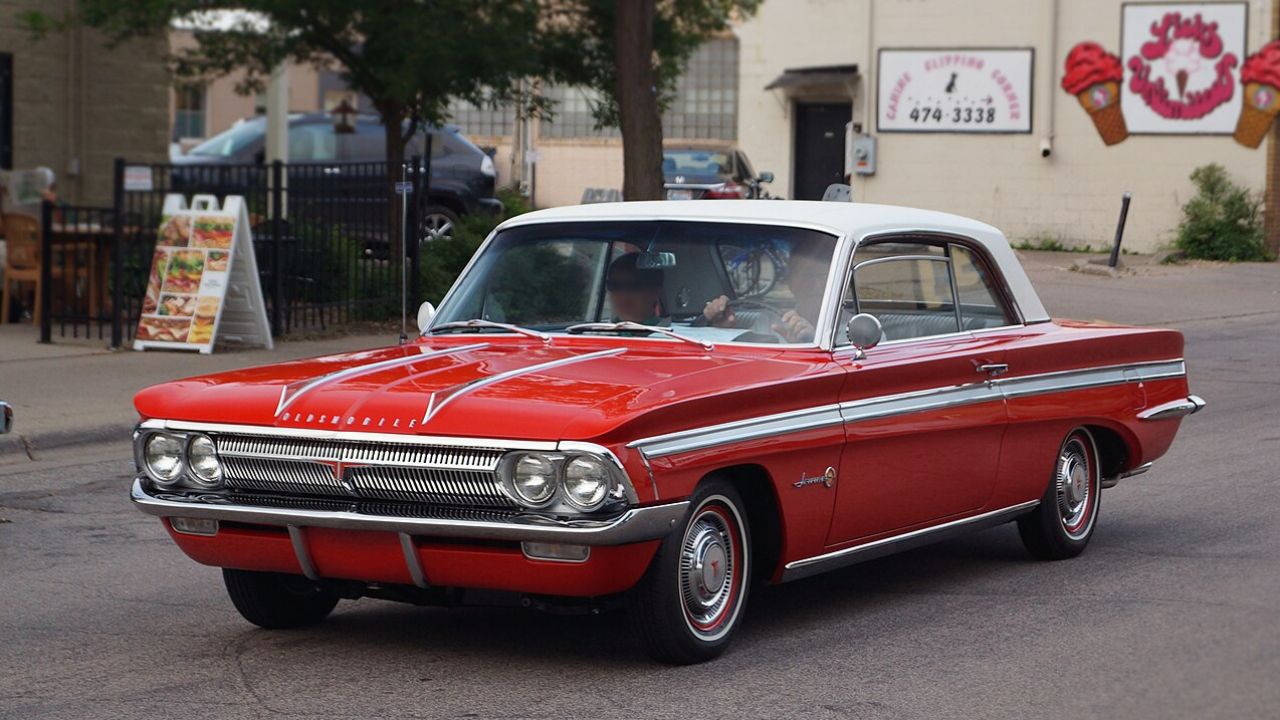
Turbocharging is now a staple of family crossovers and compact hatchbacks, yet the idea of forcing more air into a small engine once sounded like science fiction to American buyers. Long before modern downsized turbo fours, Oldsmobile’s 1962 Jetfire tried to sell mass market drivers on boost, packaging exotic hardware and chemistry in a tidy compact coupe. The experiment was short lived, but it dragged turbocharging into the mainstream conversation far earlier than the market was ready.
Today the Oldsmobile Jetfire is remembered as the first production car to put a turbocharger on a gasoline V8 and one of the earliest factory boosted passenger cars of any kind. Its mix of innovation, complexity and commercial disappointment shaped how automakers would approach turbocharging for decades afterward.
The turbocharged moment Detroit did not expect
In the early 1960s, Detroit’s default answer to performance was more cubic inches. Big block engines and rising compression ratios defined the arms race. Against that backdrop, Oldsmobile quietly prepared a very different proposition: a compact F-85 coupe with a small aluminum V8 and a turbocharger.
The car that emerged, the Oldsmobile Jetfire, arrived as one of the first production vehicles to feature a turbocharger on a gasoline engine. Contemporary descriptions of the 1962 Oldsmobile Jetfire emphasize how radical that was in a showroom full of naturally aspirated V8s. Rather than chasing displacement, Oldsmobile engineers tried to extract big engine performance from a compact package.
Oldsmobile built the Jetfire on the F-85 platform, a smaller car that sat below the brand’s full size offerings. Marketed as a premium compact, the turbocharged version was positioned as a technological flagship that could out punch its modest size.
From F-85 Cutlass to turbo pioneer
The Jetfire’s foundation was the F-85 Cutlass, a unibody compact that gave Oldsmobile an entry in the growing smaller car segment. The turbocharged model was officially labeled the Oldsmobile F-85 Jetfire and introduced in April of 1962, a timing that several historical accounts treat as the start of mass produced turbocharging in American passenger cars.
One detailed history explains that Oldsmobile offered the boosted version of the compact F-85 for just two model years, 1962 and 1963, and that it was explicitly called F-85 Jetfire to highlight both its platform and its new performance identity. The figure 85 in the name, repeated across period literature, tied it visually to the base car while hinting that this was something more exotic.
Another period description of a 1962 Oldsmobile F-85 Jetfire Hardtop Coupe in April underscores how the car used exhaust gas to turn impellers that raise intake pressure, a concise explanation of turbocharging aimed at buyers who had never encountered the concept. That same account refers to the 1962 Oldsmobile F-85 Jetfire Hardtop Coupe In April as one of the rarest performance cars ever built, a status that has only grown as survivors have thinned out over time. The number 85 appears repeatedly in these sources, reinforcing how tightly the Jetfire’s identity was bound to the F-85 line.
The 215 cubic inch aluminum V8 and its turbo
At the heart of the Jetfire sat an all aluminum V8 with a displacement of 215 cubic inches. This engine had already appeared in naturally aspirated form in other F-85 models, but the Jetfire’s version gained a single turbocharger and a distinctive fuel and fluid system.
One technical overview describes the 1962 Oldsmobile Jetfire as based on the Cutlass body shell and powered by a 215 cubic inch V8 with a single turbo unit. In that account, the 215 figure is central, since it highlights how small the engine was relative to the torque Oldsmobile claimed.
Other retrospectives on the car’s engineering stress that in an era obsessed with “more cubes,” Oldsmobile’s aluminum V8 and turbo system broke every informal rule about how American performance should work. One analysis of the Jetfire’s design notes that in the 1960s Detroit was fixated on displacement, yet Oldsmobile Jetfire Was First Turbocharged Production Car, using boost rather than sheer size to reach its performance targets. That same piece frames the Jetfire as a direct challenge to the big engine orthodoxy of the period.
Turbo Rocket Fluid and a chemistry lesson in the glovebox
The turbo hardware was only part of the story. To keep detonation under control on contemporary fuel, Oldsmobile paired the turbo with a fluid injection system that sprayed a methanol and water mixture into the intake under boost. The company branded this cocktail Turbo Rocket Fluid and plumbed it from a reservoir under the hood to the engine.
Modern accounts describe how this setup baffled many of the car’s buyers. One retrospective on the model notes that Turbocharging was practically science fiction for average drivers and that the Jetfire’s requirement for a separate fluid, along with a dashboard warning system, confused owners who were used to simply filling the gas tank. Another modern feature on the Oldsmobile Jetfire states that for all its 1963 Oldsmobile Jetfire innovation, the Jetfire was high maintenance, with the Turbo Rocket Fluid being essential for full power delivery. When that tank ran dry, performance dropped and the system could trigger safety modes that frustrated owners.
The complexity did not stop there. Service departments had to explain to customers why the car needed a special fluid in addition to gasoline and oil, and why ignoring the warning lights could lead to drivability problems. For a mass market brand like Oldsmobile, this level of owner education was a significant hurdle.
Too much, too soon for showroom customers
The Jetfire’s market story is one of bold innovation colliding with real world usage. Several historical narratives argue that the car arrived roughly a decade ahead of its natural audience. One detailed review of the Oldsmobile F-85 Jetfire describes it as the first mass produced turbocharged car in the United States, a marvel of 1960s engineering that arrived perhaps a decade too early, and stresses again that the number 85 was central to its branding.
Another modern analysis frames the Oldsmobile Jetfire as America’s first turbocharged muscle sedan and asks directly, Was The Jetfire Too Much Too Soon. That piece argues that the car’s advanced setup baffled many of the car’s buyers, whose expectations had been shaped by simpler V8 sedans. The phrase Was The Jetfire Too Much Too Soon appears verbatim in that discussion, highlighting how the question has become part of the car’s legend.
Contemporary reports from the period describe waves of customers bringing their Jetfires back to GM dealers with complaints about drivability and reliability. One narrative centered on the early turbocharged muscle car recounts that There were waves of customers bringing their Jetfires back to GM, which quickly drove warranty costs higher. That same account explains that GM responded with a drastic decision: dealers were instructed to remove the turbo hardware entirely on some cars and convert them back to conventional carbureted setups.
Reliability headaches and GM’s retreat
The Jetfire’s mechanical troubles were not limited to the turbo plumbing. The underlying aluminum V8, even in naturally aspirated form, had its own issues with cooling and head sealing. A detailed technical history notes that even the normally aspirated aluminum V8 was still not the world’s most reliable engine, particularly with regard to cooling and corrosion. When the turbo system was added, along with the Turbo Rocket Fluid injection, the potential for problems multiplied.
Another retrospective on the Turbocharged Olds Jetfire emphasizes that it was ahead of its time but that owners often neglected or misunderstood the maintenance demands. That account states that the 1962 Jetfire was a one year only model in its original form and that even without the turbo, the all aluminum engine had quirks that could lead to reliability problems. It also notes that many owners and dealers did not fully grasp the technology, which contributed to early failures of these groundbreaking models.
As warranty claims accumulated, GM’s patience wore thin. The narrative about the first turbocharged muscle car explains that dealers were formally instructed to remove the turbocharger hardware from some Jetfires that repeatedly returned with issues. The turbo components were discarded or shelved, and the cars left the service bays as conventional F-85s. That decision effectively ended the Jetfire experiment after a very short production run.
How the Jetfire shaped turbo thinking
Although the Jetfire was a commercial disappointment, it had a lasting impact on how automakers approached turbocharging. One early history of turbo technology notes that in 1962 the first turbocharged production passenger cars arrived in the United States, listing the Oldsmobile F-85 Jetfire alongside its contemporary competitor, the Chevrolet Corvair Monza. That context places the Jetfire at the start of a broader shift, in which forced induction moved from aircraft and heavy equipment into everyday cars.
Modern coverage of the model often returns to the idea that GM introduced turbocharged passenger cars through the 1962 Oldsmobile Jetfire. One analysis of forced induction muscle cars states plainly that GM Introduced Turbocharged Passenger Cars Through The 1962 Oldsmobile Jetfire and adds that the 1962 Oldsmobile Jetfire was the first production turbocharged muscle car, using a single turbo with a specific carburetor setup. The wording in that source underscores how the Jetfire has come to symbolize the beginning of turbocharging in American performance cars.
Another retrospective on the first mass produced turbocharged car in the United States credits The Oldsmobile F-85 Jetfire as the first ever turbocharged car in that context, while also stressing the specific and high maintenance catch of its fluid injection system. The repeated emphasis on the F-85 name and the 85 figure in these sources reinforces how this short lived model has taken on outsized historical significance.
Rarity, rediscovery and collector fascination
The Jetfire’s short production run and the dealer conversions that removed many of its turbo systems have made surviving examples rare. Modern enthusiasts treat intact cars as historical artifacts that capture a turning point in automotive engineering.
One enthusiast video that asks viewers if they know which car paved the way for turbocharging technology in the automotive industry invites them to explore the fascinating story of the Jetfire and refers to Jan as a timestamp in its description. The clip, shared under the title Forgotten Turbocharged Legend, reflects how the car has become a favorite topic among historians and fans who see it as a lost milestone.
Another social media feature on a 1962 Oldsmobile F-85 Jetfire Hardtop Coupe In April describes it as one of the rarest performance cars ever built and explains again how exhaust gas is used to turn impellers that raise intake pressure. That post, which highlights Oldsmobile and refers to the model as a Jetfire Hardtop Coupe In April, links the car’s rarity to its technical daring and short life. It also repeats the number 85 as part of the full name, keeping the original branding intact. The same feature is shared through a video post that invites viewers to see one of the rarest performance cars ever built, reinforcing the Jetfire’s cult status.
More from Fast Lane Only