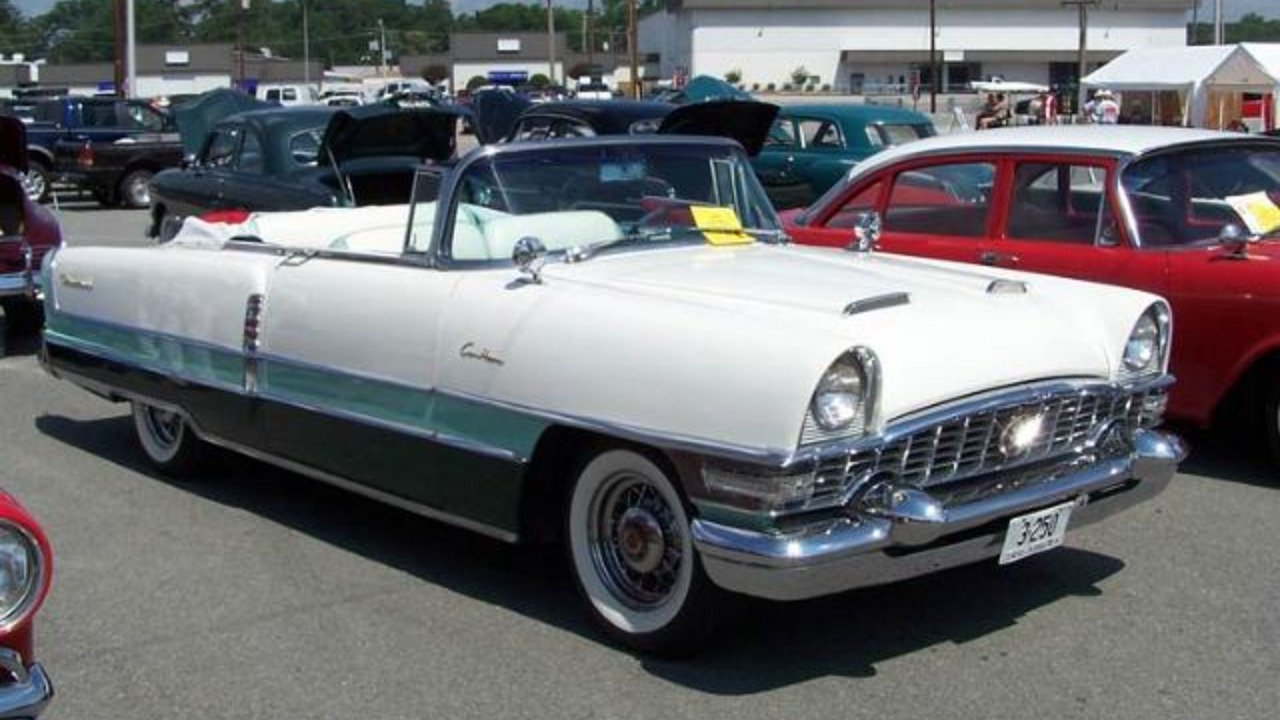
The 1955 Packard Caribbean arrived as a last, almost desperate attempt to prove that Packard still belonged at the top of the American luxury market. It wrapped advanced engineering and striking styling in a package that, for a brief moment, made Cadillac and Lincoln look conservative. Yet the very ambition that made the Caribbean so compelling also exposed the financial and production weaknesses that would soon end Packard as an independent automaker.
Viewed today, the 1955 Caribbean feels like a near miss. It demonstrated that Packard could still build a car to outshine Detroit’s best, but it appeared just as the company’s resources, dealer network, and reputation were slipping beyond repair.
The Caribbean’s custom roots
Packard did not invent the Caribbean name in 1955. Earlier in the decade, the company had introduced a new model for 1953, the luxurious Caribbean convertible. That first Caribbean featured clean custom bodywork inspired by show cars, with a low, almost custom-car stance and minimal chrome compared with some rivals. It was Packard’s way of signaling that it could still set taste rather than follow it.
The early Caribbean was built in limited numbers and priced high, more a brand statement than a volume product. It helped keep Packard in the conversation among buyers who might otherwise have gone straight to Cadillac showrooms. Those cars set the template: a halo convertible with special trim, exclusive colors, and the most advanced mechanicals Packard could offer.
A new V8 and a serious power play
By 1955, Packard knew it could not keep selling straight-eight engines to buyers who were hearing about overhead-valve V8 power from every direction. For that model year, the company introduced an all new overhead valve V8 to replace its long-serving inline eight, and the Caribbean received the most potent version. According to auction documentation for a Packard Caribbean convertible, the 1955 model used a 275 horsepower, 352-cubic-inch V8, figures that put it squarely in the hunt with Cadillac’s offerings.
Power was only part of the story. For 1955, production records and enthusiast research describe the Caribbean as one of 500 built, a figure repeated in multiple sales listings and club histories. A later catalog entry for a Packard Caribbean Convertible 1955 explicitly notes that it was 1 of 500 built in that year, confirming how rare the car was even when new.
That combination of limited production, strong performance and high specification was meant to reclaim Packard’s image as America’s luxury automaker. The V8 finally gave salespeople a credible answer when customers asked how Packard compared with the latest Cadillac or Chrysler 300.
Styling that refused to blend in
The 1955 Caribbean was no shrinking violet. Period descriptions and later auction copy describe the Packard Caribbean Convertible as one of the company’s most striking final masterpieces, with flamboyant tri-tone paint, full wheel cutouts, and a long, low profile. The Pa design language mixed traditional Packard cues like the classic grille with a more contemporary, jet-age look.
Where Cadillac leaned into tailfins and chrome, the Caribbean’s visual drama came from color and proportion. Many cars wore three-color paint schemes that visually lowered the body and emphasized the sculpted sides. Inside, deep-pile carpets and multi-tone leather reinforced the sense that this was not just a dressed-up Clipper but a bespoke luxury convertible.
Packard also used the Caribbean to experiment with features that would filter down to other models. The 1955 Packard “The 400” hardtop, for example, shared much of the Caribbean’s luxury positioning. Enthusiast writeups on that model note that Packard was trying to appeal to buyers who might otherwise choose a Cadillac Sixty Special or a Chrysler New Yorker, and that the company was determined to stay competitive in the evolving market.
Engineering that impressed the experts
If the styling grabbed attention, the chassis made believers. The Caribbean used Packard’s torsion-level suspension, a system that linked the front and rear wheels with long torsion bars and added automatic leveling. In a period road test quoted in a later analysis of Why Packard Failed, one driver reported that, “You can drive into a corner at high speed with this car and the body remains almost level.” Such praise seemed to vindicate James Nance and his decision to invest in advanced suspension at a time when most rivals were still refining coil and leaf springs.
Modern perspectives echo that view. In a video walkaround of a 1955 Packard Caribbean, Jay Leno contends that the car has to be one of the smoothest riding cars of the 1950s, and that the torsion bar suspension simply works so well. That combination of period and contemporary testimony reinforces the idea that Packard’s engineering really did match, and in some ways exceed, what Cadillac and Lincoln were offering.
The V8 itself was not perfect, especially in early production, but owners of related Packard engines have long praised their basic robustness. In an owner discussion of the 1955 and 1956 Packard V8, one participant identified as GB notes that this perspective comes from an owner of a 1953 Packard and that, while the Packard is most certainly a very reliable engine to a certain degree, it can develop issues if neglected. That kind of comment suggests that the underlying design was sound even if Packard’s rushed production created some early headaches.
Price, exclusivity and the Cadillac problem
The 1955 Caribbean was never meant to be a bargain. Auction notes on a well preserved 1955 Caribbean note that the car was priced at nearly $6,000 when new, a figure that placed it directly against Cadillac’s top convertibles and some imported luxury cars. At that price, Packard could not rely on tradition alone. Buyers had to be convinced that the Caribbean offered more style, more technology, or more exclusivity than a Cadillac Eldorado.
On paper, Packard had a case. The Caribbean’s limited production of 500, its tri-tone paint, and its torsion-level suspension created a package that felt more bespoke than the higher volume Cadillac. Some enthusiasts argue in club forums and social media posts that the 1955 Caribbean outclassed Cadillac in ride and presence, with one Packard Caribbean Convertible discussion highlighting how the car represented America’s luxury automaker at its most ambitious.
Prestige, however, is about more than specifications. Cadillac benefited from General Motors’ vast dealer network, marketing muscle, and perception of long term stability. Packard, by contrast, was already struggling to maintain dealer franchise requirements through 1958, as club histories of the Caribbean era explain. For a buyer spending nearly $6,000, the question of future parts and service support mattered as much as a clever suspension layout.
Production trouble in Detroit
Behind the scenes, Packard’s attempt to modernize its manufacturing was faltering. The company moved final assembly to the Conner Avenue plant, a decision that was supposed to streamline operations and cut costs. Instead, the transition produced chaos. An analysis of Packard’s final years describes how a “conditioning line” was set up at Conner to rework cars that came off the line with defects, and that Conner’s problems were eventually surmounted only after serious damage to Packard’s reputation.
Those same reports on Conner emphasize that worse news was ahead. While the 1956 models were, ironically, much better built and benefited from a sharp facelift and vivid paint jobs, the damage from the 1955 quality issues had already been done. Early Caribbean buyers who encountered leaks, rattles or electrical problems were unlikely to recommend the car over a bulletproof Cadillac.
Later commentary on Packard’s final Detroit-built cars notes that the 1956 models showed what the company could do once production settled down. One summary of those cars explains that Conner’s problems were eventually surmounted and that the 1956 Packards were much better built, with improved details that appealed to loyalists of the “true” Packards. That improvement only deepens the sense that the Caribbean’s timing, rather than its concept, was the problem.
Reputation, reliability and the end of the line
The Caribbean’s technical ambition carried risks. The torsion-level suspension required careful setup and maintenance. The new V8, though powerful, was Packard’s first in-house design of that type and suffered from teething problems when combined with the company’s Ultramatic automatic transmission. According to a detailed Caribbean profile, these troubles, coupled with the car’s high price, irreparably harmed its reputation and ultimately spelled the end of the model.
That same analysis points out that the Caribbean’s limited production and high specification made it expensive to build. Each car demanded extra attention on the line for its special trim and paint. In a plant already struggling to manage basic quality, that extra complexity increased the chances of mistakes. Buyers paying top dollar were unforgiving, especially when Cadillac and Lincoln could offer similar performance with fewer headaches.
Among Packard enthusiasts, there is still debate over whether the V8’s issues were overstated. Some point to high mileage survivors as proof that, once sorted, the engines were durable. The Packard owner who described the engine as very reliable to a certain degree also acknowledged that maintenance and proper setup were key. For a mass-market luxury car, that caveat was a problem.
A halo that could not save the company
The Caribbean was intended as a halo that would lift the entire Packard range. The company surrounded it with other upscale models, including the Packard “The 400” hardtop, which one enthusiast summary describes as one of the most luxurious cars money could buy in mid century America. The idea was that showroom traffic drawn by the Caribbean would spill over into sales of these slightly less expensive models.
Corporate strategy at the time was shaped by executives and planners who believed consolidation among independent automakers was inevitable. Research into the period, including references that surface through Why Packard Failed and analyses of The End of the Road, often point to the role of leaders like George W. Mason and George W. Romney in shaping the broader context. Both men, whose careers are detailed in entries on George W. Mason and George W. Romney, were involved in efforts to combine or rationalize independent brands during the 1950s, and their decisions affected Packard’s merger with Studebaker and its access to capital.
By the time the 1955 Caribbean hit showrooms, Packard was already entangled in that merger and struggling to present a clear identity. Some prospective buyers saw the Studebaker connection as a dilution of Packard’s prestige. Others worried about the company’s long term viability. No matter how impressive the Caribbean looked on the showroom floor, those doubts hung over the purchase decision.
Legacy of a near miss
Today, the 1955 Caribbean is widely regarded among enthusiasts as a pinnacle of American automotive luxury and engineering. A social media tribute to the Packard Caribbean describes it as a pinnacle of American automotive luxury and labels it an American icon, language that reflects how collectors now see the car. Another enthusiast post on the Packard Caribbean calls it the epitome of luxury and innovation in mid twentieth century Amer, tying it directly to the golden age of American cars.
More from Fast Lane Only