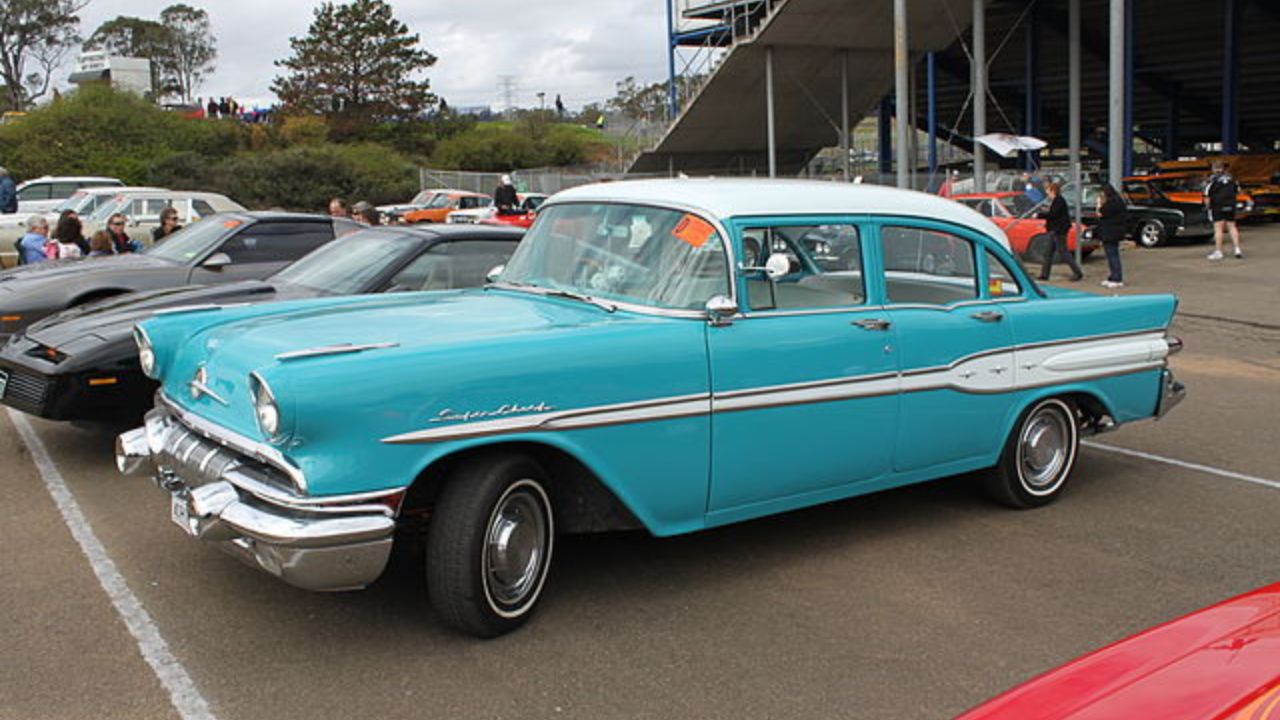
The 1957 Pontiac Star Chief arrived in showrooms as if Detroit had been given permission to stretch everything. Length, chrome, tailfins, even engine displacement all grew, and with them came a new set of expectations about what a family car could be. In a decade obsessed with rockets and road trips, this long, low Pontiac tried to turn sheer size and style into a statement about American confidence.
Nearly seventy years later, the car that once sat at the top of Pontiac’s lineup is often overshadowed by later muscle machines, yet the 1957 Star Chief still captures a moment when power, glamour and practicality were meant to coexist in one glittering package.
The prestige Pontiac that had to stand out
Between 1954 and 1957, the Star Chief served as Pontiac’s prestige model, riding on a longer wheelbase than its siblings and sharing its basic structure with the Pontiac Chi series of full-size cars. Period specifications listed overall width at 76.6 inches, or 1,946 m in metric terms, a footprint that signaled its status as the brand’s flagship in an era when size equaled status. That positioning mattered inside the Pontiac Division of General Motors, which had spent an 80-year history trying, with mixed results, to push itself a little more upmarket than Chevrolet without threatening Buick or Oldsmobile.
By the mid-1950s, Pontiac’s leadership understood that the division’s image had grown tired. The Star Chief was supposed to be the antidote: longer, flashier and more luxurious than the workaday sedans, yet still attainable for middle class buyers who wanted a taste of the premium life.
Jet age styling and a body that went on forever
If the mission was to be noticed, the 1957 Star Chief succeeded the moment it rolled to the curb. General features across the Pontiac line that year included missile-shaped side trim, flatter and more rocket-like tail fins, extended rear fenders with V-shaped tips and a GM-wide move to 14 inch wheels. On the Star Chief, those cues were dialed up with extra brightwork and longer rear quarters that made the car look even more stretched than its actual dimensions.
Later enthusiasts would describe the 1957 Pontiac Star Chief as a classic example of 1950s American optimism, a car that wore its luxury on the outside as much as on the inside. In Catalina hardtop form, the Pontiac Star Chief combined a pillarless roofline with a sweeping chrome spear that visually lengthened the already generous body. A contemporary social media tribute to the Catalina calls the 1957 Pontiac Star Chief a shining symbol of postwar American exuberance, a description that fits the car’s mix of glittering trim and confident stance.
Other fans focus on the jet age cues that run from bumper to bumper. One enthusiast post highlights the Star Chief with its bold, jet age design, sweeping body lines and signature silver streaks running down the hood, celebrating how the Mar era styling turned the car into a rolling piece of roadside theater. Those silver streaks had been a Pontiac trademark for years, but on the 1957 Star Chief they seemed to point the car toward the horizon, as if the whole vehicle were an arrow aimed at the future.
Inside, comfort stretched as far as the sheet metal
The Star Chief’s cabin followed the same philosophy. Wide bench seats, bright two tone upholstery and a dashboard dotted with chrome details created an interior that felt closer to a living room than a basic commuter. In some trims, color keyed steering wheels and elaborate door panels reinforced the sense that this was not an entry level Pontiac.
Contemporary descriptions of a 1957 Pontiac Star Chief in Pink Color The paint emphasize how the pastel exterior shades worked with the interior to showcase American ideas of luxury. The same account notes that the Pontiac Star Chief was all about comfort and convenience, reflecting a buyer who wanted power windows, power steering and a smooth automatic transmission as much as they wanted performance. In convertible form, a power operated top and power accessories turned the car into a highway cruiser that asked its driver to do as little work as possible.
Bunkie Knudsen and the push for performance
Styling alone was not enough to rescue Pontiac’s reputation. When Semon E. Bunkie Knudsen took over the division, he made it clear that he wanted to foster a performance image for Pontiac. Advertising for 1957 went so far as to proclaim Pontiac America Number 1 Road Car, a bold claim in a market crowded with V8 powered rivals. Knudsen understood that the division needed credibility at speed, not just in the showroom.
Under his watch, the engineering team gave the Star Chief real muscle. Earlier in the decade, Pontiac had introduced its Strato Streak V-8 as a modern overhead valve engine. By 1957, the Strato Streak family had grown in size and ambition. One detailed retrospective notes that in 1957 Pontiac’s Strato-Streak V-8 engines were enlarged to 347 cubic inches across the board, a significant jump from the engine that had launched just three years earlier. That figure, 347, became the magic number that year for buyers who wanted both effortless cruising and the ability to surge past slower traffic.
From boulevard cruiser to fuel-injected flagship
Most Star Chiefs left the factory with carbureted versions of the 347. They delivered smooth, quiet power that suited the car’s luxury leaning mission, especially when paired with the Strato-Flight Hydramatic automatic transmission. A later auction listing for a 1957 Pontiac Star Chief convertible notes that under the hood sits a 347ci V8 paired with a 3 speed Strato Flight Hydramatic automatic, a combination that gave the heavy convertible enough punch to match its image.
At the very top of the range sat the Star Chief Custom Bonneville, a limited production showcase for Pontiac’s most advanced technology. A detailed auction catalog for a surviving example explains that the sole engine option was the Rochester fuel injected 347-cubic-inch V-8, and that with a 10.25 compression ratio it delivered performance that matched or exceeded many sports cars of the era. The same description points out that this fuel injected 347-cubic-inch engine was backed by a Strato-Matic three speed automatic transmission, turning the Custom Bonneville into a high speed luxury car rather than a stripped down racer.
Production of the Pontiac Star Chief Custom Bonneville stayed extremely low. A video feature on the model notes that only 630 m examples were built, and that Only a handful remain in top condition today, which helps explain why collectors treat each surviving car as a minor event when it appears at auction or shows.
Body styles that stretched the Star Chief story
The 1957 lineup offered several ways to experience the Star Chief formula. Two door and four door hardtops, sedans and convertibles all carried the same basic styling cues, while the Safari wagon added practicality to the mix. A recent feature on a 1957 Pontiac Star Chief Safari filmed at the Arizona Concord with Olan Johnston And Olen shows how the long roof body turned the Pontiac into a family hauler without sacrificing the dramatic side trim and tailfins. In the video, the host asks, Can you tell me what makes this Pontiac special, and the answer is immediately visible in the combination of wagon utility and Star Chief glamour.
Among collectors, the convertible often sits at the top of the desirability list. An AutoHunter listing highlighted earlier this year described how a 1957 Pontiac Star Chief convertible was Available for purchase for bidders who wanted an open top version of Pontiac’s flagship. The same spotlight stressed that Nineteen fifty seven was an important year for Pontiac Star Chief buyers because the car combined the enlarged 347 engine with updated styling and a full suite of comfort features.
From forgotten flagship to social media favorite
For a long stretch, the 1957 Star Chief lived in the shadow of Pontiac’s later performance legends. Enthusiasts gravitated toward GTOs and Firebirds, while the big 1950s cars were dismissed as relics of a pre muscle car era. One detailed piece on Pontiac’s forgotten 57 argues that despite its role in Building a performance rep for the brand, the 1957 Star Chief never enjoyed the same spotlight as the more aggressive models that followed.
That perception has shifted in recent years. Social media accounts devoted to classic cars now showcase the Pontiac Star Chief regularly, often emphasizing its role as a symbol of American optimism and mid century design. One post about a Pontiac Star Chief Catalina in particular calls it a classic example of 1950s American automotive style, pairing period photos with captions that celebrate its fins and chrome as much as its V8 power. Another page that shares a 1957 Pontiac Star Chief in Pink Color The paint leans into the nostalgia, presenting the car as a rolling piece of Americana rather than a mere collector item.
Specialist blogs and enthusiast communities have also helped rehabilitate the model’s image. A detailed photo feature on a 1957 hardtop coupe uses the car to illustrate how Bunkie Knudsen’s push for a performance image intersected with Pontiac’s luxury ambitions. The same ecosystem of content includes spinoff channels, such as the cgautomotive presence on Facebook and Twitter, and the Car Stuff podcast that further explores models like the Pontiac Star Chief Hardtop Coupe for a new generation of fans.
Driving character: more than just straight line speed
On the road, contemporary accounts and later test drives suggest that the Star Chief behaved like the large, powerful cruiser it appeared to be. The long wheelbase and wide track delivered a stable ride at highway speeds, while the 347 V8 provided enough torque to move the heavy body without strain. The Strato-Flight Hydramatic and Strato-Matic automatics prioritized smooth shifts over aggressive downshifts, which suited buyers who valued refinement more than drag strip times.
Enthusiasts who have sampled well preserved examples often describe the steering as light and the suspension as soft by modern standards, yet they also praise the way the car soaks up rough pavement. With the jet age styling in view over the long hood and the silver streaks pointing forward, the experience is less about carving corners and more about covering long distances in comfort.
Market values and collector expectations
Values for the Star Chief reflect its status as a desirable yet still somewhat underappreciated classic. Market tracking data for the Pontiac Star Chief line, which covers model years 1954 to 1966, lists an average sale price of $56,448. That figure blends coupes, sedans, convertibles and wagons, with exceptional cars such as the Custom Bonneville fuel injected models commanding significantly higher prices when they appear.
More from Fast Lane Only