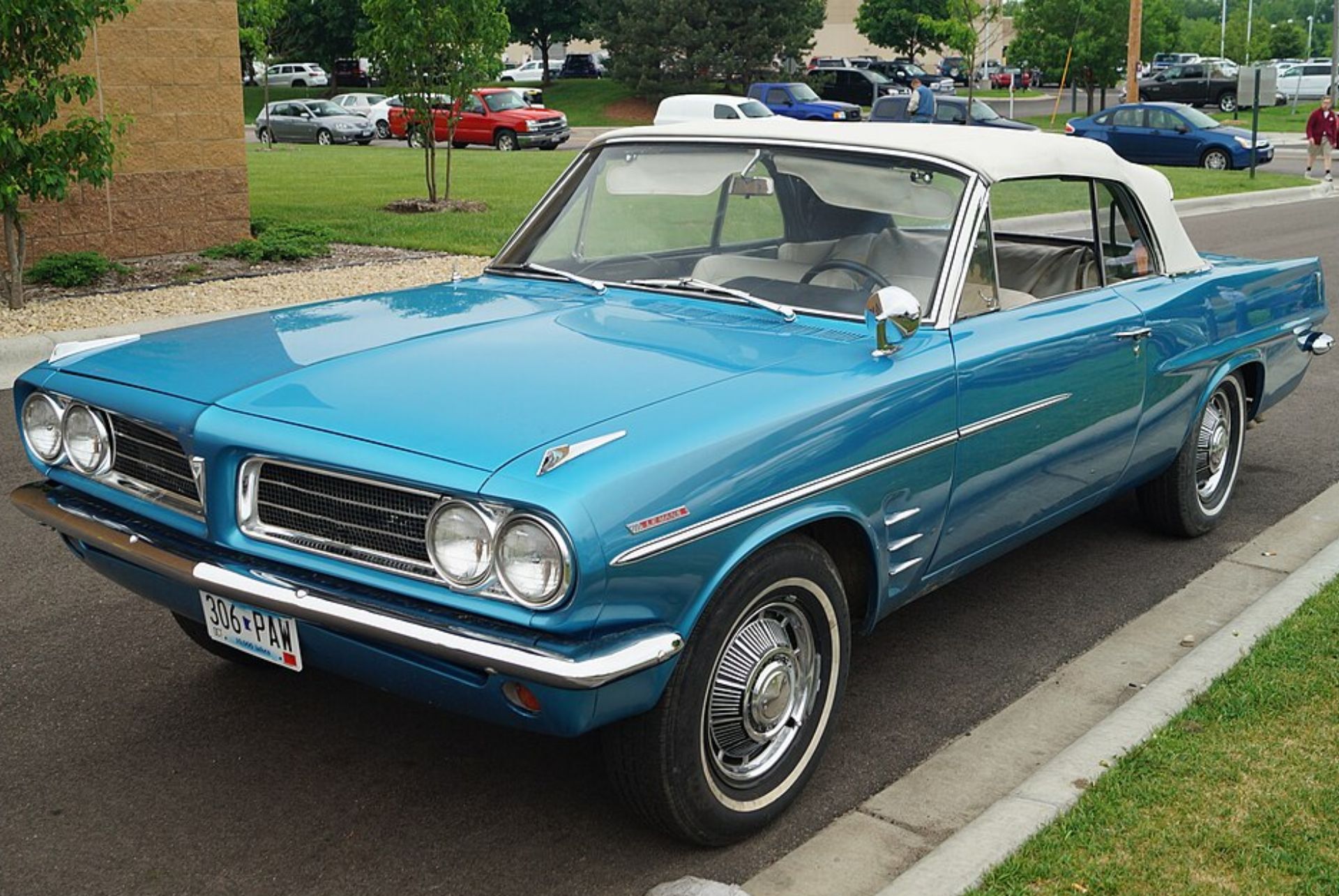
The 1963 Pontiac Tempest did not behave like the rest of Detroit’s compact crowd. It split its engine in half, hid its transmission at the back, and sent power through a flexible shaft that looked more like a speedometer cable than a driveshaft. In a market built on safe bets, Pontiac’s small car played by different rules and became one of the most intriguing American machines of the early 1960s.
What emerged was a car that tried to mix European-style balance with American muscle long before that formula became fashionable. The experiment was short lived, but the engineering gambles, the drag strip legends, and the way the Tempest pointed Pontiac toward the GTO still echo through enthusiast circles today.
GM’s compact gamble and Pontiac’s odd path
When General Motors moved into the compact segment at the start of the 1960s, each division was told to build a smaller car on a shared basic footprint. Buick and Oldsmobile, however, were not planning on using any such exotica on their small cars, preferring to stick with conventional front engine and front transmission layouts that felt familiar to buyers. Pontiac went in another direction and turned its entry into a rolling engineering lab.
While the Buick and Olds versions used a conventional drivetrain, Pontiac created a unique layout that put the engine in front and a transaxle at the rear. The Tempest featured a flat floor with increased interior space and a weight distribution that aimed more at European sports sedans than Detroit compacts. That decision set the car apart from its corporate siblings before a single option box was ticked.
Inside Pontiac, the compact was also a chance to stretch the brand’s growing performance identity into a new price bracket. Rather than selling a simple economy car, the division tried to build something that could feel refined on a twisty road yet still answer the stoplight challenge. That tension shaped every odd decision that followed.
The “rope drive” that redefined the floorpan
The most famous of those decisions was the so-called rope drive. From 1961 to 1963, the senior compact Pontiac Tempest used a novel powertrain layout featuring a front engine and a rear transaxle connected by a long, flexible driveshaft. That shaft was not a straight steel tube. It was a curved, torsionally stiff cable that ran inside a torque tube and allowed the floor to stay low and nearly flat.
Instead of a normal driveshaft, the Tempest put this curved shaft on a slight arc under the body. That let engineers drop the transmission into a rear-mounted unit and tuck the tunnel away so passengers had more foot room. The balance benefit was real. With the gearbox and differential at the back, the car carried its weight more evenly between the axles than a typical front heavy American sedan.
Period explanations of the system describe how the drive shaft would hook into the transmission housing, which contained a two-speed transmission and a three-element torque converter. The rear transaxle was compact and shared some thinking with the contemporary Corvair, although the Tempest kept its engine in front. The result was a drivetrain that looked conventional from the curb but behaved very differently from the firewall back.
Modern video retrospectives have called the 1961 Pontiac Tempest one of the most unique cars in automotive history, and the same basic hardware carried into 1963. Enthusiasts who study the layout often describe it as a magnificent kludge, a clever solution to packaging and balance that also introduced new complexity and service headaches.
Half a V8 under the hood
The engine bay was just as unconventional. Pontiac did not design a clean sheet four cylinder for its compact. Instead, it literally sliced its existing V8 in half. The Tempest’s base engine took one bank of the big Pontiac V8 block and turned it into a slant four, sharing bore spacing and many internal parts with the larger engine.
That decision kept tooling costs down and gave the small car a large displacement four that delivered strong low rpm torque. It also created a powerplant with the rough idle and vibration one would expect from half a big bent eight. The car’s unusual drivetrain layout helped mask some of that harshness, but owners still noticed the difference from the smooth sixes in rival compacts.
All told, there were three basic engines available in the early Tempest years, including that big four and, in some cases, a compact aluminum V8. Buick’s 215 cubic inch aluminum V8 found its way into a small number of Tempests as an option, giving the car a lighter, more refined power source for buyers willing to spend extra. That 215 option was expensive and rarely installed, but it hinted at how flexible the Tempest chassis could be.
1963: from exotic experiment to GTO warmup
By 1963, Pontiac had started to rethink how much exotic hardware it wanted in its compact. But that was just the first act; for 1963, Pontiac ditched the expensive and rarely installed optional Buick 215 aluminum V8 and developed its own small V8 that fit the same space. New for 1963 was Pontiac’s “326” CID Pontiac V-8, which arrived as the most serious performance engine yet offered in the Tempest line.
The 326 gave the LeMans and other Tempest variants a stronger link to the brand’s full size performance cars. The rear transaxle was also upgraded, with internal changes to handle more torque and a revised weight distribution that moved slightly rearward. The combination turned the compact from a quirky engineering exercise into a legitimate warm up act for the coming GTO.
Contemporary road tests of the 1963 Pontiac Tempest LeMans with the 326 V8 described a car that finally matched its innovative layout with the sort of acceleration buyers expected from Pontiac. The compact still carried its unusual rope drive and rear transaxle, but the new engine gave it the authority to exploit that balance on real roads.
A compact that thought like a BMW
Modern enthusiasts often compare the 1963 Pontiac Tempest LeMans to European sport sedans that would not arrive in force until later in the decade. One detailed retrospective has even argued that Pontiac tried to build a BMW before BMW built theirs, and almost succeeded. The combination of a relatively light body, independent rear suspension linked to the transaxle, and a torquey engine gave the car a personality that felt very different from a typical American compact.
In an era when Detroit’s small cars often rode on leaf springs and live axles, the Tempest’s rear layout made it more composed over rough pavement and more willing to rotate into a corner. The flat floor and unusual weight distribution also meant passengers sat lower and more centrally than in rivals. Owners who understood what the engineers had tried to achieve sometimes drove these cars hard on back roads, treating them less like economy sedans and more like oversized sports cars.
The styling did not shout about any of this. The 1963 body was clean and restrained, with a hint of full size Pontiac cues on a smaller canvas. The LeMans trim level added bucket seats and sportier details, reinforcing the idea that this was the enthusiast’s choice within the Tempest range.
The wild side: 421 Super Duty Tempests
If the regular 326 powered cars were interesting, the factory backed drag machines were outrageous. Pontiac built a tiny batch of Tempests with its race bred 421 cubic inch Super Duty V8, turning the compact into a giant killer at the strip. The 1963 Pontiac Tempest Wagon 421 Super Duty, remembered as the famous Union Park Wagon raced out of Maryland, is one of the best known survivors of this program.
That Pontiac Tempest Wagon carried all the correct Super Duty hardware, including lightweight body panels and a heavily fortified driveline. All 12 cars in the run had aluminum components and were tuned for quarter mile dominance. The combination of a compact body and a huge 421 engine created a lethal combination on the dragstrip that shocked competitors who expected big full size Pontiacs in the opposite lane.
Modern coverage of these cars notes how the Pontiac Tempest Super Duty program was laser locked on performance. One of the most unique aspects of the 63 Pontiac Tempest Super Duty has to do with its transmission, which used an unusual shift pattern that jumped from second to fourth gear. The cars were not built for comfortable cruising. They existed to win trophies and to show what the compact chassis could handle when pushed to extremes.
On road courses, the same basic hardware proved its worth against European exotics. The Pontiac Tempest Super Duty was up against the likes of giants from Ferraris to Stingrays to Jags to Porsches, and contemporary accounts describe how drivers learned to be surgical, not just brutal, with the power. Those results helped cement the idea that Pontiac could build cars that ran with the world’s best, even when they started from a humble compact shell.
Abandoned experiment or start of an era?
The Tempest’s story did not end in a smooth arc. By 1964, Pontiac moved its intermediate cars to a more conventional front engine, front transmission layout and created the GTO on that new platform. The rope drive and rear transaxle vanished from the catalog. That rapid retreat has fueled debate among historians and enthusiasts about how to judge the 1961 to 1963 cars.
Some modern commentators argue that experts still cannot agree whether the Pontiac Tempest was born in the era of innovation or it was the model that started the era for Detroit compacts. A popular video on America’s iconic abandoned 4 cylinder muscle car frames the early Tempest as a secret chapter in American performance history, one that hid its brilliance behind an economy car badge.
Other analysts focus on the engineering compromises. The flexible driveshaft and rear transaxle created unique maintenance demands, and the half V8 four cylinder could be rough and thirsty compared with rival sixes. For a mass market brand, those tradeoffs were hard to justify once the novelty faded and warranty claims arrived.
Yet even critical voices tend to agree that the Tempest showed a side of Pontiac that refused to accept the obvious solution. The car’s willingness to defy convention, from its drivetrain to its engine choices, helped shape the mindset that later produced the GTO and a generation of muscle cars.
How history remembers the 1963 Tempest
Modern classic car guides describe the 1963 Pontiac Tempest as more than just another early 1960s compact. One detailed catalog calls the model a harbinger of change and a car that dared to defy convention, emphasizing how its unusual engineering and styling helped bridge the gap between economy cars and serious performance machines.
More from Fast Lane Only