Ralph Teetor lost his sight as a small boy, and he never got it back. Even so, he became a mechanical engineer, ran a major parts company and patented the speed control that grew into modern cruise control. Chrysler brought Ralph Teetor’s idea to market for 1958, with the Imperial as its showcase.
The idea, as the family tells it, grew out of a ride in the passenger seat. Teetor often rode with his patent attorney, a family friend whose foot kept speeding up and slowing down. The constant surging bothered him. So he set out to build a device that kept a steady pace.
That story fits the man. His family’s companies in Hagerstown built railway cycles and light inspection cars, according to Hagerty. In fact, he helped build a simple gasoline-powered car when he was just 12 years old.
Who was Ralph Teetor?

Teetor was born in 1890 in Hagerstown, Indiana, according to the National Inventors Hall of Fame. At age five, a knife accident injured one of his eyes. Within a year, he had lost the sight in both. Smithsonian magazine names the cause of the second loss as sympathetic ophthalmia.
Blindness did not keep him out of engineering school. Penn Engineering says the University of Michigan rejected him because of his disability, but the University of Pennsylvania admitted him. He then earned a bachelor’s degree in mechanical engineering there in 1912 and a master’s in 1930. A cousin helped him with reading and written work, Smithsonian notes.
Afterward he joined the family business, which became The Perfect Circle Co., a maker of piston rings. The Hall of Fame says he rose to vice president of engineering in 1937 and president in 1946. Later he served as chairman from 1957 to 1963. Hagerty adds that Dana bought the company in 1963.
The company grew with him. Penn Engineering says Perfect Circle’s piston rings became the industry standard, and the firm reached 6,500 employees at its peak. It also avoided laying off workers during the Great Depression, according to the same profile.
How Ralph Teetor’s Speedostat worked
Teetor first filed a speed-control patent in 1948. Smithsonian says U.S. Patent No. 2,519,859 was granted on August 22, 1950, under the plain title “Speed Control Device For Resisting Operation of the Accelerator.” He called the device the Speedostat.
At first, the system did not hold a speed by itself. Instead, a dashboard selector set a target, and a mechanism driven by the drive shaft tracked the car’s pace. As the car neared that speed, a governor triggered a vacuum-driven piston that pushed back against the gas pedal. The driver felt the pedal resist, which worked as a warning.
A later speed lock went further. An electromagnetic unit held the set speed until the driver tapped the brake, according to Smithsonian. Jalopnik says the Speedostat had that electromagnetic lock by 1958.
The 1958 Imperial and its Auto-Pilot
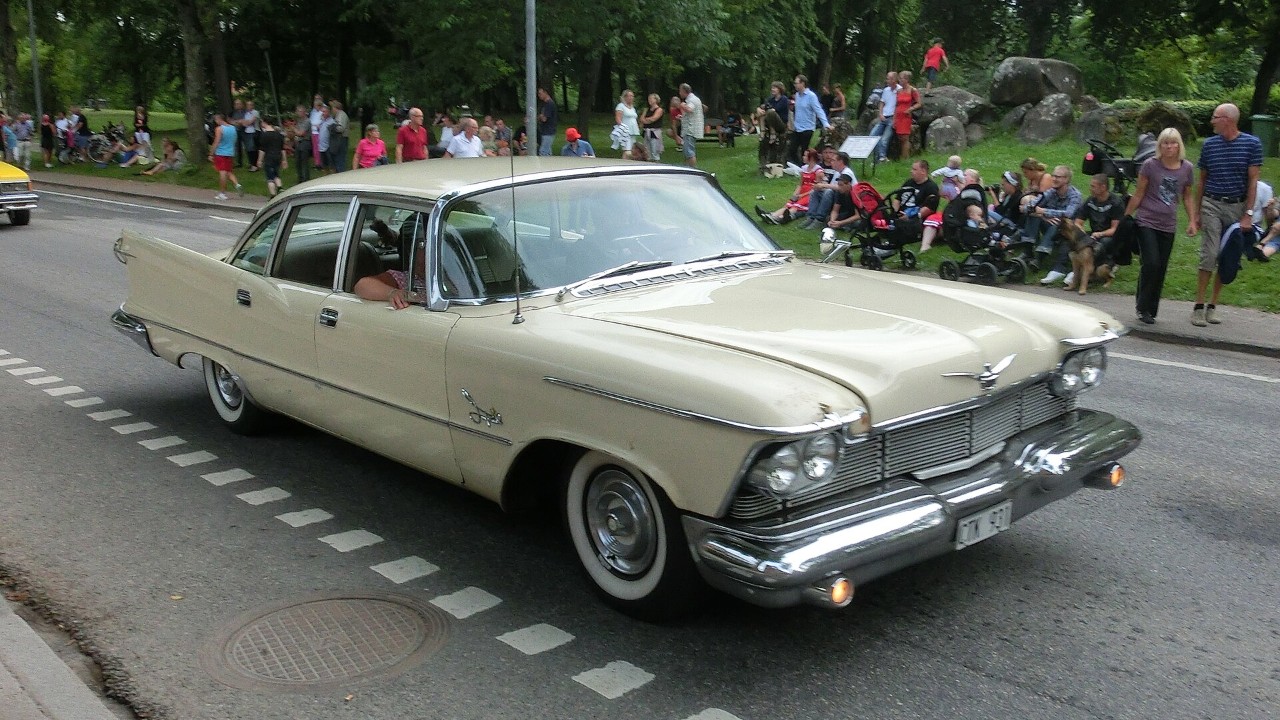
Chrysler was first to adopt the technology, as a luxury option in 1958, according to Hagerty. Chrysler renamed it Auto-Pilot. Jalopnik singles out the 1958 Imperial, the flagship of Chrysler’s Forward Look, as carrying “one of the first modern cruise-control systems.” The Hall of Fame also lists the 1958 New Yorker and Windsor among the first Chrysler cars with it.
The Imperial needs a note of its own. By 1958, it was no longer simply a Chrysler model. Chrysler had launched Imperial in 1955 as a brand-new division, Jalopnik notes, to take on Cadillac and Lincoln. As a result, a 1958 buyer drove home in an Imperial, not a Chrysler Imperial.
The option then spread fast. A year later, Smithsonian says, Chrysler offered it on all its models.
How Cadillac gave it the name cruise control
General Motors’ luxury brand soon followed. Hagerty says Cadillac offered the Speedostat in 1959 as “Cruise Control,” and the name stuck. That’s why most drivers today know the feature by Cadillac’s label rather than Teetor’s or Chrysler’s.
The device became an everyday tool years later. Smithsonian credits the 1973 OPEC oil embargo with making it a widely accepted way to save fuel. Meanwhile, Teetor stayed on at Perfect Circle as chairman until 1963.
Cruise control was only one of Teetor’s ideas. Hagerty points to a hydraulic automatic transmission design from 1924. Smithsonian adds a process for dynamically balancing steam turbines on U.S. Navy warships. Penn Engineering, for its part, mentions piston ring expanders in the early 1930s and a fluid-operated gearshift in the 1920s.
He also had a clear view of his own blindness. Penn quotes him telling veterans, “You are not handicapped so long as you can think logically.” That line sums up a career spent proving it.
He died in 1982. Hagerty notes he held more than 40 patents at the time of his death. The Automotive Hall of Fame inducted him in 1988, and the National Inventors Hall of Fame followed in 2024.
More from Fast Lane Only