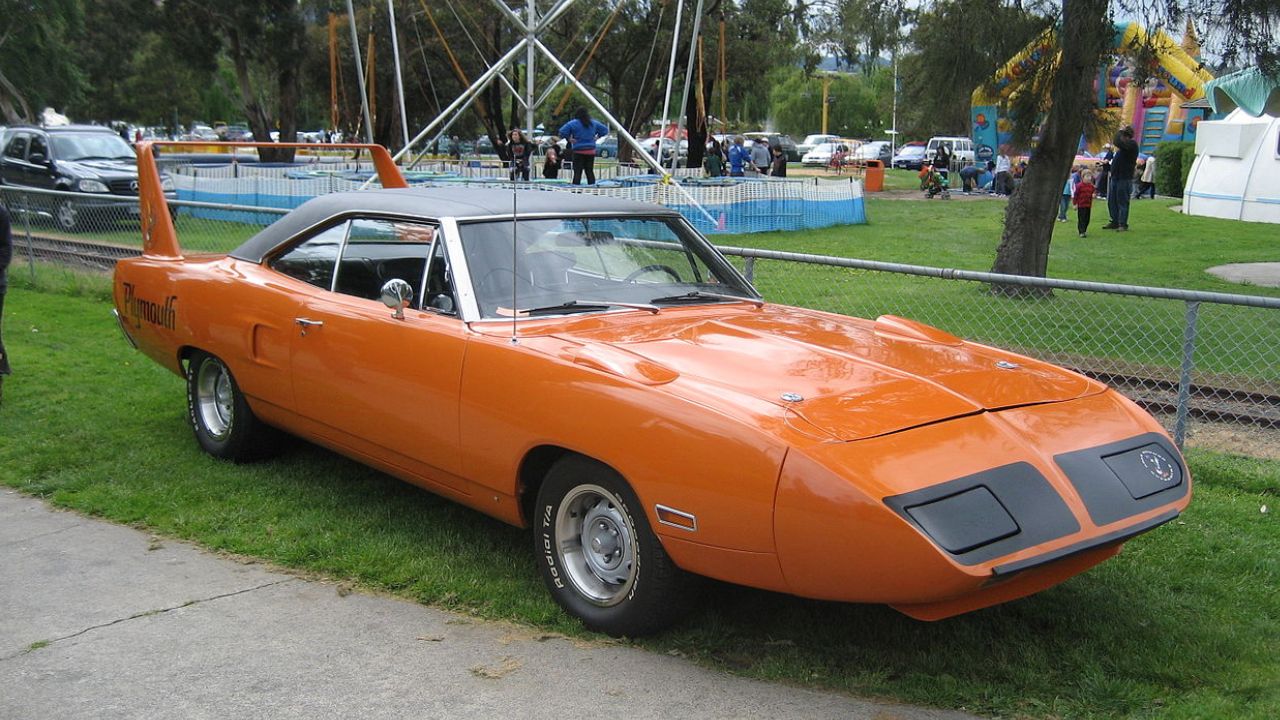
The towering rear wing on the 1970 Plymouth Superbird has inspired jokes, myths, and endless bench racing, but it was never a styling gag. The car was engineered as a weapon for high-speed NASCAR ovals, and that skyscraper spoiler was a deliberate solution to a very specific aerodynamic problem. To understand why it had to be so big, it helps to separate folklore from what the engineers who created the Superbird were actually trying to do.
The legend of the trunk-clearing wing
Among muscle car fans, one story refuses to die. The tale goes that the Superbird’s rear wing had to be mounted sky high so the trunk lid could open underneath it.
The people who actually worked on the car tell a very different story. The engineer responsible for the wing design, often cited in interviews and technical retrospectives, described a program that started with wind tunnel data and race track demands, not luggage access. When that engineer later heard the trunk-clearance myth repeated back to him, he dismissed it and explained that the wing’s position was driven by airflow and leverage, with the fact that the lid still opened described as pure happenstance.
A NASCAR missile for Earth, not a street toy
The 1970 Plymouth Hemi Superbird was born out of NASCAR’s aero wars, where manufacturers chased top speed and stability on long, banked tracks. Period footage and modern analysis of the Plymouth Hemi Superbird show a car that looks like it belongs on another planet, yet its entire shape was tuned for one purpose: to go faster on Earth’s superspeedways without lifting or wandering at more than 190 miles per hour.
To race the Superbird, Plymouth had to build a street-legal version that met NASCAR homologation rules. That requirement is why showroom buyers suddenly found a mid-size Mopar with a pointed nose cone, a cartoon Road Runner decal, and a rear wing that soared over the roofline. The production cars were essentially byproducts of a racing program that treated the body as a science project.
Wind tunnels, not whimsy
Chrysler engineers had already learned hard lessons with the Dodge Charger Daytona, the Superbird’s close cousin. In period recollections, they describe how the Daytona’s rear wing was positioned by aerodynamic testing, not by stylists, and how they worked with race teams to refine the setup. One veteran who helped set up the Daytona and later the Plymouth recalls that people kept insisting the wing was raised just so the trunk could open, and he replied that the dimension came from the wind tunnel and that the trunk clearance was a side effect, not the goal, when he talked to some who repeated the myth.
The same logic applied to the Plymouth. Engineers wanted the wing to sit in clean air above the turbulence that rolled off the roof and rear window. At lower heights, the spoiler would sit in a messy, swirling flow that reduced its effectiveness. Raising it put the airfoil in a more stable stream, which meant more consistent downforce at racing speeds.
Downforce, stability, and that pointed nose
The Superbird was not just about the tail. Its most distinctive features were a pointed nose cone and an enormous rear wing, both engineered for improved downforce and high-speed stability. Contemporary descriptions of the 1970 Plymouth Superbird emphasize how the nose reduced drag while the rear aero kept the car planted during high-speed cornering.
The long, tapered front end worked like a spear through the air, smoothing the flow over the body and helping the car slice through at speeds that would make a standard Road Runner feel nervous. A separate profile of the Superbird nose cone notes that it was specifically shaped to minimize drag and to help the car reach higher top speeds while preserving stability.
At the back, the tall wing acted as a lever on the rear axle. By placing the airfoil high and far behind the rear wheels, engineers increased its mechanical advantage. That meant more effective downforce pressing the tires into the track, which in turn improved traction when drivers like Richard Petty exited corners and rocketed down the straights.
From “fighter jet” looks to functional aero
Visually, the Superbird barely looked like a traditional muscle car. With its massive rear wing and pointed nose, it resembled a fighter jet more than a family coupe. Modern commentators often describe how the car’s silhouette, with that skyscraper spoiler and needle-like front, gave it an almost cartoonish presence on the road, but they also stress that the wing was not just for show. One retrospective on why the 1970 Plymouth Superbird became so legendary points directly to the way that the giant spoiler helped transform it into one of the most talked-about race-derived cars in history.
Physically, the wing’s height meant that, on the street, drivers could walk under it. On the track, the same height placed the airfoil in relatively undisturbed air, where its shape could generate a steady push downward on the rear tires. The result was a car that felt more locked in at triple-digit speeds, which mattered far more to NASCAR than how the car looked in a dealership lot.
What the engineers actually said
The clearest rebuttal to the trunk myth comes from the engineer who led the Superbird’s rear aero work. In interviews recounted by enthusiasts, he explained that the wing’s dimensions came from calculations and wind tunnel tests. The story traces back to a Media Superbird post that quotes him saying the height was chosen for aerodynamic reasons and that the fact the trunk could still swing open under it was, in his words, “happenstance.”
He also pointed out that the wing program was created with one goal, which, later summaries describe as maximum speed and stability on NASCAR tracks. A more recent overview of the Superbird wing program echoes that, stating that its enormous rear wing and pointed nose were engineered to maximize speed and make the car one of the most recognizable machines in automotive history.
Fact versus fiction, as owners see it
Current owners and restorers of these cars have become de facto historians. In one detailed walkaround of a Mopar Plymouth Superbird, the presenter explicitly frames the discussion as “fact versus fiction,” pointing out that the car’s exaggerated aero pieces were not cosmetic add-ons but functional components designed to win races.
He highlights how the nose, fender vents, and rear wing all serve a purpose at speed, and he pushes back on the idea that the height of the spoiler was dictated by convenience. Instead, he reinforces what the engineers have said for years: the aero package was shaped in response to NASCAR competition, and the street cars inherited that hardware almost unchanged.
Museums and experts push back on the myth
Even museums dedicated to racing history have felt compelled to correct the record. A post from the Simeone Automotive Museum bluntly states that the Superbird’s massive rear wing and pointed nose made it look more like a fighter jet than a car, and that the wing was not just for show. The museum uses its Apr myth-busting post to explain that when staff talked to some guys who had worked with the original engineers, they heard the same story: the wing height was set for aerodynamic performance, not for trunk access.
By amplifying the voices of people tied directly to the program, the museum helps close the gap between casual folklore and the documented development process. For fans who grew up repeating the trunk tale, that correction can feel almost heretical, yet it lines up with the technical evidence and with what Chrysler’s own racing partners have said.
Homologation rules and the road-going oddity
The Superbird’s existence on public streets came down to NASCAR’s homologation rules, which required manufacturers to build a batch of road cars that mirrored the race versions. One summary of the Superbird origins explains that NASCAR’s 1970 regulations forced Plymouth to plan for a production run, and that the resulting cars carried over the pointed nose cone and enormous rear wing that were engineered for improved downforce and stability.
For typical buyers, those parts were extreme. The wing towered above the roof, the nose extended the car’s length, and the graphics package leaned into cartoon imagery. Yet all of that existed because Plymouth wanted to lure Richard Petty back to its camp and to compete with rivals who were already experimenting with aero tricks on the track. The showroom models became rolling advertisements for a racecar that had been tuned in wind tunnels and refined at high speed.
How the myth took hold
Given the technical backstory, why did the trunk-clearance legend spread so widely? Part of the answer lies in how people experience the car in person. At a cruise night or a show, onlookers watch the owner swing open the trunk lid under the wing and immediately assume that the geometry must have been intentional. The visual of the lid clearing the spoiler by a small margin invites a tidy narrative: the engineers raised the wing until the trunk worked.
Another factor is that the real explanation is less intuitive. Aerodynamic flow fields and leverage arms are harder to visualize than a simple mechanical interference. Over time, the easier story won out in casual conversation, and it filtered into enthusiast writing and online references. That is how the Discovered Media commentary on the Superbird ended up tracing how the myth even slipped into widely used reference entries, despite contradicting what the engineer himself had said.
Why the truth matters to enthusiasts
For some owners, the distinction between myth and reality is more than trivia. Restorers who bring these cars back to original specification rely on understanding why parts were shaped and placed the way they were. A shop such as Patrick Autobody that specializes in classic bodywork needs to know, for example, that the wing’s mounting points and angle were not arbitrary but tied to performance targets.
Historians and curators also care about preserving the engineering story. When a museum labels a Superbird exhibit, describing the wing as a trunk workaround would misrepresent the mindset of the Chrysler aerodynamicists and race teams who pushed the limits of what a stock car could look like. A more accurate panel would explain that the car’s exaggerated features were the visible result of a competition-driven development process that prioritized speed above all else.
A car that still looks like science fiction
More than fifty years later, the Superbird still looks like science fiction parked next to modern traffic. Period photos, such as the Plymouth Superbird image that often circulates among enthusiasts, capture how radical the car appeared even in its own era. The long nose, the towering wing, and the bright paint schemes made it impossible to ignore.
More from Fast Lane Only