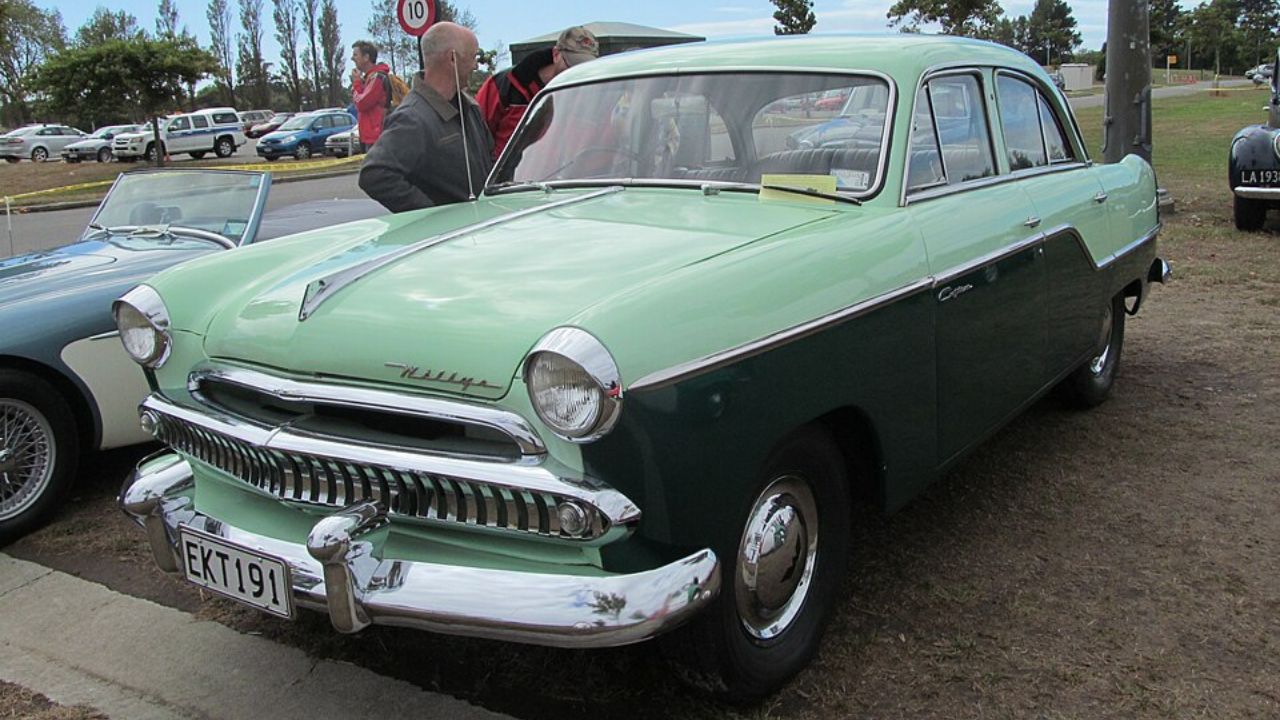
The 1955 Willys Aero never tried to dominate a boulevard the way a tailfinned Cadillac did, yet it carried a quiet confidence that still resonates with enthusiasts. In its final American season, the compact Willys two-door hardtop spoke in the language of efficiency, clean design, and stubborn independence at a time when the market was racing in the opposite direction.
That tension between understatement and ambition is what gives the last Willys compact its voice today. It did not shout in chrome or cubic inches, but it offered a different idea of what an American car could be, just before that idea disappeared from the United States.
A compact contrarian in a big-car year
By the mid 1950s, Detroit had settled into a familiar rhythm of longer, lower, wider sedans and hardtops, with more cylinders and more ornament every season. Willys Motors chose a different path. The company had introduced its compact rig in 1952, called the Aero, the brainchild of former Packard engineer Clyde Paton, as a tidy, efficient alternative to the standard American family car.
The Aero arrived with a wheelbase of 108 inches, and the passenger compartment sat between the axles, which gave the compact Willys a true six-passenger interior without the bulk of full-size rivals. That packaging solution let Willys offer family-friendly space in a car that still felt manageable in traffic and on narrow rural roads.
The Aero Willys was produced by Willys, Overland and Kaiser, and Kaiser, Wil successors, from 1952 through 1955, as part of a push to offer a more modern car alongside the company’s utilitarian Jeep products. Period material described how the Aero Willys could return up to 35 mpg with overdrive, a figure that placed it far from the thirsty Cadillacs of the period and closer to the frugal ideal that would become increasingly important decades later.
From Aero to Bermuda, a name that tried to keep up
For 1955, Willys Motors made a marketing pivot. The company ditched the familiar Aero name and rebranded its compact two-door hardtop as the Bermuda. The change was more than a badge swap. It was an attempt to give the car a sunnier, more aspirational identity at a time when buyers were flocking to glamorous hardtops from bigger brands.
In its transformation into the Bermuda, the car received styling updates that pushed it closer to mid decade fashion. The rear panel adopted brightwork that framed the tail lamps and suggested jet exhausts, a nod to the aviation theme that was everywhere in American showrooms. Yet the basic proportions and the compact footprint still marked it as an Aero at heart.
Inside the company, the Bermuda name was meant to refresh the story around a design that was already several years old. The Aero had been engineered as a rational, almost European answer to American needs. The Bermuda label tried to wrap that rational core in a more emotional promise, one that could stand alongside the glamorous coupes from larger manufacturers without directly copying them.
Built in Toledo, ending an American chapter
The Aero line, including the 1955 Willys Aero Bermuda, was built in Toledo, Ohio from 1952 through 1955. A Willys Aero Car gathering in Monroe Washington has highlighted that these compact cars were built in Toledo, until owner Kaiser decided to concentrate on Jeep production instead.
One detailed account of the model’s history notes that the Aero was built in Toledo, and that the nameplate was discontinued after the 1955 model year. The compact Willys was the company’s last United States built passenger car, which gives the 1955 cars an unintended significance. They represent the final moment when Willys tried to compete directly in the mainstream car market, before retreating to the more profitable world of Jeep utility vehicles.
That decision reflected market reality. The Aero had its fans, but the brand lacked the dealer network and advertising muscle of the major Detroit automakers. As the 1950s progressed, the gap between the resources of independent companies and the big three widened. The end of Aero production in Toledo closed the book on Willys as a conventional carmaker in its home country.
Engineering for the real world, not the brochure
The engineering behind the Aero line was quietly sophisticated. The compact Willys was designed to cope with the country’s poorer roads, with a structure that balanced light weight and durability. The small sedan concept that shaped the Aero had already been explored in Willys concept work, where designers experimented with compact bodies and sloping rear decks that owed something to contemporary Studebakers. A period description notes that here, it was the rear end that drew from Studebakers, with a deck that sloped down between elongated fenders, a form that suited both style and aerodynamics.
Under the hood, the 1955 Willys Deluxe used a straightforward inline six with a single carb, solid lifters and 115 hp, a combination that favored reliability over raw performance. A detailed road account of a 1955 Willys Deluxe describes how, if the multitudinous recent medley of flat-out romps proves anything, it is that this car is pretty much bulletproof, which is much of the point of a compact Willys. That same account notes that under acceleration, the engine is pleasingly unobtrusive and relatively quiet, in spite of rear-end gearing that was stretched for highway use.
Earlier Aero models had already shown how far Willys was willing to push efficiency. A period film about the 1952 Willys Aero highlights a figure of 60 m per from an American car in 1952, at a time when Cadillacs were gulping gas at 10 m per gallon and the average family sedan sat somewhere in between. That contrast made the Aero look almost futuristic in its priorities, even if the styling was deliberately conservative.
Design that whispered instead of screamed
Visually, the 1955 Willys Bermuda tried to split the difference between the clean, upright look of the early Aero and the more flamboyant shapes that were becoming standard. Contemporary commentary describes how Willys Motors revised the front and rear to give the Bermuda more presence. The rear bumper and brightwork were arranged to look like jet exhausts, a small but telling concession to the jet age fashion that dominated American car design.
At the same time, the basic body sides remained relatively unadorned. The greenhouse was tall enough for good visibility, and the fenders were integrated rather than heavily sculpted. In its transformation into the Bermuda, the model shared much with the Willys Custom, but it kept the compact, almost European stance that had defined the Aero from the start. A detailed look at the 1955 revisions explains that in its transformation into the Bermuda, the car gained ornament, but the underlying package still traced back to the Willys Custom and the original Aero proportions.
Color and trim did a lot of the talking. Surviving cars often wear striking two-tone paint, with a contrasting roof that emphasizes the hardtop profile. That visual drama helped the quiet mechanical package feel more current in a showroom filled with chrome and fins.
The Bermuda in the public imagination
Modern enthusiasts still respond strongly to the shape. A recent social media post opens with the line, look at this gorgeous two tone 1955 Willys Bermuda, and goes on to call it the legendary 1955 Willys Bermuda. The same post points out that most people see the Willys badge and immediately picture a muddy military vehicle or a company building bare bones farm tractors, not a stylish hardtop coupe. That disconnect between brand stereotype and reality is part of the car’s appeal.
The Willys name remains tied in many minds to wartime Jeeps and agricultural equipment, yet the Bermuda shows how the company tried to broaden its image. The hardtop roofline, bright two-tone finishes, and compact stance challenge the idea that Willys could only build utilitarian machines. That is why the phrase the legendary 1955 Willys Bermuda appears in enthusiast circles, attached to photos that highlight the car’s proportions and colors.
The same social media commentary underscores how unusual the Bermuda looks to casual observers. Most people, it notes, associate the badge with mud and farm fields, not with a neatly tailored coupe. The surprise factor becomes part of the car’s charm at shows and on the street, where it often requires a double take to reconcile the Willys name with the sleek hardtop body.
Variants and the Aero Ace legacy
The 1955 range did not stop at the Bermuda. The Aero Ace represented another expression of the same basic engineering, tuned for buyers who wanted a slightly different mix of trim and equipment. A classic car guide for the 1955 Willys Aero Ace explains that the Aero Ace’s impact on the automotive industry came from its emphasis on compact efficiency and practical performance, qualities that would become increasingly important in later decades. That assessment frames the Aero Ace not as a forgotten footnote but as an early indicator of a shift that would only reach the mainstream years later.
Specifications for classic cars are given to the best of the guide’s ability, considering the limited and variant data available for small production runs. Even with those caveats, the Aero Ace is consistently described as a car that delivered good fuel economy, reasonable power, and a comfortable ride in a package that was easier to park and maneuver than the typical mid 1950s sedan.
Those same virtues applied to the Bermuda and the Deluxe. Across the line, Willys offered a family of compacts that shared a common structure and mechanical layout, with differences in trim and body style to target slightly different customers. The limited scale of production meant that none of these models would ever rival the big three in sales volume, but they left a distinct imprint on the idea of what an American compact could be.
How it felt on the road
Firsthand driving accounts of surviving 1955 Willys cars describe a personality that matches the engineering brief. Owners report that the cars track straight at highway speeds and feel stable in crosswinds, thanks in part to the long wheelbase relative to overall length. The steering is light but not vague, and the suspension absorbs rough pavement with a composure that reflects the car’s origins on the country’s poorer roads.
The inline six in the Deluxe and related models does not turn the car into a drag strip star, but it provides enough torque for modern traffic. A detailed narrative of a 1955 Willys Deluxe notes that under acceleration, the engine is relatively quiet, and that the car’s gearing allows relaxed cruising even with modest horsepower. That combination of calm mechanical behavior and tidy size makes the car feel more modern than its age would suggest.
Braking performance reflects the era, with drum brakes that require anticipation and a firm pedal. Enthusiasts who drive these cars regularly often upgrade linings or adjust driving style to compensate. Yet the overall impression is of a machine that was engineered to be used hard and maintained simply, rather than pampered as a fragile showpiece.
More from Fast Lane Only