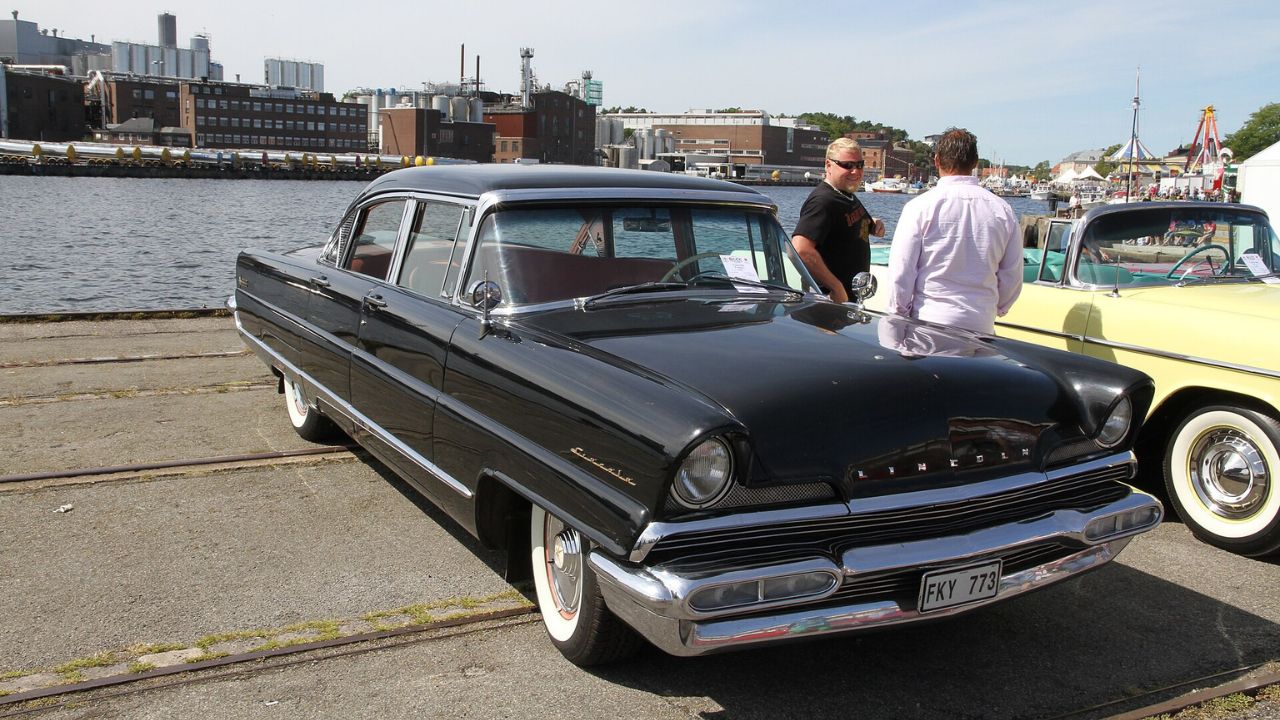
The 1956 Lincoln Premiere did not try to prove anything. It arrived with the stance of a car that already understood its place in the world, a confident flagship from a company intent on resetting its own future. In an era obsessed with fins, chrome, and jet-age optimism, this Lincoln carried itself as if the argument was already settled.
A one-year shape with lasting authority
By the middle of the 1950s, Lincoln needed a statement. The brand had spent the early part of the decade in the shadow of General Motors, with conservative bodies that left plenty of room for bolder rivals. The 1956 Premiere became that statement, a clean-sheet design that replaced the older look with lower, longer proportions and a stance that made competitors seem suddenly tentative.
Contemporary observers have pointed out that the Premiere two-door hardtop shared broad dimensions with a comparable 1956 Cadillac, yet the Lincoln read differently on the street. Instead of towering fins or exaggerated curves, it presented a wide, horizontal body with restrained sculpting and a roofline that seemed to float above the glass. The combination made the car feel both massive and surprisingly modern, a tasteful alternative in a field that often chased attention through excess.
The irony is that this confident shape would last only a single model year before Lincoln pivoted again. Its brief run, however, only sharpens the impression that the Premiere moved through 1956 as a car already certain of its identity, even as the company around it continued to experiment.
Jet-age lines and summertime charisma
Styling set the tone before the engine ever turned over. When the Premiere debuted, the car immediately stood out with sleek, jet-inspired cues, heavy chrome accents, and a stance that seemed to command any boulevard it entered. Company material later recalled that When it debuted, made an immediate impression because it looked like a rolling piece of postwar optimism rather than a dressed-up carryover.
The car’s sheer footprint amplified that effect. Official descriptions emphasize that it was Measuring over 18 used its length to stretch clean body sides, extended rear quarters, and an expansive hood that seemed to run out toward the horizon. Wide chrome moldings framed the fenders and rockers, but the brightwork followed the lines instead of fighting them, which kept the car from tipping into caricature.
Details reinforced the aviation theme that fascinated American designers at midcentury. The front end carried a broad grille that suggested an intake, flanked by rounded headlamp brows. Tail lamps sat in sculpted housings that hinted at exhaust nozzles. From certain angles the car looked less like a sedan and more like a low-flying aircraft on approach, which suited a decade that measured progress in airspeed and altitude.
A rare convertible that defined midcentury luxury
The Premiere nameplate covered several body styles, but the convertible remains the most evocative expression of Lincoln’s 1956 reset. Production of the open car was limited to exactly 2,447 units, a small run that has turned surviving examples into rolling reference points for the era’s luxury ambitions.
Period descriptions of the 1956 Lincoln Premiere Convertible With emphasize that it represented Lincoln’s complete restyle for 1956, a clean break that arrived as the brand’s bold challenge to the prevailing definition of a prestige American car. With the top down, the car dramatized its long rear deck and high, padded interior surfaces, creating a profile that looked as comfortable on a Palm Springs driveway as it did at a hotel entrance in New York.
Observers then and now have argued that this convertible epitomized midcentury American luxury. The combination of sheer size, confident surfaces, and intricate brightwork signaled a car built for visibility as much as transportation. It was not simply a vehicle to arrive in. It was part of the arrival.
Inside: restraint, clarity, and quiet confidence
If the exterior projected authority, the cabin delivered a quieter, more controlled kind of confidence. Commentators who have studied preserved cars describe one of the most distinctive instrument panels of the decade. In a detailed look at surviving examples, one account notes that exterior isn’t enough,, described as clean yet intriguing and simple yet full of presence.
The dashboard arranged its gauges in a horizontal cluster, minimizing visual clutter. Chrome trim traced the shapes without overwhelming them, and the steering wheel carried a delicate horn ring that contrasted with the car’s bulk. Upholstery patterns and door panels echoed the exterior lines, using straight pleats and rectangular motifs instead of busy scrollwork. The result felt modern in a way that many contemporaries, with their busy textures and ornate patterns, did not.
That restraint aligns with the broader personality of the Premiere. The car did not shout inside or out. It simply presented a unified design that suggested the driver had already arrived at a certain level of assurance, with no need to advertise it through gimmicks.
From Capri to Premiere: a deliberate step up
Within Lincoln’s own lineup, the Premiere occupied a clear place in the hierarchy. Company material from the period describes how the car was Positioned above the used bold, sweeping body lines, a wide chrome grille, and dramatic tail lamp treatments to distinguish itself from the more restrained Capri series.
Pricing reflected that ambition, with the Premiere marketed as a step closer to the brand’s ultra-luxury Continental offerings. The intent was clear. Buyers who wanted something more expressive than a Capri but not as rarefied as a Continental would find their answer in the Premiere, which paired advanced styling with full-size comfort and power.
That structure also reveals how Lincoln viewed its own customers in the mid 1950s. The company expected some owners to climb the ladder from Capri to Premiere, then perhaps into a Continental for those who wanted an even more exclusive statement. The Premiere’s confident posture on the road mirrored its role in that strategy. It signaled that the owner had moved beyond the entry point of the luxury field without needing to reach for the most ostentatious option.
Engineering presence and the Continental connection
Underneath the styling, the Premiere shared its basic mechanical philosophy with other midcentury American luxury cars. It relied on a large displacement V8, a smooth automatic transmission, and a chassis tuned for isolation rather than sharp reflexes. Period commentary on the broader 1956 Lincoln line notes that the company offered the car as a two-door hardtop, a four-door hardtop, and the Premiere, while a side note for 56 and 57 highlights how the halo models sat alongside the more common body styles.
That proximity to the Continental nameplate mattered. The Continental series had long served as Lincoln’s ultimate expression of luxury, and its presence in the same showroom gave the Premiere an implicit endorsement. Buyers could see the design language and engineering philosophy flow from the top of the range down into the more accessible models, which reinforced the idea that the Premiere carried a measure of the same confidence and pedigree.
Even enthusiasts who focus on the fine-grain details of vintage hardware tend to treat the 1956 Lincoln as a coherent package. Modern video walkarounds of a 1956 Lincoln Premiere, dwell on the way the trim pieces, panel gaps, and mechanical layout all reflect a company intent on matching Cadillac and other rivals part for part. The engineering may not have broken new ground in every dimension, but it did support the car’s visual promise.
Marketing language that matched the attitude
Lincoln’s advertising did not shy away from big claims. Period promotional material described the car with phrases that matched its visual bravado. Enthusiast groups that preserve this history point to one striking example, where the car was heralded as completely, daringly, new, a tagline that underlined how thoroughly the 1956 design broke from the earlier series that ran from 1952 to 1955.
That kind of language can sound inflated decades later, yet in the context of the time it aligned closely with what the car actually delivered. The body was genuinely new, the proportions were more aggressive, and the interior layout moved away from the ornate forms of the early 1950s. The Premiere did not simply receive a heavier dose of chrome or a taller fin. It represented a reset in how Lincoln wanted to be seen.
Marketing also leaned into the social setting implied by the car. Photographs and brochures placed the Premiere in front of modernist homes, city hotels, and coastal resorts, all environments where its long, low profile and intricate trim could catch the light. The message was consistent. This was a car for people who already felt established, not for those still trying to announce themselves.
Preservation, memory, and the museum lens
Today, the 1956 Premiere often appears in museum collections and enthusiast gatherings, where it is treated less as a curiosity and more as a reference point for midcentury taste. Detailed writeups of preserved convertibles and sedans highlight how the design has aged with surprising grace. One such account recalls that Many pictures of been shared among enthusiasts, which helped inspire deeper written reflections on why the 1956 Lincoln was attractive in the first place.
Those images, often gathered in online pools such as the Discovered Museum Classics, group, show cars in various states of preservation. Some sit in museum lighting with flawless chrome and paint. Others appear in more ordinary settings, parked on grass or pavement that could be any small-town show field. In both contexts, the Premiere’s proportions and detailing continue to draw attention.
High resolution photographs, including close views of the grille, tail lamps, and interior trim, circulate widely. Examples hosted at Discovered Museum Classics, and other related images such as Discovered Museum Classics, and Discovered Museum Classics, give current audiences a close look at details that casual observers in 1956 might have missed. Even shots of the car on the street, such as those preserved at Discovered Museum Classics,, reinforce how the design still commands space.
Why the Premiere still feels sure of itself
Viewed through a modern lens, the 1956 Lincoln Premiere can seem almost understated compared with the fins and chrome that would arrive in the next few years. Yet that relative restraint is part of why the car still feels self-assured. It did not chase the most extreme trends of its moment. Instead, it balanced jet-age cues, substantial size, and a calm interior layout into a package that signaled confidence without shouting.
Enthusiast videos, such as the exuberant tour where a presenter calls the Lincoln spectacular and mesmerizing, show how that confidence continues to resonate. The car glides through modern traffic as if it still owns the lane, its long fenders and low roofline separating it instantly from contemporary crossovers and sedans.
More from Fast Lane Only