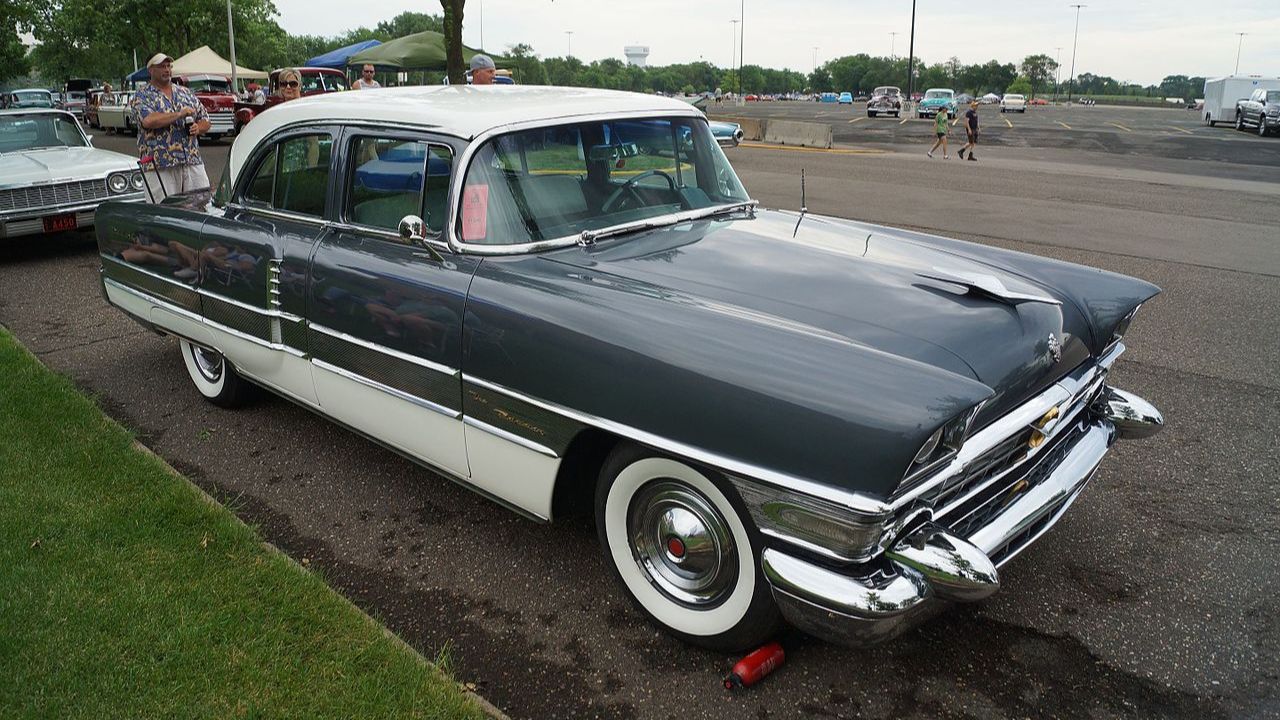
The 1956 Packard Patrician arrived as a confident, chrome-laden flagship just as its maker was running out of road. It carried new engineering, modern luxury and the full weight of Packard’s reputation as a premier American brand, yet it could not stop the company’s slide toward extinction. Today the car stands as a carefully crafted attempt to hold onto a market that was already slipping away.
Packard’s last stand in the luxury class
By the mid 1950s Packard Motorcar was under financial strain, yet the company still aimed to project strength at the top of the market. Guides describe the 1956 Packard Patrician as a sedan with “Historical Significance: The Last Stand,” presenting it as the final expression of Packard’s traditional sophistication and attention to detail, a description preserved in a detailed Packard Patrician Catalog. That framing captures how the Patrician was meant to reassure buyers that Packard still belonged beside Cadillac and other prestige rivals.
Earlier in the decade Packard Motorcar had already started to experience serious financial struggles, as later analysis of the 1954 period makes clear in coverage of Packard Motorcar. Management tried to spend its way back into relevance, betting that a thoroughly modern flagship could restore the brand’s aura. The Patrician name, already associated with top-tier Packards, was pushed as the definitive luxury sedan in this strategy.
Design and engineering aimed at Cadillac
The 1956 Patrician was not a half-hearted effort. Enthusiast descriptions refer to the car as a “big Patrician” that sat at the top of Packard’s sedan lineup, priced directly against the Cadillac 62 and loaded with luxury equipment that buyers in that segment expected, according to a period-focused look at the Patrician and Cadillac. Styling followed contemporary American fashion with a long hood, high beltline and generous chrome, while Packard tried to maintain a slightly more conservative, formal presence than some flashier competitors.
Under the hood, Packard invested in a new V 8 that technical histories describe as a solid design. In broader coverage of the 1955 and 1956 senior models, the engine is noted as having industry-leading power, with only the Chrysler 300 ahead of it in rated output. That same account explains that the engine was Enlarged to 374 cubic inches, which gave the Patrician formidable performance among luxury sedans, as detailed in a technical overview of the Chrysler 300 and. Packard paired this power with advanced suspension and a full suite of comfort features to signal that it could still innovate.
Inside the Patrician: comfort as a last argument
Inside, the Patrician leaned heavily on comfort and craftsmanship. A detailed catalog explains that the year 1956 saw the Patrician offered with luxury appointments that rivaled even modern standards, with extensive trim and careful tailoring, according to the same Packard Patrician Catalog. The car’s interior tried to remind buyers of Packard’s long history of building quiet, dignified cabins.
Enthusiast groups highlight specific equipment on the 1956 Packard Patrician, often focusing on the powertrain and amenities. One summary of the 1956 Packard Patrican Sedan Here lists key facts about the sedan, including that the 1956 Packard Patrician had a 37 reference in its description of the Engine The section, underscoring how owners still trade detailed specifications of these cars in dedicated communities such as a Packard Patrician group. That level of attention reflects how the Patrician’s comfort and engineering continue to attract enthusiasts who see it as the last fully realized Packard sedan.
Production lines winding down
Despite the Patrician’s strengths, the company’s situation kept deteriorating. Historical accounts of the period describe how in 1954 Packard Motorcar was already struggling to fund new tooling and keep up with General Motors and others, as later commentary on Packard explains. The merger with Studebaker, intended to create scale and cut costs, instead added complexity and more financial pressure.
The end came quickly. Coverage of Packard history notes that on June 25, 1956 the last Packard came off the production line in Detroit, a moment remembered in a retrospective about June and Detroit. Another detailed Packard history recounts that on this day in 1958 the last vehicle to carry the Packard name rolled off the assembly line after a 1956 merger with Studebaker, a sequence described in a look back at Packard and After. That later car carried the badge but not the independent engineering tradition that the Patrician represented.
The Patrician as the “last real Packard”
Enthusiasts often draw a line between the Detroit-built 1956 cars and the later Studebaker based models. A video tour of a 1956 Packard Clipper four door sedan, introduced by Steven at PNF Auto Parts in Mson Massachusetts for the Packard Clipper, refers to that car as part of the “last real Packard” generation, a phrase that also applies to the Patrician in the same family of senior models, as seen in coverage from Steven at PNF. The idea is that once production left Detroit and Packard bodies were essentially reworked Studebakers, the brand’s core identity had already ended.
Other historical summaries echo this view. One account of the late 1950s explains that Packard badged cars were produced until 1958, but they were essentially re bodied Studebakers and the marque was retired in 1959, a timeline laid out in a modern feature on Packard and Studebakers. In that framing, the 1956 Patrician becomes the last flagship that still reflects Packard’s own engineering culture and production base.
Memory, clubs and a lingering aura
Decades after the factory closed, the Patrician still inspires organized passion. Enthusiast pages describe the 1956 Packard Patrician as a classic American luxury car known for its distinctive styling and luxurious features, language that appears in a celebration of the Packard Patrician American. Another enthusiast feature frames the Patrician’s Legacy under a section labeled Historical Importance, stating that The Patrician marked Packard’s last stand as a premier luxury automaker before the brand faded, a view repeated in tributes that highlight The Patrician and Legacy and Historical.
Even within broader classic car communities, the Patrician stands out as a symbol of what Packard once represented. A social media post that reflects on how in 1950s, Packard tried hard to compete with Cadillac and others, lists The Patrician under a Legacy heading and again stresses its Historical Importance as the height of the brand’s excellence, as seen in a shared discussion of Patrician and Packard. The car’s story has become shorthand for an American luxury maker that once led and then lost its way.
A single sedan and the end of an era
The symbolic weight of the Patrician is captured in a detailed Packard museum post that recalls how on June 25th, 1956 a lone Packard rolled off the line, body number 5682 4775, a four door Patrician, described as the last of its kind in a remembrance titled Today in Packard history that focuses on Today and Packard. That single sedan, indistinguishable on the surface from other 1956 Patricians, has become a touchstone for collectors who see it as the final chapter of true Packard production.
Specialist parts suppliers and clubs help keep these cars on the road. Support sites connected to the original catalog, such as help.metroparts.com, and community channels like metromouldedparts, Pinterest collections, an X account and sharing links for the Packard Patrician Catalog keep reference data and restoration parts accessible. Visual archives, including a pool of street photography at Curbside Classic and multiple images of the Packard Patrician in galleries such as Packard Patrician, Please Proceed, and additional views like Please Proceed images and further Patrician views, give the car a vivid presence for new generations.
More from Fast Lane Only