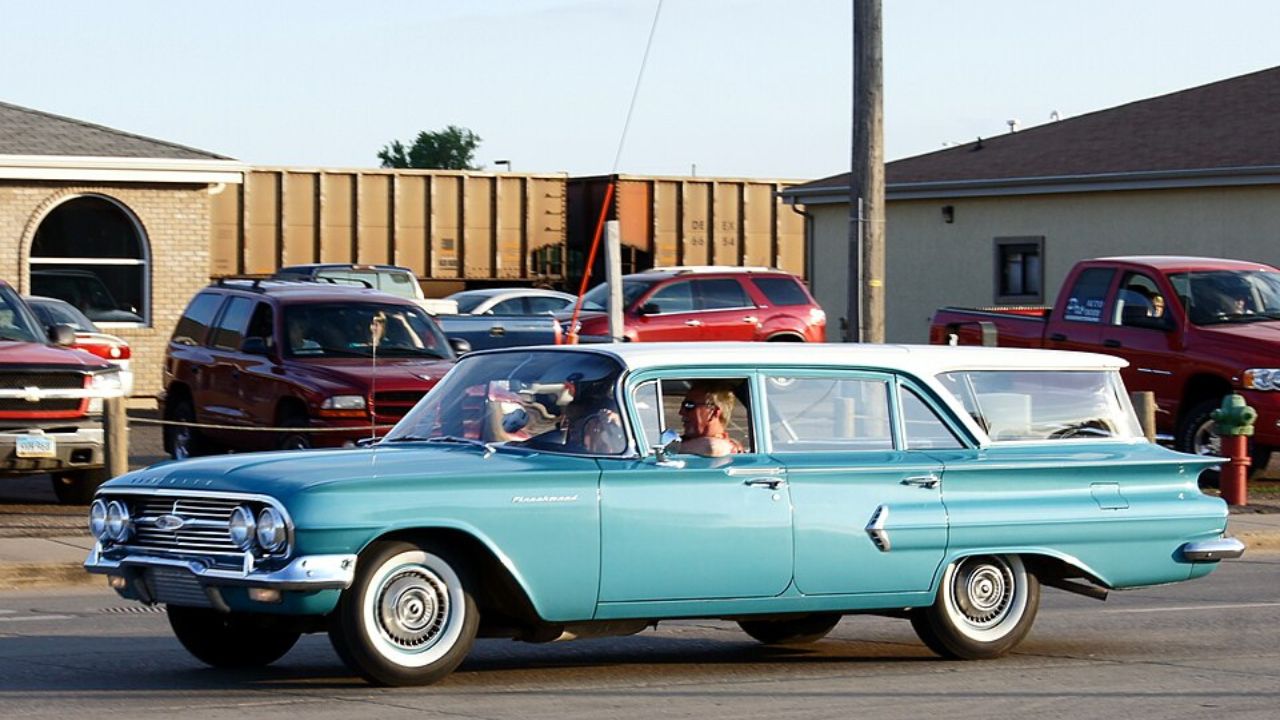
The 1959 Chevrolet Brookwood was never meant to be a halo car. It was the wagon that took kids to school, hauled plywood on weekends, and sat outside supermarkets with the tailgate down. Yet in one model year, Chevrolet managed to turn that workhorse brief into something that looked like it had rolled straight out of a Jet Age sketchbook, all fins, chrome, and glass.
That tension between everyday duty and dramatic styling is why the Brookwood has shifted from forgotten family hauler to cult favorite. It delivered practicality, but did it with a roofline and rear end that still stop people in their tracks nearly seven decades later.
The family wagon that wore Jet Age fins
Chevrolet built the Brookwood as a full-size station wagon, aimed squarely at families that needed space more than flash. The 1959 version, however, leaned hard into late fifties exuberance, with a body that enthusiasts now describe as a chrome-laden, finned masterpiece with a heavy dose of Jet Age style. Owners of one restored example simply call their car the 1959 Brookwood Wagon and treat it as a timeless piece of automotive history, a reminder that practicality did not have to look dull in the late fifties.
The Brookwood shared the basic platform and engineering with Chevrolet’s other big cars, but the wagon body gave designers a huge canvas. The long roof, expansive glass, and wide tailgate turned what could have been a box into a rolling billboard for General Motors design confidence. It was the ultimate family hauler that happened to look ready for a magazine cover.
All new sheet metal and the “Flat Top” revolution
The Brookwood did not appear in a vacuum. Chevrolet’s entire 1959 lineup was rethought from the ground up, part of a broader General Motors push that also reshaped Buick, Cadillac, Oldsmobile and Pontiac. The new roof design that defined the wagons and hardtops was so successful that this popular configuration was also used on Buick, Cadillac, Oldsmobile models for 1959 as well.
Inside General Motors, stylists referred to these dramatic greenhouses as Flat Tops or Flying Wings. The cantilevered top configuration, with its thin pillars and vast glass area, was developed by Bug Sugano with support from Carl Renner, then pushed into production as part of a complete break from earlier designs. Under Design Director Bill Mitchell, the 1959 cars became lower, longer, and wider, with horizontal fins and a wide, almost aircraft-like rear treatment that made even a family wagon look futuristic.
For the Brookwood, that meant a roof that floated above a beltline of glass and a tail that seemed to stretch out beyond the rear wheels. The result was a wagon that felt airy inside and visually dramatic outside, a rare mix of practicality and theater.
Powertrains that matched the look
Under the skin, the Brookwood could be ordered with a range of engines, including a V8 that gave the big wagon real highway pace. Enthusiasts today describe the 1959 Chevrolet Brookwood Wagon as a full-size model that combined practicality with striking visual appeal and a powerful V8 engine, a combination that made it more than just a grocery getter. Period marketing leaned on that dual identity, presenting the car as both family transport and a machine that could cross states at speed.
The same year, Chevrolet’s sports car showed how the brand was trimming and sharpening its styling. Corvettes for 59 wore more conservative details than the 1958 version, with cleaner surfaces and a more purposeful visual effect. While the Corvette moved toward restraint, the Brookwood and its siblings embraced the full drama of the new corporate look, which made the wagon’s mechanical competence feel even more surprising.
From showroom workhorse to barn survivor
The Brookwood nameplate did not last continuously. It soldiered on until 1961, then disappeared, only to return for another short stint between 1969 and 1972. That limited run helped turn the 1959 version into a snapshot of a specific moment in American car design rather than a long, slow evolution. Survivors from that year now carry the patina of both age and changing tastes.
One 1959 Chevrolet Brookwood survivor that recently emerged from storage still wore its factory paint and original trim. The car had sat long enough to qualify as a true barn find, yet the basic structure and styling remained intact. That kind of discovery shows how durable these wagons were, and how their distinctive proportions can shine through even decades of dust and neglect.
Another Brookwood surfaced as a project without a transmission, its engine described as not everybody’s cup of tea, and sold as a blank canvas for the next owner. The Brookwood sells with that kind of honest disclosure because enthusiasts know they are buying a platform with presence, even if the mechanicals need to be reimagined.
Original and Unmolested versus wild custom
Among collectors, there is a split between those who want an Original and Unmolested Brookwood and those who see the wagon as the perfect base for a Massive Engine Upgrade. One stock example has been described as begging for more power, precisely because the factory specification leaves so much visual promise on the table. The long roof and wide rear fenders seem to demand a driveline that can back up the look.
At the other end of the spectrum are cars that have been transformed far beyond Chevrolet’s intent. A 1959 Bagged Brookwood Wagon Restomod built around a 383 V8, Auto Custom Leather interior, and modern suspension required parts from three different cars to complete. The builder shared the project with a community that included Mark Anderson and 131 others, and the post drew 35 visible reactions from enthusiasts such as Khalid Rakan who appreciated the blend of old sheet metal and new engineering.
Another custom, described as a 1959 chevy Biscayne Brook Wood wagon, sits on Budnik GTX painted and drilled wheels, 17×7 at the front and 20×9.5 at the rear, wrapped in Michelin Sport tires. The owner summed up the build by saying that all this cool custom resto mod hardware turned the wagon into something ready for a beach party, with room for surfboards and friends, yet still unmistakably a Brookwood at its core.
The $800 Chev that became a star
Perhaps the clearest example of how far a Brookwood can be taken comes from a builder named in enthusiast circles as How Cody Walls. He started with an $800 59 Chev wagon that many would have written off, then methodically reshaped it into a show-stopping custom. The project, highlighted through a link Discovered via a community post, showed how vision and metalwork could turn a cheap, tired wagon into a headline car.
The finished 1959 Chevrolet Brookwood Custom Wagon was described as a striking blend of classic design and practicality that appealed to both restorations and hot rod enthusiasts. The builder kept the essential 1959 silhouette, including the sweeping fins and long roofline, but cleaned up the trim, adjusted the stance, and updated the mechanicals. The result was a Chevrolet Brookwood Custom Wagon that looked like a concept car yet still carried kids and luggage.
Another enthusiast post simply referred to a 1959 Chevrolet Brookwood Custom Wagon as a station wagon that balanced classic design and practicality, reinforcing the idea that the platform can support both subtle updates and radical rethinks. In each case, the wagon’s proportions did much of the heavy lifting.
Community affection and the Jet Age aura
Part of the Brookwood’s modern appeal comes from the way owners talk about it. One group of fans described their 1959 Brookwood Wagon as the ultimate family hauler with a heavy dose of Jet Age style, highlighting how the car still feels futuristic despite its age. That same community shares restoration stories that treat the wagon as a timeless piece of automotive history, with careful attention to original trim and colors.
Another enthusiast page framed the 1959 Chevrolet Brookwood Wagon as a car that embodies the spirit of the late fifties, built as a full-size station wagon that combined practicality with striking visual appeal. The Brookwood, in that telling, sits alongside other period Chevrolets such as the 1959 Chevrolet El Camino as part of a family of vehicles that pushed styling boundaries while still serving everyday needs in places as varied as New York, NY and small towns across the country.
Even casual social posts about a 1959 Chevrolet Brookwood Station Wagon treat the car as something special. Photographs of long, low wagons in bright colors, often with modern wheels and lowered suspensions, circulate widely among fans who may never own one but understand its presence. The Brookwood has become a shorthand for a certain kind of American optimism, where even the family car looked ready to blast off.
Why the 1959 Brookwood still matters
On paper, the Brookwood was a rational product. It offered three rows of seating, a big cargo area, and the option of a V8 that could tow or cruise without strain. It shared parts with other Chevrolets, which made it easy to build and service. In an era when the station wagon was the default family vehicle, it did everything buyers asked.
What sets the 1959 model apart is how far Chevrolet went beyond that brief. The Flat Top roof, sweeping fins, and wraparound glass were not necessary for practicality. They were statements. They turned a grocery-getter into a rolling piece of design, one that still feels bold even parked next to modern crossovers.
That is why collectors now debate whether a Chevrolet Brookwood Wagon should be preserved as a Chevrolet Brookwood time capsule or turned into a restomod with a modern drivetrain. The car’s basic form supports both approaches. An untouched survivor can highlight the original factory vision, while a custom build can push the design even further, with big engines, updated suspensions, and interiors trimmed in materials such as Auto Custom Leather.
The Brookwood also illustrates how quickly automotive fashion can change. Within a few years, fins shrank, glass areas tightened, and wagons began to give way to other body styles. The 1959 car sits near the peak of that expressive period, which makes it feel more like a snapshot than a stepping stone. It captures a moment when American manufacturers believed that even a family wagon should look like it belonged on a runway.
A practical icon for the long haul
The continuing stream of barn finds, survivor stories, and high-end customs shows that the Brookwood’s appeal is not limited to nostalgia. Owners still use these wagons for road trips, car shows, and daily drives. The long roof swallows luggage and parts, the big chassis can be tuned for comfort or performance, and the styling guarantees attention at every fuel stop.
When a 1959 Brookwood emerges from a barn with its factory paint intact, enthusiasts see not just a restoration candidate but a link to a time when family cars were styled with the same ambition as coupes and convertibles. When someone spends years turning a tired shell into a Bagged Brookwood Wagon Restomod with a 383 under the hood, the community responds because it recognizes the platform’s potential.
More from Fast Lane Only