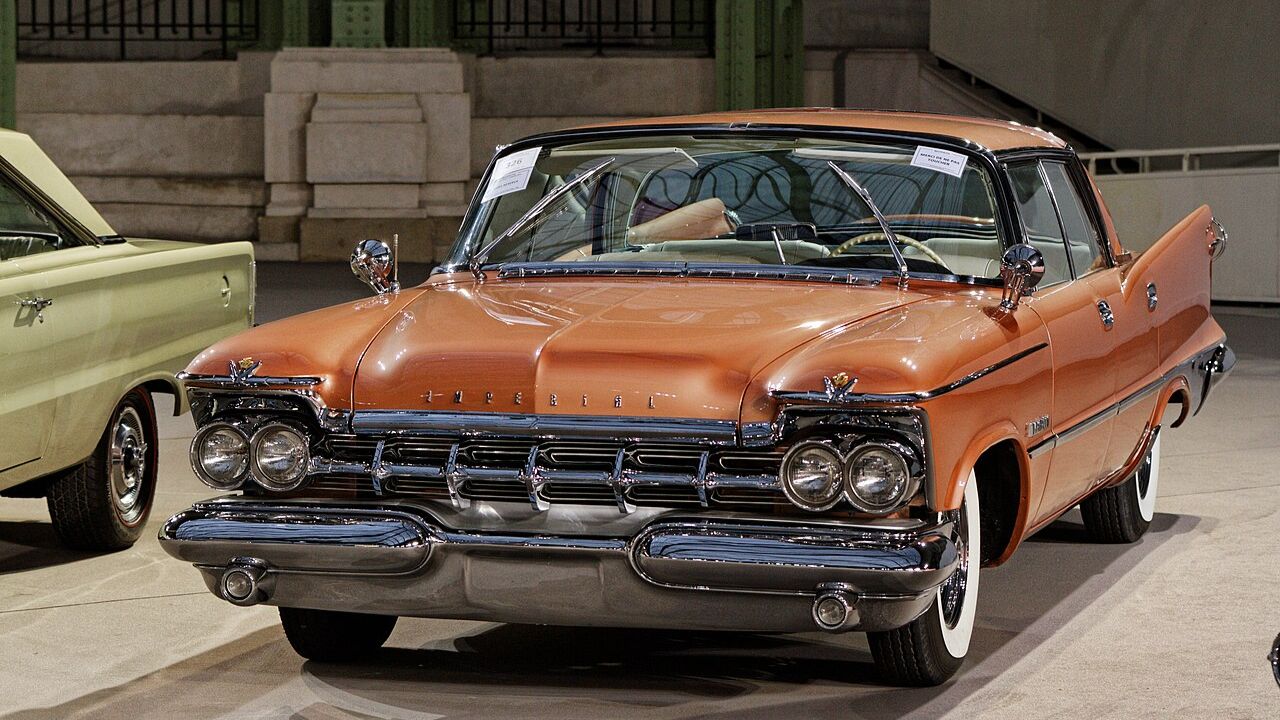
The 1959 Imperial Crown was not built for subtlety. In a late‑fifties luxury market full of fins and chrome, it still managed to look like it came from another planet, a car that refused to be mistaken for a Cadillac, Lincoln, or anything else. It was long, lavish, and defiantly theatrical, a rolling statement that American excess had reached its most exuberant form.
Seen today, the car still jolts the eye. Its proportions, detailing, and unapologetic size capture a moment when designers and buyers agreed that more was more, and when Chrysler’s flagship division was determined to stand apart from Detroit’s other luxury empires.
The Forward Look taken to its extreme
The 1959 Imperial Crown arrived as a showcase for Virgil Exner, whose “Forward Look” philosophy pushed Chrysler products toward lower, longer, more dramatic shapes. On the Imperial line, that thinking produced some of the most distinctive luxury cars of the decade, with soaring tail fins and deeply sculpted body sides that made even large Cadillacs seem restrained. The top LeBaron Southampton models were singled out as one of the most expressive results of Virgil Exner’s Forward, but the same visual language ran through every Crown.
Chrysler had spun Imperial into a stand‑alone marque to chase Cadillac and Lincoln more directly, and the 1959 Chrysler Imperial Crown Sedan was framed as a monument to American automotive extravagance at its peak. As Chrysler’s separate luxury flagship, the Chrysler Imperial Crown embraced late‑fifties futurism and cutting‑edge gadgets to signal that it sat above the rest of the corporation’s lineup.
Nineteen feet of rolling theater
Size alone set the car apart. Measuring nearly 19 feet in length, the Imperial Crown Sedan made a striking impression even before its details came into focus. Contemporary descriptions of the model highlight that, at nearly 19 feet, the car stretched the definition of a personal vehicle, more akin to a limousine than a family sedan. One enthusiast summary of the 1959 Imperial notes this imposing length and pairs it with distinctive tailfins and quad headlights to explain how the car dominated any street scene, an effect captured in a detailed post about the Measuring nearly 19 Imperial.
That footprint allowed for a long hood, a formal roofline, and a trunk that seemed to stretch to the horizon. The car’s stance gave designers room to emphasize the fins and the sculpted rear quarters, while the wheelbase and overhangs reinforced the impression that this was a car for wide American highways, not tight European streets.
The taillights that refused to blend in
If the fins created the silhouette, the taillights delivered the punch line. One of the most notable design elements on the 1959 Imperial Crown was its free‑standing chrome plated taillights, perched like small jet pods above the rear bumper. These separate units, set away from the sheetmetal, were described by owners as a unique touch that set the car apart from its contemporaries, and they feature prominently in enthusiast discussions of the 1959 Chrysler Imperial.
While Cadillac integrated its tail lamps into the fins, Imperial turned them into separate sculptures. The effect at night was dramatic, with the glowing pods hovering in space as the car moved. In daylight, the heavy chrome housings and their placement above the bumper signaled that function had happily made room for spectacle.
A face only an Imperial could wear
The front of the car continued the theme of visual excess. Commentators have described the 1959 Imperial’s front end as baroque, with quad podded headlights and a complex grille that traded subtlety for presence. One detailed review of the car notes that words like “Classic” or “dignified” are not the first reactions to the Imperial’s face, and that its quad headlamp pods and heavy ornamentation make some observers find it weird and rather unattractive, a judgment captured in a piece on the Classic Imperial.
Yet that divisive quality is part of the car’s enduring appeal. The floating headlamp pods, the massive bumper assemblies, and the hood ornament all worked together to ensure that no one could confuse an Imperial with a lesser Chrysler or with a rival brand. The front end read like a piece of industrial jewelry, designed to impress from a distance and overwhelm up close.
Details for those who wanted even more
Imperial offered additional flourishes for buyers who felt the standard car was not quite special enough. A one‑year option for 1959, the Silvercrest Landau top, covered part of the roof with a stainless steel applique that framed the rear section like a formal carriage roof. Enthusiast descriptions of the 1959 Imperial highlight this Silvercrest Landau treatment as a rare and sought‑after feature, and they describe how the Imperial Silvercrest Landau added yet another layer of visual distinction.
Inside, the cabin matched the exterior’s ambition, with deep seats, elaborate door panels, and a dashboard that wrapped around the driver. Materials and color combinations were chosen to reinforce the idea that Imperial sat at the top of Chrysler’s hierarchy, and the overall effect was closer to a private lounge than a simple passenger car.
Technology as a status symbol
The 1959 model year for Imperial embraced futuristic styling and cutting‑edge technology to reinforce its luxury positioning. Contemporary summaries of the car describe how the model year embraced the spirit of the late 1950s, combining advanced features with bold design. A detailed overview of the Imperial features and notes that the Crown Sedan paired its fins and quad headlights with a suite of modern conveniences that signaled high status.
Power accessories, elaborate heating and ventilation controls, and other comfort features were used as selling points in dealer material. The car’s size and weight required a strong V8 and heavy duty components, which only reinforced its image as a serious, no‑compromise luxury machine.
How Imperial sold its difference
Imperial’s own marketing leaned into this sense of difference. In a dealer comparison film pitched against Lincoln, a salesman named Bud Ames walks through the advantages of Imperial and explains how he lost a sale to a rival before learning to emphasize the car’s strengths. The film, which features Bud Ames speaking directly to other salespeople, highlights Imperial’s engineering, its ride quality, and its features as reasons buyers should choose it over a Lincoln, and it survives today in an Imperial Over Lincoln video.
The underlying message was clear: Imperial was not just another luxury car; it was a statement of taste that rejected understatement. The company encouraged dealers to present the car as a more advanced and more distinctive alternative to its competitors, something that could not be mistaken for anything else on the showroom floor.
Variants that pushed the look even further
The Crown name covered several body styles, each with its own twist on the shared design language. The Imperial Crown Southampton two‑door hardtop, for example, has been described as one of the most striking and luxurious American cars of the late 1950s, created under Virgil Exner’s direction. Enthusiast groups often spotlight the Imperial Crown Southampton for its dramatic roofline and expansive glass, which made the fins and free‑standing lamps appear even more pronounced.
Convertible and hardtop sedans carried the same visual themes across different proportions. A Copper Spice Metallic hardtop finished with white leather, highlighted in a separate enthusiast post, is described as being known for its dramatic and futuristic styling, with pronounced tailfins, bullet style tail lamps, and a spare tire outline pressed into the trunk lid that is identified as a hallmark of Imperial elegance. That description of the Imperial Crown Sedan captures how even color and trim choices were used to underline the car’s theatrical presence.
On screen and in the background
The 1959 Imperial Crown also found its way into popular culture, although not always in starring roles. One account of the Crown Southampton notes that a 1959 example appeared only in background scenes of early episodes of a television show’s third season, and that the character associated with it was never shown driving or sitting in the car. The description of these Early episodes underscores how the car’s silhouette was recognizable enough that it could communicate wealth and status even when it appeared only briefly in the frame.
That background presence mirrors the car’s real world role as a symbol of success. Owners did not need to explain what they had bought; the fins, the lamps, and the sheer scale did the talking.
Living alongside other finned icons
The Imperial shared the road with other flamboyant late‑fifties designs, most famously the Cadillac Coupe models whose tailfins have become shorthand for the era. A museum video about a 1959 Cadillac Coupe notes that the presenter is speaking in front of one of the cars from a collection of 200 vehicles on display at a museum located at 161 M, and that the Cadillac’s distinctive tailfins typify 1950s optimism. The reference to 200 cars at underscores how Cadillac has become the default symbol of finned excess.
Imperial, however, chose a different path. Instead of simply extending the fins, it isolated the lamps, reshaped the rear deck with the spare tire outline, and layered on chrome and stainless details that gave the car a more eccentric personality. In a field of dramatic designs, the Imperial Crown still managed to look like the boldest experiment.
From showroom drama to collector fascination
Today, surviving 1959 Imperials continue to fascinate collectors and casual observers. Enthusiast videos show owners marveling at rare color combinations, such as a red Crown hardtop that one presenter describes as something he has never seen another example of, and that rarity adds to the car’s mystique. A walkaround of a convertible at Ellingsson Motorc Cars in Rogers Minnesota, filmed on the sales floor, presents the car as a prized piece among more conventional classics and appears in a video from Ellingsson Motorc Cars.
These modern spotlights often emphasize the same qualities that defined the car when new: its length, its fins, its free‑standing lamps, and its unapologetic presence. The car’s scale and styling, once routine on American streets, now read as extraordinary artifacts from a different mindset.
Why it still cannot be mistaken for anything else
Looked at from any angle, the 1959 Imperial Crown was engineered to avoid anonymity. The nearly 19‑foot body, the soaring fins, the free‑standing chrome plated taillights, the Silvercrest Landau roof option, and the heavily ornamented front end all pushed the design beyond the boundaries of conventional taste. Enthusiast descriptions of the 1959 Imperial Crown repeatedly return to the idea that the car’s unique details and proportions set it apart from its peers.
In an era when many modern cars converge toward similar shapes and restrained ornamentation, the 1959 Imperial Crown stands as a reminder of a different design philosophy. It was not meant to be tasteful in a quiet way; it was meant to announce itself from blocks away. That commitment to standing out, supported by Virgil Exner’s Forward Look vision and Chrysler’s willingness to indulge extravagance, is why the car still commands attention and why, more than six decades later, nobody confuses it with anything else.
More from Fast Lane Only